Bon from now on I'll be a more positive person.
I'll only engage in good vibes and cheerful stuff sf.
No more doomposting.
No more answering to obvious baits.
From now on, only good vibes and logs of emojis ❤️ 🫡👌👌👌👌👌👍👍👍👍👍💪💪💪💪
🇫🇷 Voici les principales mesures que François Asselineau souhaite mettre en place s’il est élu président de la République en 2027 :
- Remplacer l’euro par le franc.
- Déclencher l’article 50 dès la première semaine de son mandat pour quitter l’Union européenne sous deux ans, sans référendum préalable.
- Mettre fin à toute aide financière et militaire française à l’Ukraine dès son entrée en fonction.
- Engager immédiatement le retrait de la France de l’OTAN pour quitter l’Alliance sous un an.
- Demander aux Français, par référendum, s’ils veulent inscrire dans la Constitution que la France est une "République laïque de tradition chrétienne".
- Faire primer la durée de cotisation pour le départ à la retraite. Il cite l’exemple d’un salarié qui a commencé à 16 ans dans un métier pénible et pourrait partir à 58 ans après 42 ans de cotisation.
- Augmenter le SMIC dans les 100 premiers jours, avec une baisse de certaines cotisations sociales pour les petites et moyennes entreprises.
- Organiser des référendums sur l’immigration, la dette publique et le nucléaire.
- Rétablir les contrôles aux frontières pour les personnes et les marchandises.
- Interdire aux associations d’utiliser des fonds publics pour aider à contourner une obligation de quitter le territoire français (OQTF).
- Supprimer les régions administratives.
- Ramener le nombre de sénateurs de 348 à 100 et réduire celui des députés.
- Diviser par deux le budget de l’Élysée.
- Mettre fin au rôle de Première dame à l’Élysée.
- Permettre aux citoyens de déclencher eux-mêmes un référendum. Il se dit aussi ouvert à ce qu’ils puissent révoquer le président de la République par cette voie.
- Soumettre à référendum un éventuel retour du mandat présidentiel de 5 à 7 ans.
- Obliger chaque candidat à la présidentielle à déclarer ses éventuelles autres nationalités, son appartenance à une loge maçonnique, ainsi que l’origine des fonds et le montant des dettes de son parti.
- Réserver les marchés publics aux entreprises françaises après la sortie de l’Union européenne.
- Rétablir le contrôle des mouvements de capitaux entre la France et l’étranger.
- Lancer un emprunt réservé aux épargnants français pour racheter la part de la dette publique détenue par des fonds étrangers.
- Relever les droits de douane sur les fruits et légumes importés pendant les récoltes françaises, puis les baisser hors saison.
- Renforcer la protection de la liberté d’expression dans la Constitution sur le modèle du premier amendement américain.
- Réduire de moitié le nombre de conseillers départementaux.
- Encourager les collèges à faire visiter aux élèves des lieux historiques comme les châteaux de Versailles, de Fontainebleau ou de Chantilly.
(site officiel du candidat)
Anyone notice how the biggest opponents of AI's advances on mathematics are all men (apart from our dear crank in general JLN lol)
it seems like only a certain class of people (read: privileged entitled men) who remember pre-LLM mathematics as a "utopia"
Ou bien, tu ne comprends pas la valeur apportés par ces emplois ?
C'est souvent ça le soucis des mecs de formation technique qui croient que pour faire tourner un business y'a que la partie ingé qui est réellement nécessaire.
Alors que c'est pas totalement vrai.
je vais vous dire au fond honnêtement je rêve que tous ces BS jobs ( LIRE FEU DAVID GRAEBER) soient totalement anéantis par l’IA parce que ce sont précisément tous ces postes de merde qui ont toujours été les nids à piston par excellence de la France jusqu’à la suisse
comme ils n’apportent aucune vraie valeur tangible au monde réel, on pouvait y placer n’importe quel copain ou profil coopté et noyer son incompétence dans des réunions interminables et des présentations PowerPoint ennuyeuses à mourir
à’l inverse, dès qu un métier exige un savoir-faire concret ou une capacité réelle à résoudre un problème sur le terrain, tricher avec son réseau devient beaucoup + compliqué parce que le réel finit toujours par te rattraper
et de mon côté je crois que c’est aussi pour ça que l’IA va aussi mettre fin à d’immenses injustices sociales
@oxythan un moyen de subsistence ou de dignité nécessaire à la vie. Cependant, le système du marché abouti à être "pareto optimal", c'est à dire que tout le monde finira avec une configuration où augmenter le bien-être de qlq reviendra au dépend de celui de qlq d'autre.
@oxythan Non, mais c'est la situation optimale au niveau individuel et social (ce qui est très rare en économie).
Le mécanisme du marché de façon générale, repose sur une idée fondamentale de dotation initiale pour être capable de participer au marché, mais il n'est pas équivalent à
Il faut donner des incentives aux entreprises de recruter (sans trop toucher à la productivité des entreprises). Favoriser des contrats à temps partiel pour le tertiaire et éventuellement taxer l'IA (à l'usage marginal).
Pour surfer sur la vague générale des réactions sur cet article :
- Il faut aujourd'hui plus que jamais flexibiliser les emplois en France. Avec de tels gains de productivité, les outsiders n'auront tout simplement plus leur place dans le marché actuel
Non la plupart craignent avoir investi 5 ans de leur vie dans des études obsolètes, des fois avec des crédits à rembourser et rien que du chômage en vue.
Faut arrêter de sugarcoater une réalité qui n'est pas si libératrice que ça.
la vérité que personne n’ose dire sur la peur de l’IA chez les cols blancs, c’est que bcp pleurent la fin d’un confort anesthésiant où l’on échangeait sa liberté contre un salaire fixe à la fin du mois et
sortir de cette cage dorée fait forcément peur au début quand on a passé sa vie sur des rails tout tracés mais c’est souvent au moment où le sol se dérobe sous nos pieds que l’on découvre enfin de quoi l’on est vraiment capable
Faut m'expliquer la séquence logique qui part de "RH a été résolue" à "On est dans une simulation" car là c'est fort. Faut doser sur la crise existentielle.
Débat parallèle sur la résolution de Riemann :
Est-ce que vous êtes prêt à accepter l’hypothèse qu’on est dans une simulation, mathématiquement codée, que le chaos n’existe pas.
Et que les religions sont obsolètes ?
Que les mecs qui nous ont codé n’en ont rien à faire de si vous allez à la messe tous les dimanches, que vous mangiez pas de porc ou kasher ?
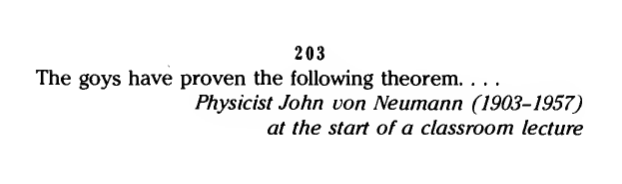
"The goys have proven the following theorem…"
-John von Neumann, statement at the start of a lecture.
Quoted in '1,911 Best Things Anyone Ever Said' (1988) by Robert Byrne.
Zucman est Dr en Économie, enseigne à Berkeley l'une des meilleures universités au monde, a eu Piketty en directeur de thèse, est un des rares non américain à gagner la prestigieuse médaille John-Bates-Clark
Mais "Sardoche", gamer-pointeur, du haut de son bac, ne valide pas.
Using maths in economics has largely been to prove intuition and compare magnitudes.
A common intuition in econ is that global aggregate demand is downward sloping as a function of price. Maths disproved this intuition.
All of economics has been super-mathematicized for like the past 30 years or so. PhD admissions criteria, criteria for judging papers, and the like. I predict this will quickly reverse, and in hindsight future economists will be puzzled why we did such silly things for so long
Similarly when there are two changes in opposite directions, we need to know which one's more important.
Increasing wages would decrease production but an increased demand would tend to increase supply if possible. Which effect would win ? What are the conditions etc.