Huge for ethereum:0x4a220e6096b25eadb88358cb44068a3248254675:
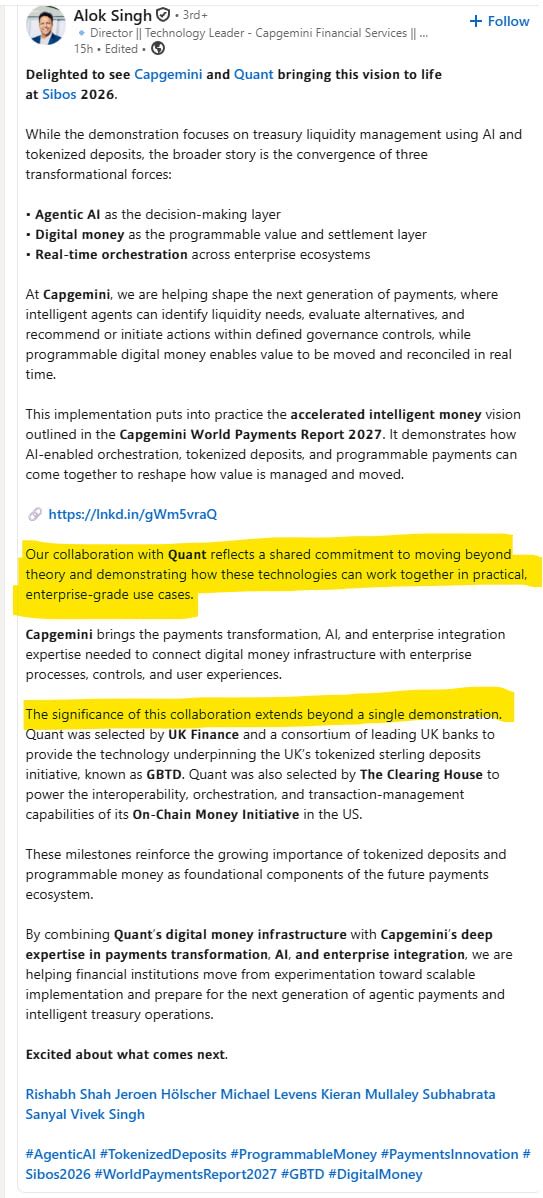
“At Capgemini, we are helping shape the next generation of payments, where intelligent agents can identify liquidity needs, evaluate alternatives, and recommend or initiate actions within defined governance controls, while programmable digital money enables value to be moved and reconciled in real time. … Our collaboration with Quant reflects a shared commitment to moving beyond theory and demonstrating how these technologies can work together in practical, enterprise-grade use cases.”
@Capgemini 🤝 @quantnetwork
Via @SanNL11
Huge for ethereum:0x4a220e6096b25eadb88358cb44068a3248254675:
“At Capgemini, we are helping shape the next generation of payments, where intelligent agents can identify liquidity needs, evaluate alternatives, and recommend or initiate actions within defined governance controls, while programmable digital money enables value to be moved and reconciled in real time. … Our collaboration with Quant reflects a shared commitment to moving beyond theory and demonstrating how these technologies can work together in practical, enterprise-grade use cases.”
@Capgemini 🤝 @quantnetwork
Via @SanNL11
Its confirmed: Capgemini partnering with ethereum:0x4a220e6096b25eadb88358cb44068a3248254675 for agentic payments and liquidity management 🔥🔥🔥
Capgemini:
✅420.000 employees
✅servicing more than 50% of the world largest companies
To everyone fudding the $QNT token, pushing the narrative that the token is not needed:
Gilbert spent years perfecting the design of the new financial system. He clearly thought about tokenomics throughout it.
He intentionally made the supply scarce.
1/x
To everyone fudding the $QNT token, pushing the narrative that the token is not needed:
Gilbert spent years perfecting the design of the new financial system. He clearly thought about tokenomics throughout it.
He intentionally made the supply scarce.
1/x
🤖 CoinMarketCap | Agentic Charts 🤖
25 US banks just picked Quant ($QNT) to connect their payment systems.
It tripled in price, so we asked our agent to read the chart!
🔹 Support is now between $252.82 and $260.95
🔹 The last hourly close was $262.45, just above it
🔹 The next resistance is $290, the 28 Sep high
Try Agentic Charts here 👇
https://t.co/UZwdPPAATG
Keep fading ethereum:0x4a220e6096b25eadb88358cb44068a3248254675 .
The only article you need to understand why this thing is a monster, and why the beast just woke up.
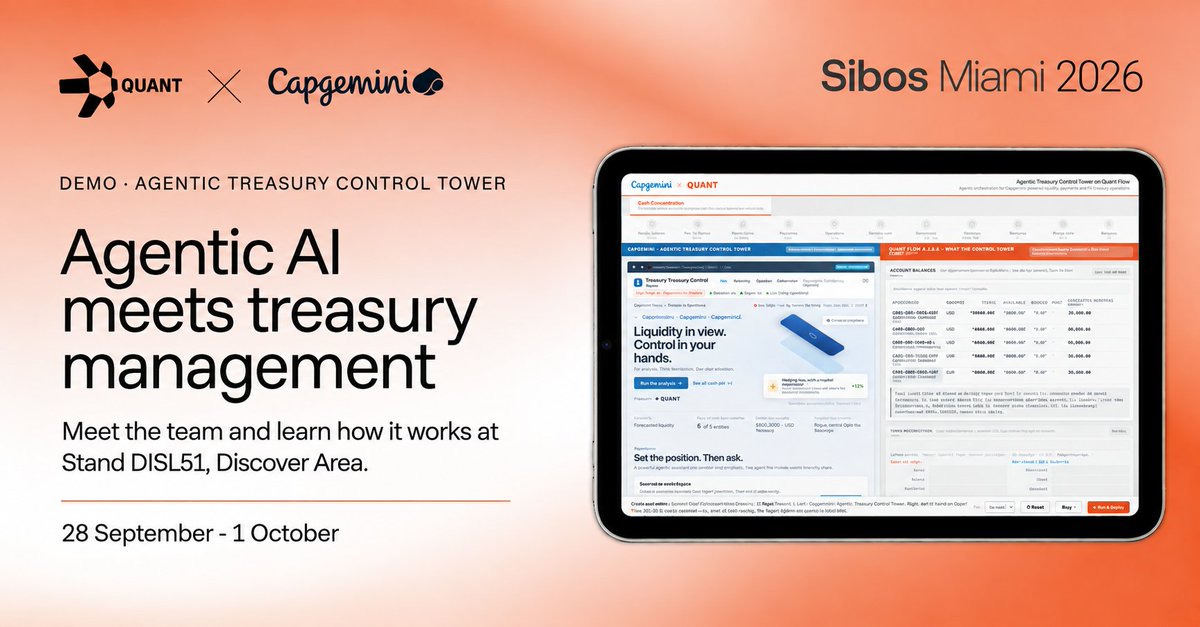
At @Sibos Miami this year, Quant and @Capgemini will be running a joint demo showing how agentic AI can handle the liquidity work that #treasury teams deal with day-to-day.
The demo walks through two treasury shortfalls, one small enough for the agent to fix on its own and one large enough that recommends a funding action and waits for human approval before Quant moves the money using #tokeniseddeposits.
The agent can weigh balances, currencies and market conditions together in a way fixed rules can't, while manual approval thresholds keep the larger decisions with those accountable.
Moving funds as tokenised deposits also means transfers can happen around the clock, with the reconciliation visible on screen from the initial recommendation through to the final balances.
Quant built the tokenised deposit issuance, workflow and policy engine, while @Capgemini engineered the liquidity alerts, agent decisioning and approval experience.
Learn more at Quant's stand DISL51 or at Capgemini's booth L010.
https://t.co/g1yJaw7mbm
#Sibos2026 #AgenticAI
Barclays, HSBC, and five more UK banks ran real customer payments with tokenized pounds on Quant's platform. Now Quant $QNT says the data inside those payments could become a new revenue line for banks. Find out more: ⬇️
https://t.co/7Wl5vEPyKH
Barclays, HSBC, and five more UK banks ran real customer payments with tokenized pounds on Quant's platform. Now Quant $QNT says the data inside those payments could become a new revenue line for banks. Find out more: ⬇️
https://t.co/7Wl5vEPyKH
👀👀👀
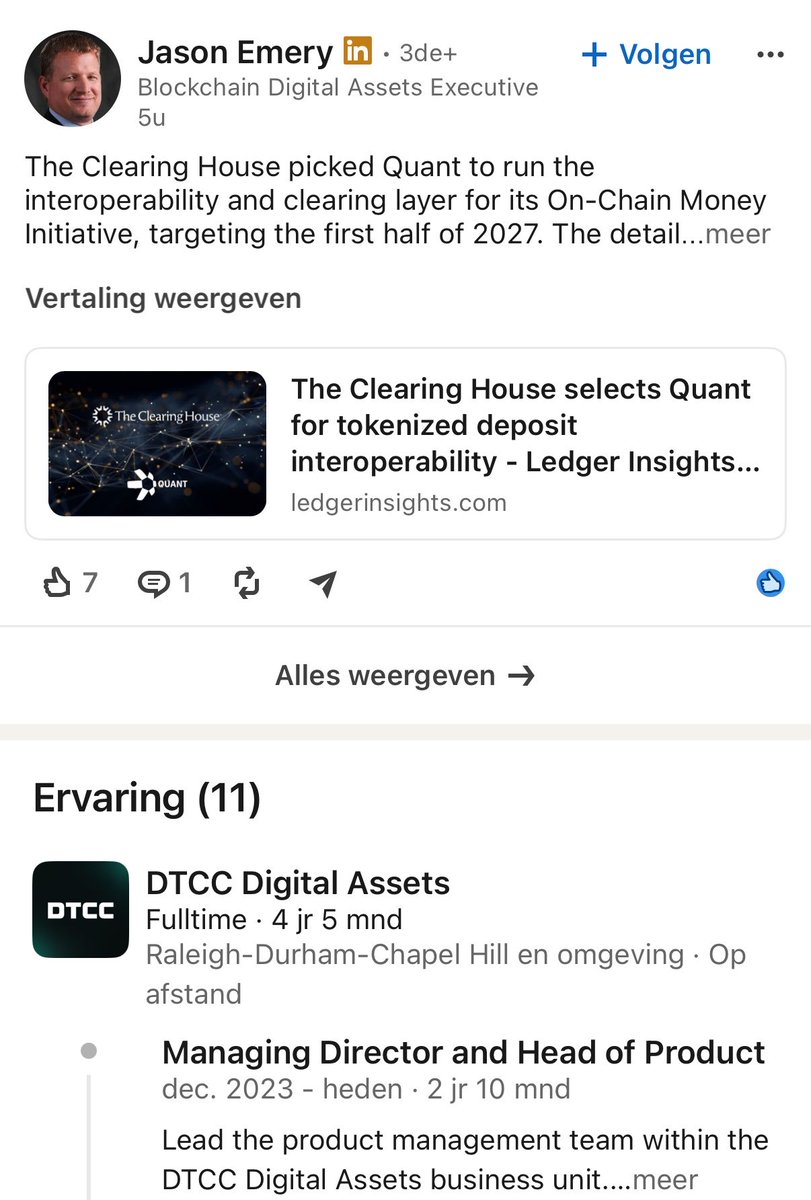
The managing director and head of product of the DTCC is talking about ethereum:0x4a220e6096b25eadb88358cb44068a3248254675
Matter of time till $QNT is part of their tech stack
👀👀👀
The managing director and head of product of the DTCC is talking about ethereum:0x4a220e6096b25eadb88358cb44068a3248254675
Matter of time till $QNT is part of their tech stack
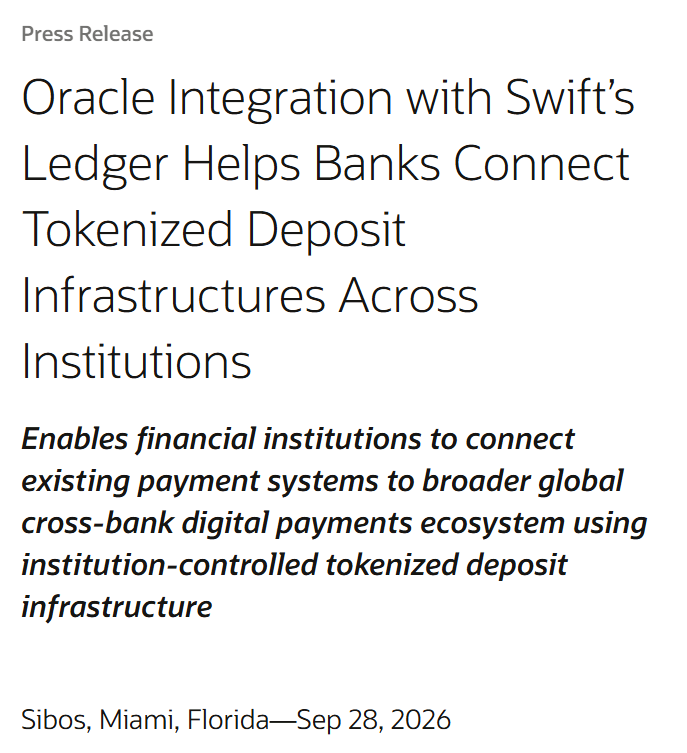
⚔️🔥 BREAKING: Oracle has announced their integration with Swift’s blockchain for cross-bank tokenized deposits.
Hmm, that sounds familiar...
Considering Oracle already has a certified solution for cross-ledger orchestration sitting inside its own stack:
$QNT’s Overledger.
This announcement describes the EXACT kind of problem Overledger was specifically built to solve.
→ Different banks
→ Different ledgers
→ Different deposit systems
All needing to communicate with each other.
This is why deals like The Clearing House matter so much — they don’t just add another customer, they strengthen the network effects around the underlying infrastructure.
Once enough major institutions plug into the same connective layer, everyone around them is more and more incentivized to follow.
You’re watching in real-time how interoperability eats an entire industry.
⚔️🔥 BREAKING: Oracle has announced their integration with Swift’s blockchain for cross-bank tokenized deposits.
Hmm, that sounds familiar...
Considering Oracle already has a certified solution for cross-ledger orchestration sitting inside its own stack:
$QNT’s Overledger.
This announcement describes the EXACT kind of problem Overledger was specifically built to solve.
→ Different banks
→ Different ledgers
→ Different deposit systems
All needing to communicate with each other.
This is why deals like The Clearing House matter so much — they don’t just add another customer, they strengthen the network effects around the underlying infrastructure.
Once enough major institutions plug into the same connective layer, everyone around them is more and more incentivized to follow.
You’re watching in real-time how interoperability eats an entire industry.
If you're wondering why $QNT price pumped 3x this week, this list is probably a good place to start ��↓
• Quant was just chosen to build the next generation of US bank money. The Clearing House, owned by 25 major US banks like Chase, Bank of America, HSBC, and Citi settle more than $2 trillion per day and selected Quant to connect its new on-chain money network.
• Quant is now powering the largest banks in the UK. Barclays, HSBC, Lloyds, NatWest, Santander and others are now executing live customer transactions on infrastructure built by Quant.
• Quant is directly integrated into Murex’s MX.3 platform. MX.3 is the financial software engine powering 65 of the world's 100 largest banks, and Quant gives them crypto-ready infrastructure without requiring them to rewrite existing infrastructure.
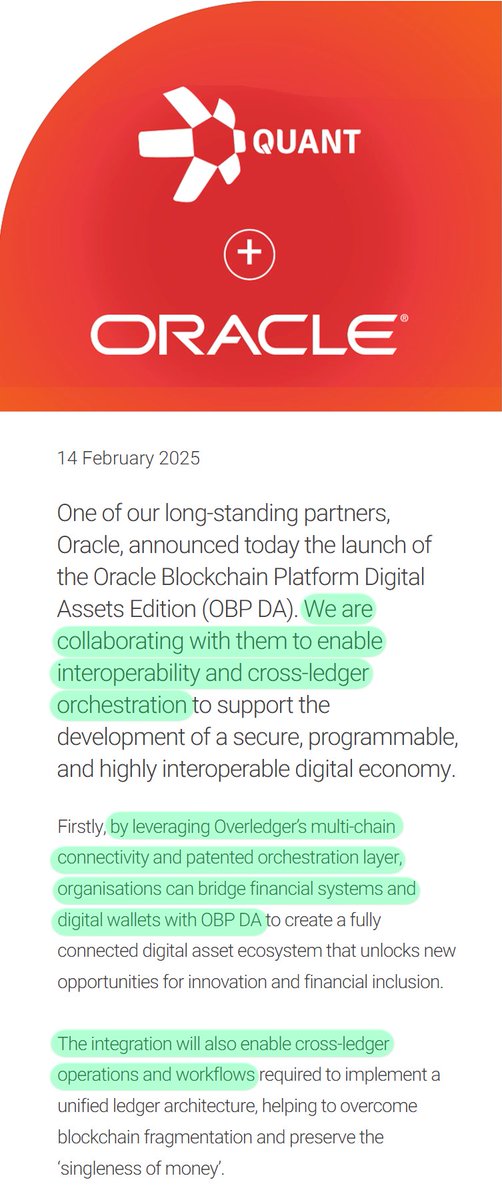
• Oracle has put Quant inside its enterprise digital-asset stack. One of the world's largest enterprise software companies has certified Overledger to provide cross-ledger orchestration for settling transactions across different ledgers and off-chain databases.
• Quant is shaping the standards that will govern value movement across the internet. SATP is designed to let digital assets move safely between separate networks, and the protocol is now in the IETF's final community-review stage before a decision on publication.
• Quant has built technology for the Bank for International Settlements and the Bank of England. Project Rosalind tested 33 API functions and 30+ real-world use cases, with Quant supplying blockchain infrastructure, smart contracts and interoperability.
• The European Central Bank picked Quant to help experiment with the Digital Euro. Quant is testing how programmable payments could work directly with central-bank digital money, putting it inside one of Europe’s most important future payments projects.
• Quant has already integrated with Nexi’s European payments infrastructure. The underlying SIA network spans 580 nodes across 208,000+ km of fiber, connecting banks, payment providers, and financial institutions across Europe.
• Quant has been working on blockchain infrastructure spanning 12 countries across Latin America. The LACChain network gives Quant exposure to cross-border payments, tokenized money and interoperability across multiple national markets.
• Quant has a direct route into Japan’s banking system through Dentsu Soken. Dentsu Soken builds mission-critical systems tied to BOJNET, SWIFT, CLS, internet banking, and core banking, and the partnership includes a joint go-to-market plan for Japanese banks.
• Quant has been granted multiple patents across the US, Europe, Japan, and China. This gives Quant a defensible IP position in one of the hardest problems in digital finance — enterprise-grade multi-ledger technology.
• Quant’s founder helped launch the ISO standard for blockchain and distributed ledger technology. Gilbert Verdian was instrumental in establishing ISO/TC 307, the international committee for blockchain and distributed ledger standards, going on to lead its interoperability working group.
• Quant isn't betting the company on just one product. Overledger, Quant Flow, PayScript, QuantNet, and Fusion give it multiple products around interoperability, programmable money, payments, and multi-network settlement.
• Gilbert was working on this problem before most people had even heard the word “interoperability.” Before Quant, he spent 20+ years in cybersecurity and senior technology roles across the Federal Reserve, Bank of England, HM Treasury, Mastercard, PricewaterhouseCoopers, HSBC, Ernst & Young, and other major institutions.
• $QNT is unusually scarce for an asset servicing a global market. Its maximum supply is just 14.88 million tokens, giving it one of the tightest supply profiles in large-cap crypto. As we've seen this week, when demand spikes, upward moves can be violent.
• Staking could create an even more powerful supply-and-demand loop. Likely arriving in 2027, Quant's staking mechanism could see millions of $QNT tokens locked away, while participants earn rewards and growing network usage competes for the same fixed supply.
• All of this is only what we're allowed to see. Quant is built to operate behind the scenes as white-label infrastructure; we actually have no idea how many more integrations are already live, being tested, or sitting in the pipeline waiting to be announced.
So when people ask me why $QNT suddenly ran this hard this week, I think they're asking the wrong question.
The better question is why the market ignored all of this evidence for so long.
If you're wondering why $QNT price pumped 3x this week, this list is probably a good place to start ↓↓
• Quant was just chosen to build the next generation of US bank money. The Clearing House, owned by 25 major US banks like Chase, Bank of America, HSBC, and Citi settle more than $2 trillion per day and selected Quant to connect its new on-chain money network.
• Quant is now powering the largest banks in the UK. Barclays, HSBC, Lloyds, NatWest, Santander and others are now executing live customer transactions on infrastructure built by Quant.
• Quant is directly integrated into Murex’s MX.3 platform. MX.3 is the financial software engine powering 65 of the world's 100 largest banks, and Quant gives them crypto-ready infrastructure without requiring them to rewrite existing infrastructure.
• Oracle has put Quant inside its enterprise digital-asset stack. One of the world's largest enterprise software companies has certified Overledger to provide cross-ledger orchestration for settling transactions across different ledgers and off-chain databases.
• Quant is shaping the standards that will govern value movement across the internet. SATP is designed to let digital assets move safely between separate networks, and the protocol is now in the IETF's final community-review stage before a decision on publication.
• Quant has built technology for the Bank for International Settlements and the Bank of England. Project Rosalind tested 33 API functions and 30+ real-world use cases, with Quant supplying blockchain infrastructure, smart contracts and interoperability.
• The European Central Bank picked Quant to help experiment with the Digital Euro. Quant is testing how programmable payments could work directly with central-bank digital money, putting it inside one of Europe’s most important future payments projects.
• Quant has already integrated with Nexi’s European payments infrastructure. The underlying SIA network spans 580 nodes across 208,000+ km of fiber, connecting banks, payment providers, and financial institutions across Europe.
• Quant has been working on blockchain infrastructure spanning 12 countries across Latin America. The LACChain network gives Quant exposure to cross-border payments, tokenized money and interoperability across multiple national markets.
• Quant has a direct route into Japan’s banking system through Dentsu Soken. Dentsu Soken builds mission-critical systems tied to BOJNET, SWIFT, CLS, internet banking, and core banking, and the partnership includes a joint go-to-market plan for Japanese banks.
• Quant has been granted multiple patents across the US, Europe, Japan, and China. This gives Quant a defensible IP position in one of the hardest problems in digital finance — enterprise-grade multi-ledger technology.
• Quant’s founder helped launch the ISO standard for blockchain and distributed ledger technology. Gilbert Verdian was instrumental in establishing ISO/TC 307, the international committee for blockchain and distributed ledger standards, going on to lead its interoperability working group.
• Quant isn't betting the company on just one product. Overledger, Quant Flow, PayScript, QuantNet, and Fusion give it multiple products around interoperability, programmable money, payments, and multi-network settlement.
• Gilbert was working on this problem before most people had even heard the word “interoperability.” Before Quant, he spent 20+ years in cybersecurity and senior technology roles across the Federal Reserve, Bank of England, HM Treasury, Mastercard, PricewaterhouseCoopers, HSBC, Ernst & Young, and other major institutions.
• $QNT is unusually scarce for an asset servicing a global market. Its maximum supply is just 14.88 million tokens, giving it one of the tightest supply profiles in large-cap crypto. As we've seen this week, when demand spikes, upward moves can be violent.
• Staking could create an even more powerful supply-and-demand loop. Likely arriving in 2027, Quant's staking mechanism could see millions of $QNT tokens locked away, while participants earn rewards and growing network usage competes for the same fixed supply.
• All of this is only what we're allowed to see. Quant is built to operate behind the scenes as white-label infrastructure; we actually have no idea how many more integrations are already live, being tested, or sitting in the pipeline waiting to be announced.
So when people ask me why $QNT suddenly ran this hard this week, I think they're asking the wrong question.
The better question is why the market ignored all of this evidence for so long.