The ALTI summer party is done, and the academic year with it.
Before everyone scatters for the break, we asked each researcher for one an album or a movie that stayed with them this year. Consider it peer-reviewed.
The full list, with links, is here: https://t.co/ZJyC9lOE12
A quick note for Master’s students and supervisors working on competition law, competitiveness, economics, or related topics:
The call for submissions is still open for the Best Master’s Thesis Award in European Competition Law & Competitiveness, organized by the Amsterdam Law & Technology Institute and the International Center for Law & Economics.
We will select three outstanding Master’s theses. The selected authors will be invited to Amsterdam in November 2026 to present their work at Vrije Universiteit Amsterdam, with travel and accommodation covered.
I am delighted that this year’s jury brings together Christian Bergqvist, Natalie Harsdorf, Frédéric Jenny, Maria Maciá, Alba Ribera Martínez, and myself.
📅 Deadline: 31 August 2026
📩 Submit your thesis in PDF format to: [email protected]
Full call: https://t.co/001g42HPza
I would be grateful if colleagues could share this with students who might be interested.
The Google Android fine was never the story.
The story is one sentence at paragraph 278 that retires the as-efficient competitor test in digital markets. It will be quoted for years.
My full audit of C-738/22 P, including the two paragraphs of Intel the Court walked past 👇
https://t.co/OIzs0Cehe3
New: the Best Master’s Thesis Award in European Competition Law, run by @LawEconCenter and us.
Finished a Master’s on competition law or competitiveness this year? Submit it. Three winners present in Amsterdam, travel covered.
Deadline 31 August 2026.
https://t.co/PlpFTpdRTm
🎥 Now online: Jason Potts — “Institutional Acceleration”
What if innovation happens not just *within* institutions, but *to* them?
Evolutionary economist @profjasonpotts on i/acc: using digital tech to innovate directly on economic institutions.
▶️ https://t.co/VDGxLGkseX.
New ALTI seminar online!
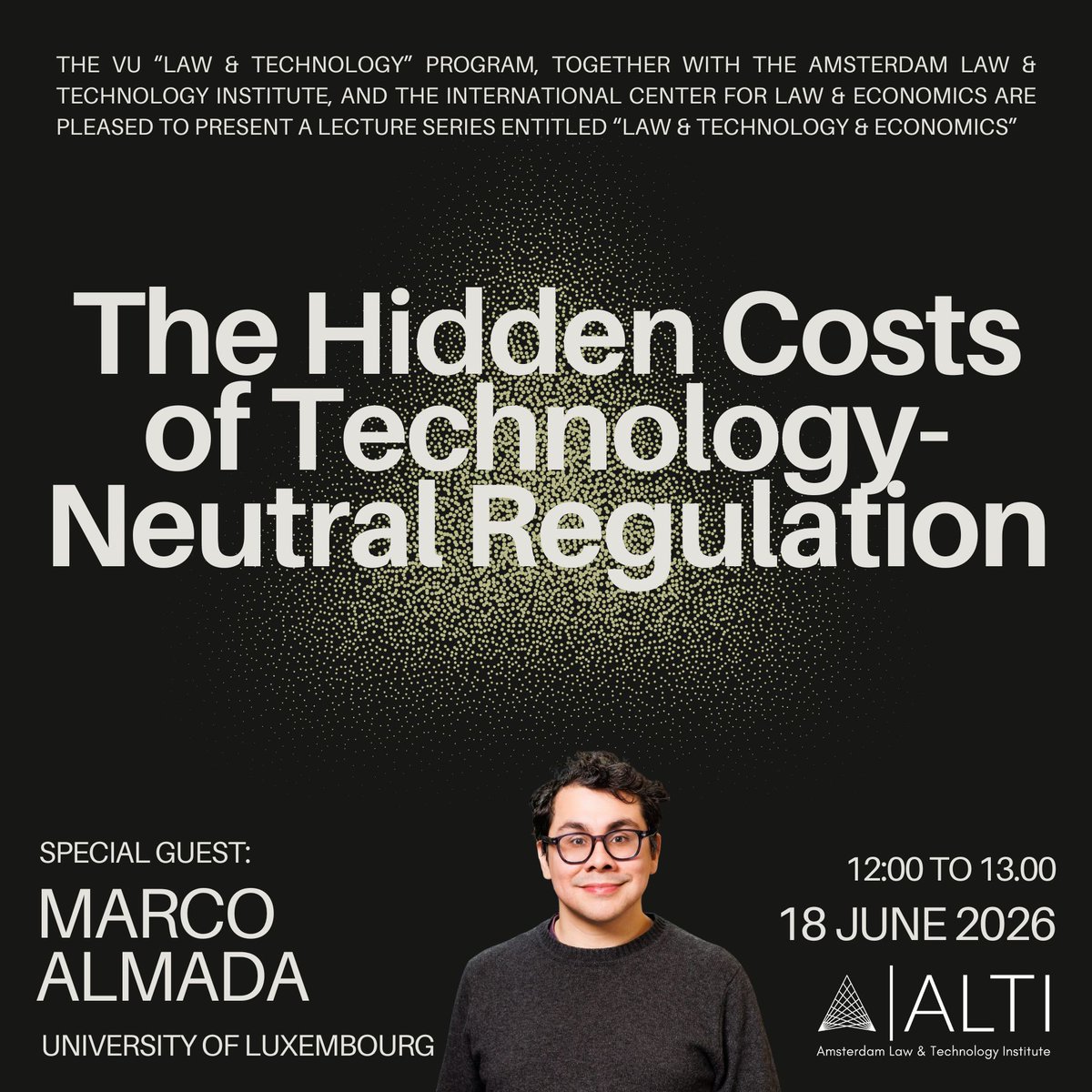
Marco Almada (University of Luxembourg) reframes technology neutrality as a delegation of power, and shows how it concentrates power while weakening accountability.
Watch 👉 https://t.co/QKMJGJSDkC.
ALTI is hosting ATLANTIS, a five-year ERC project led by @ProfSchrepel, and the project is now hiring three fully funded PhD candidates.
https://t.co/dzh5zB7ciM
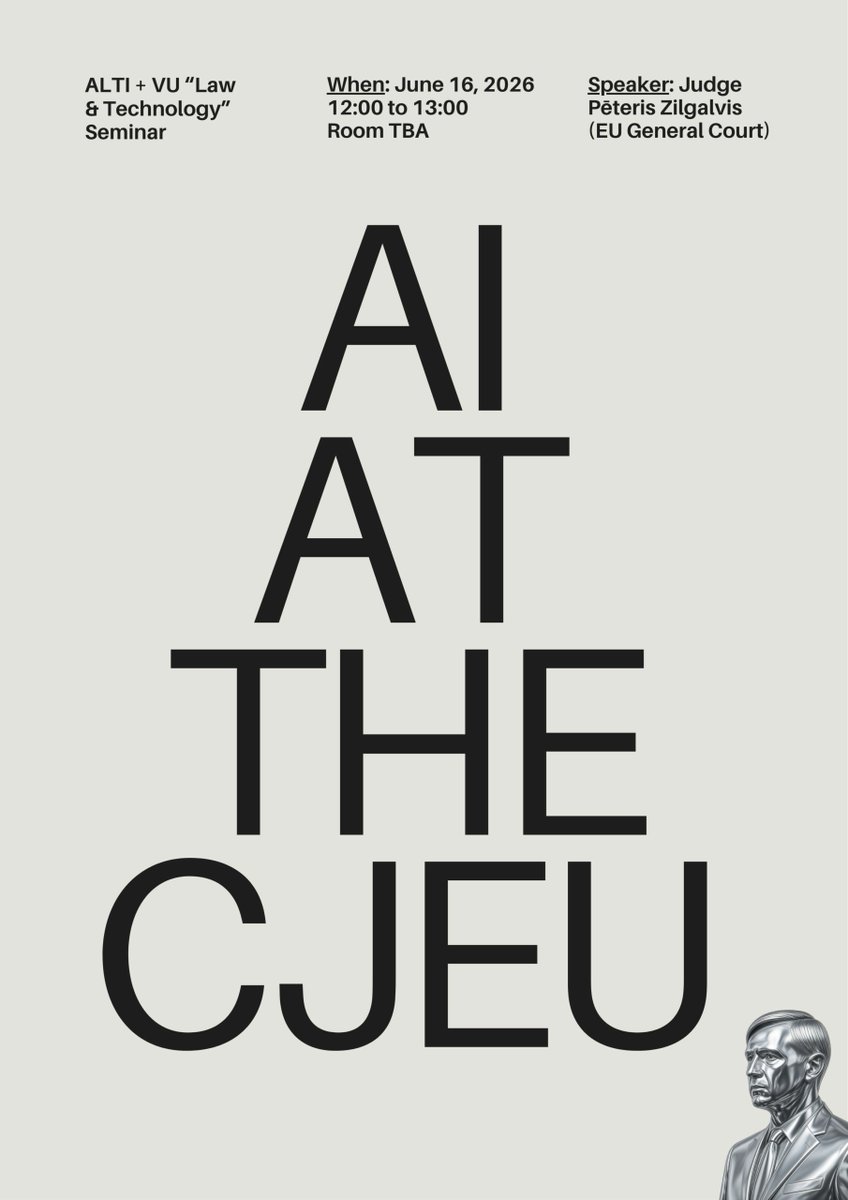
The recording of our ALTI Law & Tech seminar with Judge @PZilgalvis is now online.
Judge Zilgalvis sits on the General Court of the European Union. He joined us to discuss the recently adopted CJEU Artificial Intelligence Ethics Charter.
Watch it here: https://t.co/HmhFy3qUXa.
I am HIRING three fully funded PhD candidates for ATLANTIS, my five-year ERC project at Vrije Universiteit Amsterdam. Together, we will build a robust legal framework for #computationalantitrust.
Every EU competition agency now enforces the law with AI and other computational tools. The legal framework has not kept pace. ATLANTIS builds it.
The positions start on 1 December 2026 and run for four years. Candidates will get a direct access to a network of 80+ antitrust agencies, real data, real interviews, and research stays at top institutions... The team already includes co-supervisors and advisory board members from Harvard, MIT, Stanford, Oxford, and other institutions (tba).
ATLANTIS is a real team, not three silos. Candidates will share weekly gatherings, walks, and runs in the Amsterdam Forest (if they are into that...). We will work hard, and have fun along the way!
Deadline: 15 September 2026. Details and application below. If you know someone who fits, a repost or tag would mean a lot.
https://t.co/GXlFA370GG
Abstraction in regulation is rarely neutral.
Marco Almada shows how technology-neutral rules concentrate power in a few public and private hands, often at the expense of accountability.
Moderated by @ProfSchrepel.
Join us 👇
https://t.co/1vhHOxUMyz
Innovation policy is mainly interested with R&D, patents, and subsidies. @profjasonpotts thinks it’s looking the wrong way.
The real frontier is institutional, and the case studies are uncomfortable: Saudi Arabia, China, regenerative crypto-finance...
https://t.co/WKoS7qHxkK
Human oversight, fundamental rights, judicial decision-making.
What changes with AI?
Judge @PZilgalvis (@EUCourtPress) discusses 👇
🗓 June 16, 12:00 to 13:00
Register: https://t.co/lZ37zGwjja
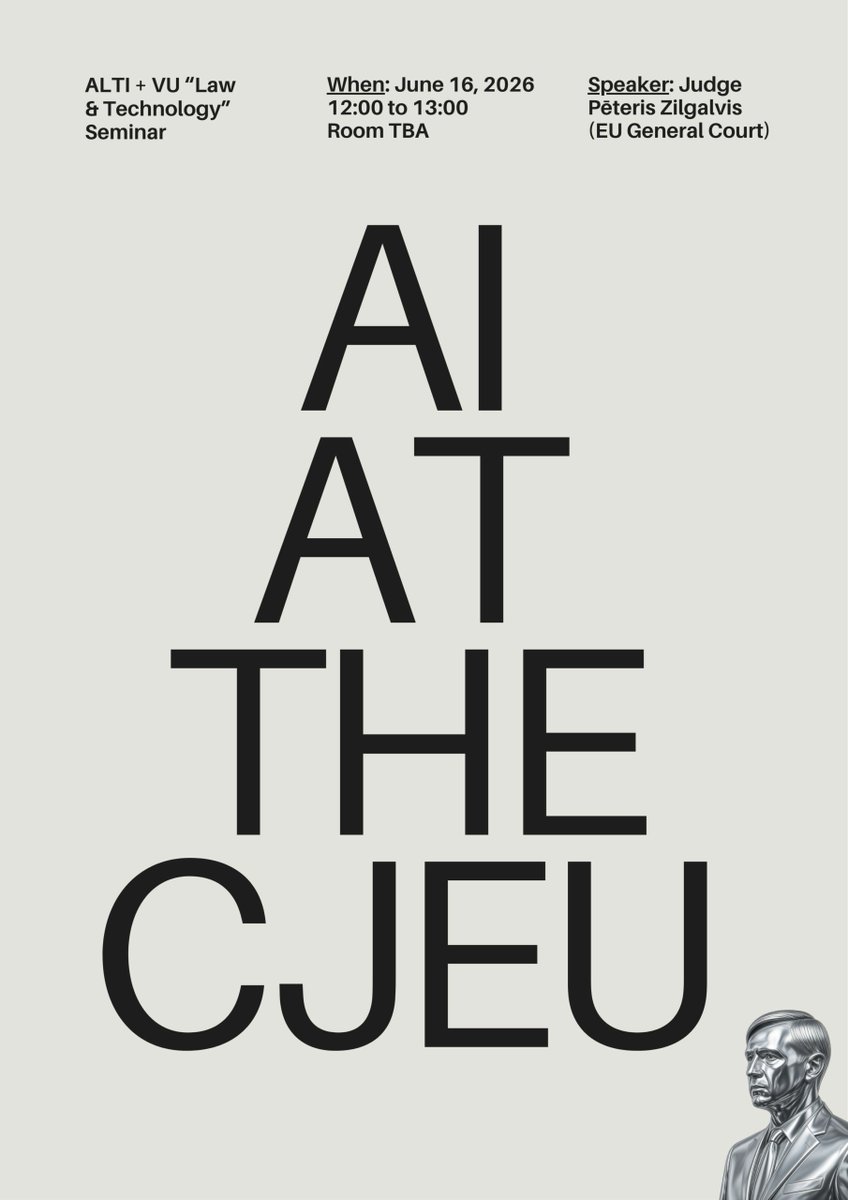
AI in courts is no longer theoretical.
How does the CJEU approach it?
Judge @PZilgalvis (@EUCourtPress) discusses 👇
🗓 June 16, 12:00 to 13:00
Register: https://t.co/lZ37zGwjja
Why do technology-neutral rules so often miss their target?
Marco Almada has a unifying answer. He’ll present it in a 30-min talk, followed by a discussion with @ProfSchrepel and audience Q&A.
Sign up 👇
https://t.co/1vhHOxUeJ1
How are courts using AI?
What limits should apply?
Judge @PZilgalvis (@EUCourtPress) discusses 👇
🗓 June 16, 12:00 to 13:00
Register: https://t.co/lZ37zGwR8I
Incumbents lose when green technologies win. That tension is now a competition law problem. Pablo Ibáñez Colomo (@LSEnews) on how to think about it properly. ALTI lecture, 30 April 2026. https://t.co/PPHIkq8Xyd
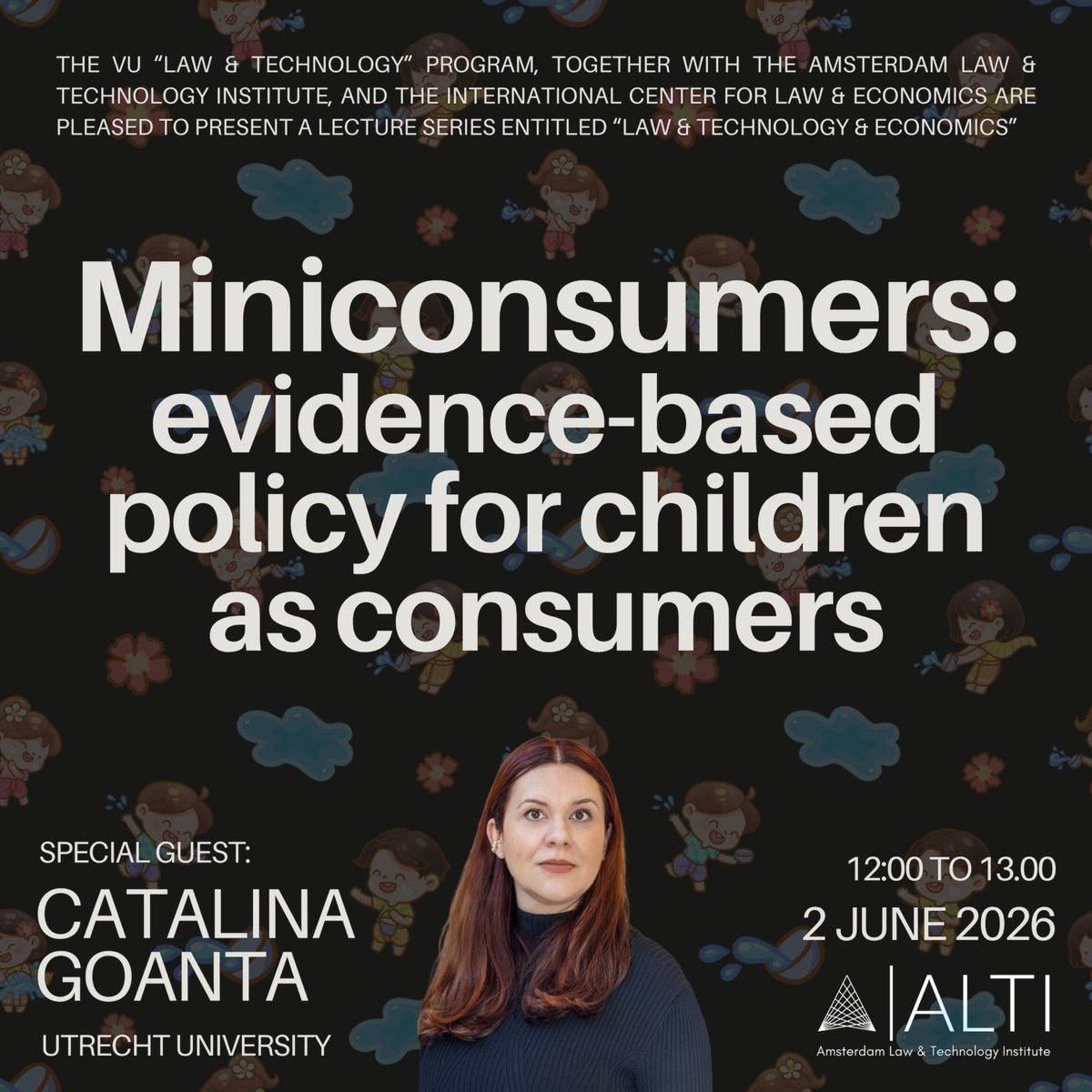
Children are not just users, they are also consumers.
What does that mean for law?
@CatalinaGoanta (@UniUtrecht) explores 👇
🗓 June 2
Register: https://t.co/ytVjb6OHEc