🎙️ NEW PODCAST 🎙️
Where should I start? I am launching a new academic podcast called “Scaling Theory”. I am of course incredibly excited, but more importantly, I hope you’ll find it interesting.
I want to explore the power laws behind the growth of businesses, technologies, legal systems, and living systems. The podcast will feature scholarly discussions with select guests (I’ve already recorded a couple, to be published very soon!!) and deep dives into the academic literature. Everything is explained in the introductory episode.
➝ Spotify: https://t.co/VbEtH0hIQU
➝ Apple: https://t.co/19CnR62PcD
➝ YouTube: https://t.co/Mo8e8keheo
NEW special issue in the Network Law Review.
The old yardsticks of competition struggle with digital markets, so we asked for new ones.
@ProfSchrepel and @AuerDirk set the stage and announce all contributors.
https://t.co/cI52FrXlm6.
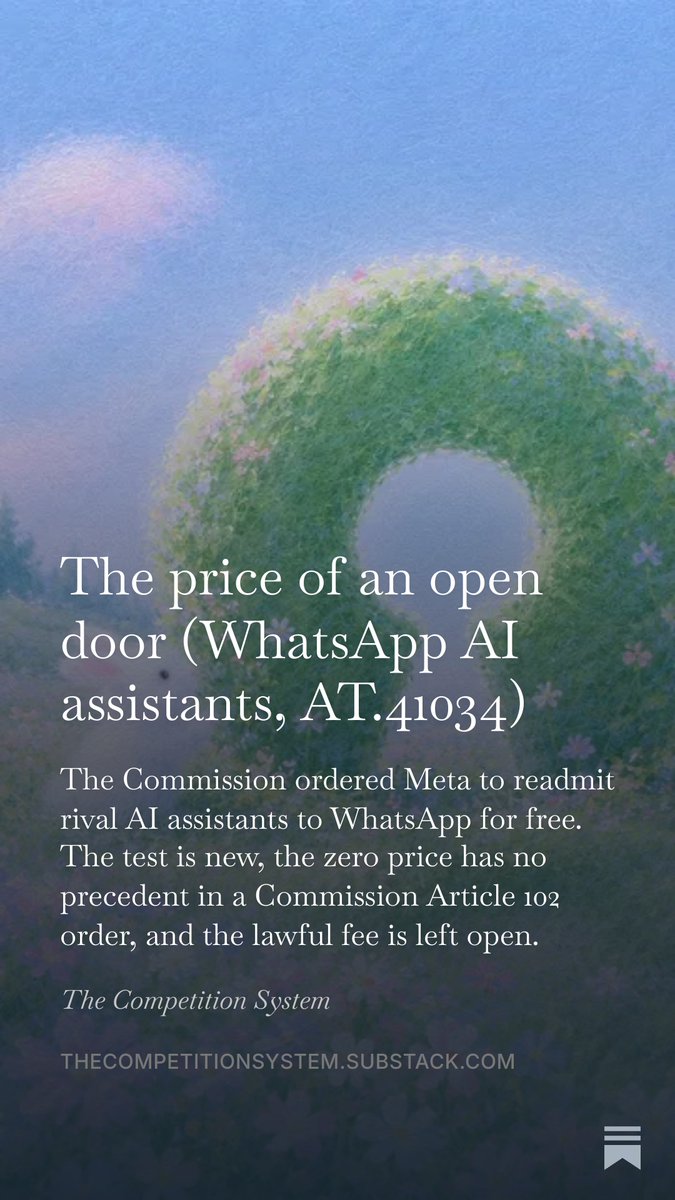
In seven weeks, the @EU_Competition priced access in three ways:
➝ ZERO for WhatsApp and for Android AI features.
➝ Costs plus a return capped at the cost of capital for Google Search data.
➝ A fee “commensurate to the value” for Google Play, with no level set. https://t.co/D1trC4GDRU
How do you measure competition when prices are zero and products change every few months? With @AuerDirk (@LawEconCenter), we asked lawyers and economists what authorities and courts should measure in digital markets. Our special issue on the Network Law Review starts Monday: https://t.co/EXFWuLpCp7
My friend David Teece is coming to Amsterdam.
On 23 November, he explains why antitrust became “precisely wrong” about innovation, and what courts and agencies should do about it.
David usually fills large halls. This one is a small room at VU, so register early: https://t.co/ouBkKQBApT
NEW in the Network Law Review: Frédéric Jenny proposes an “innovation clawback”. Merging firms that win approval on an innovation defense would bear part of the cost if the promised innovation never comes.
https://t.co/GKagGk5qeO.
We mourn the loss of Senior Lecturer Richard Allen Posner, a longtime #UChicagoLaw scholar, former federal appellate judge, and pioneer in the field of law and economics, who died on November 10.
Read more about his legacy: https://t.co/PhOaZWZIAN
I coded 108 decisions and judgments on access to a dominant firm’s input, from Commercial Solvents (1974) to WhatsApp. WhatsApp is the only Article 102 prohibition or interim order in which the Commission itself sets the price of access at zero. https://t.co/FQka0zsaa5
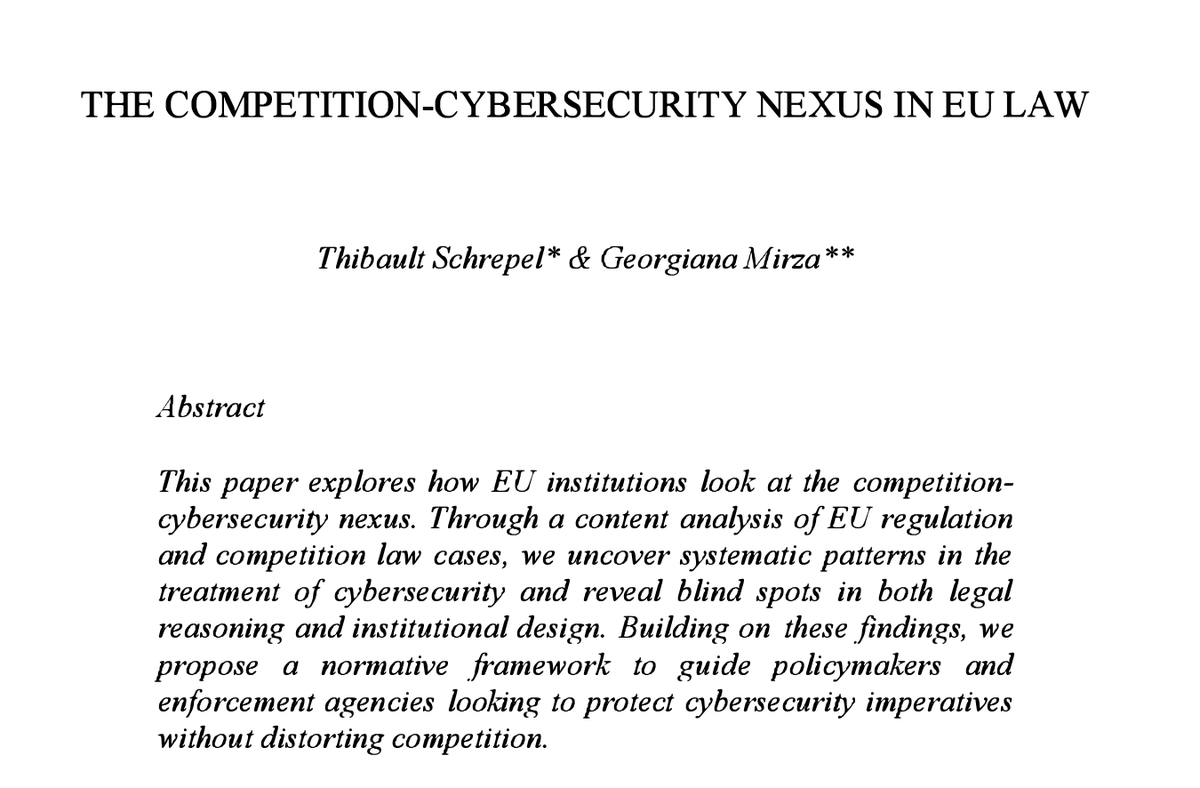
Every digital competition intervention is now a cybersecurity event. Every security architecture is a market structure decision.
EU law has not caught up. The DMA forces openness without asking what it does to security, and the Data Act reduces security to an exception clause.
Our new paper maps the gaps and proposes a fix https://t.co/g3kh4Kxjjc
I am organizing a conference at VU Amsterdam on 14 December. Peter Wennink, Martijn Snoep, Cani Fernández, Marc van der Woude and an Oxford-style debate I will moderate. Join us!!
https://t.co/6Rd0yGRmMm
The lesson of the WhatsApp decision for every platform. Opening an API to third parties creates the evidence that will be used to keep it open, whatever the reason you opened it. Openness now carries a legal cost. https://t.co/FQka0zsaa5
The Commission has published no merger simulation results since 2018. Why? James Andrews and Peter Ormosi have a clear idea why... https://t.co/HaZo8461Y2
@cdenizata@EU_Competition@Meta Well… in a sense yes, but as I also highlight in the piece, @EU_Competition has priced access in three ways in just 7 weeks. The last of consistency is… hard to explain.
The European Commission @EU_Competition has just told @Meta that once you open your door to others, you may not close it. For now, you may not charge at the door either. #Locke would have had questions. https://t.co/FQka0zrCkx
The General Court defines network effects as the value of a product rising with the number of its users. Then it applies the definition to hotels and travellers, which is a different mechanism with different economics. Odd. https://t.co/MAJOzyQzSy
We decoupled memory from the model.
Living Brain is one persistent brain for ChatGPT, Claude, Cursor, Codex and your own agents. Write in one, retrieve in any.
92.2% on LoCoMo. 464ms median retrieval. Up to 22.6x fewer tokens per question.
LLMs have parameters. Living Brain has plasticity.
The CrowdStrike outage crashed 8.5 million Windows machines in July 2024. Part of the reason was a 2009 EU antitrust commitment that forced Microsoft to open its kernel to rival security vendors.
With Georgiana Mirza, we look at what EU law does when competition and cybersecurity collide. Short answer: not much.
https://t.co/g3kh4Kxjjc