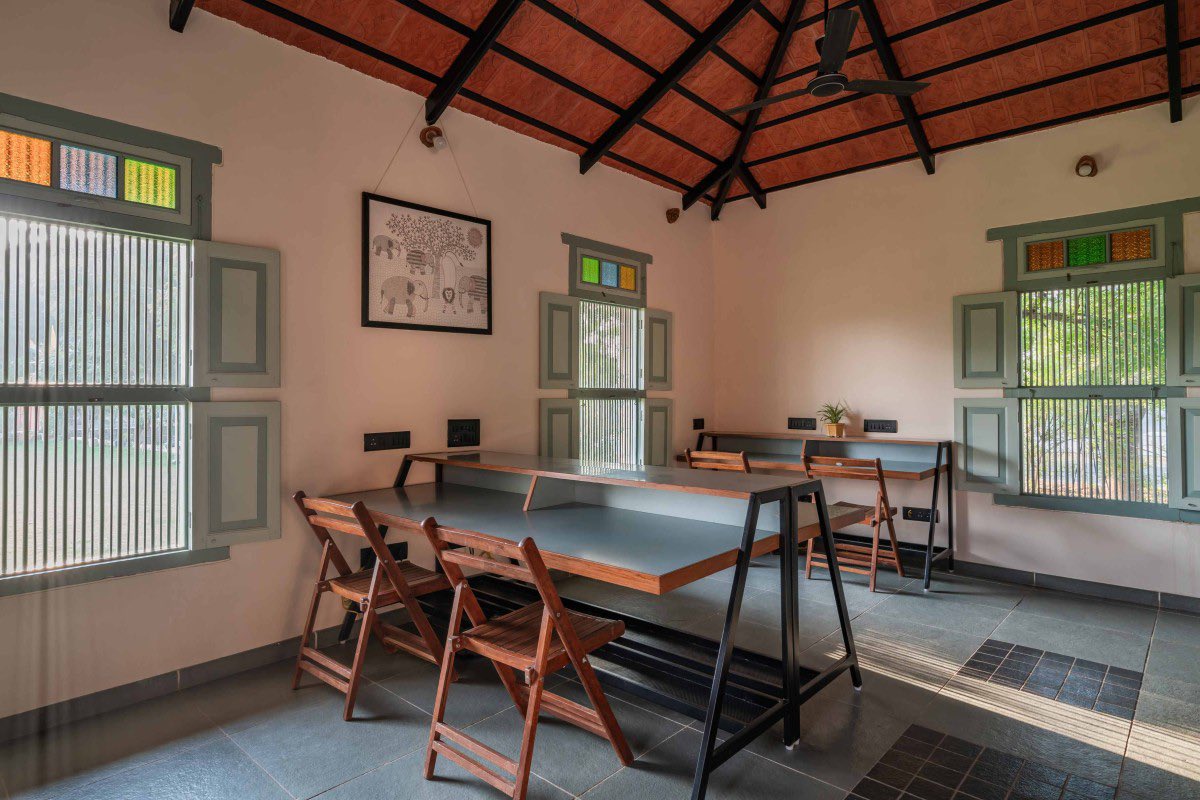
Most architects design vernacular buildings for clients and go home to something entirely different themselves, an imported aesthetic disconnected from the climate it sits in. The philosophy stays a pitch, not a practice.
Himanshu Patel didn’t do that. Tribhuvana is his own architecture studio, the workspace he actually shows up to every day, built in Khanderaopura village near Ahmedabad, Gujarat. d6thD Design Studio. 2,691 sq ft. Completed 2022.
It is built the same way he designs for clients, vernacular material, local form, detail drawn from the village around it rather than imposed on it. He didn’t build a monument to the idea and go live somewhere else. He built the argument and put himself inside it.
An architect who believes his own philosophy enough to inhabit it isn’t selling an idea. He’s demonstrating one.
Project: Tribhuvana, Khanderaopura, Gujarat, India
Architect: d6thD Design Studio, Himanshu Patel
Completed: 2022
Photography: Inclined Studio
A doctor couple left the noise of Chennai for two acres of land outside the city, in a village called Sholavaram. They wanted a modest two bedroom home with traditional building elements, nothing extravagant.
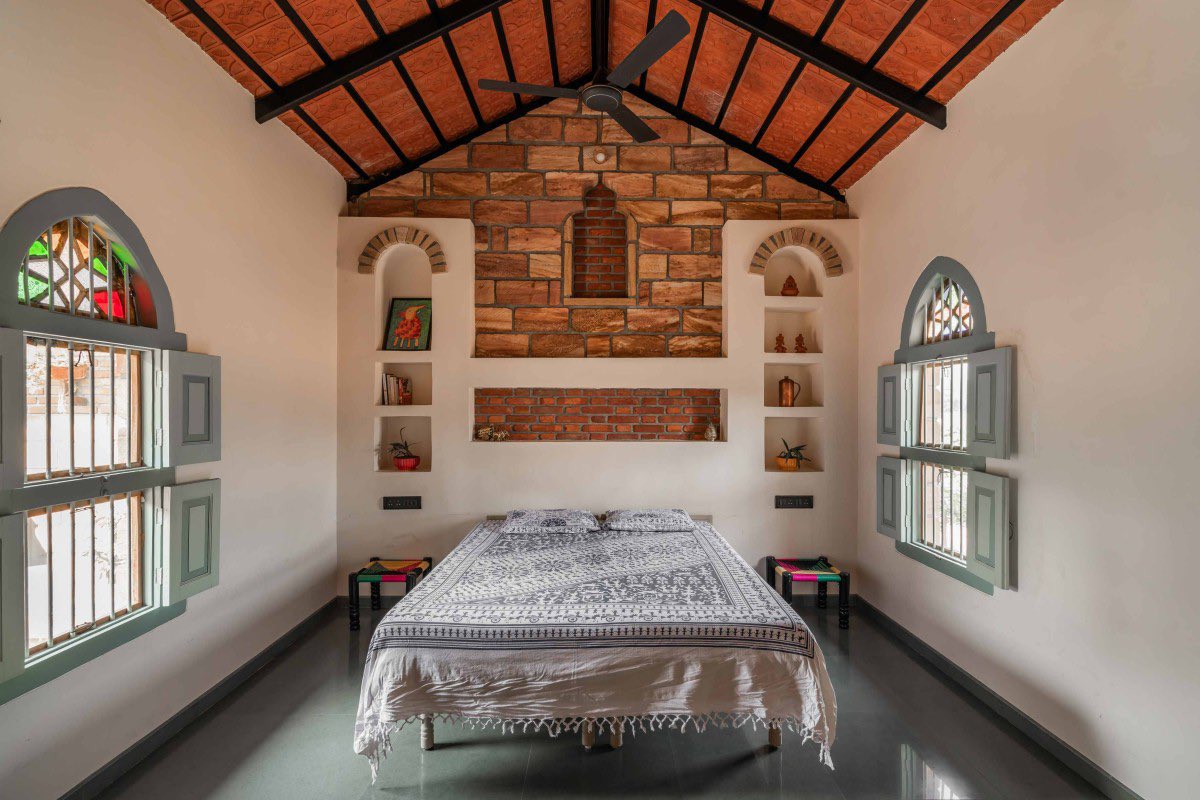
That home is VIPA Farm House, designed by Studio One By Zero, architects Deepak Sundaram and Kavya Rajendra. The walls are exposed brick and plain cement plaster, nothing hidden behind imported cladding. The ceiling uses a filler slab technique and the floor is oxide finish, both of which keep the house cool without any air conditioning doing the work. Every piece of furniture, the wardrobes, kitchen cabinets, doors, is reclaimed wood pulled from old palaces and houses across Tamil Nadu instead of freshly cut timber. Two courtyards run through the house east to west, so light, air, and even the smell of rain reach straight into the dining space. 2,350 sq ft, completed 2022.
None of these choices were made to look expensive. Exposed brick costs less to install than plastered and painted walls, and it never needs repainting. Reclaimed wood costs less than new hardwood and comes with a history new material can’t replicate.
A similar case exists on another continent. Casa Morro da Manteiga in Brazil, a much smaller 75 square meter home, was built under a government low income housing program using the same logic, brick left exposed, electrical and structural elements left visible instead of covered, to keep both the look and the cost down.
Two different countries, same conclusion. Building with local, honest materials is not a luxury choice, it is often the cheaper option and the one that survives the climate longer. The conversation Africa needs is not about waiting for bigger budgets. It’s about building with what already costs less and lasts longer.
Architect: Studio One By Zero, Deepak Sundaram, Kavya Rajendra
Location: Sholavaram, Chennai, India
Completed: 2022
Photography: Yash R Jain
How you help yourself to "let go" of this "freedom" illusion that has been successfully sold to you by Hollywood and US-funded media and civil society is to ask yourself a few important questions:
What exactly is "freedom"? Is "freedom" the ability to thumbprint on a ballot paper that will be tippexed at the collation centre with your vote given to APC regardless of who you voted for?
Is "freedom" the ability to make social media skits insulting your president that was imposed on you by a foreign power even though nobody voted for him?
Is "freedom" the ability to rant endlessly on Twitter about your "bad leaders", knowing fully well that you are just wasting English and kilobytes to no end whatsoever?
Joseph Stalin once said “It is difficult for me to imagine what "personal liberty" is enjoyed by an unemployed person, who goes about hungry, and cannot find employment. Real liberty can exist only where exploitation has been abolished, where there is no oppression of some by others, where there is no unemployment and poverty, where a man is not haunted by the fear of being tomorrow deprived of work, of home and of bread. Only in such a society is real, and not paper, personal and every other liberty possible.”
I think that's a much more constructive way of viewing "freedom." Poor, deprived, uneducated people are not, and can never be "free" in any meaningful sense. What use are my "constitutional freedoms" if my stomach is empty? If my stomach and my brain are empty, I am automatically a slave to whoever can put bread in my belly and information in my head - and that person automatically has the power to turn me into a weapon fashioned against myself and those around me. In that situation, which describes most of modern Africa, can you describe me as "free"?
"Democracy" and "freedom" are some of oyibo's most dangerous linguistic weapons when used in the context of people living on a per capita income of less than $3,000/year. Where are you likelier to live a full, happy life - Nigeria or China? Nigeria supposedly has the "democracy" that China doesn't - why are Nigerians leaving that "freedom" and migrating to China for a better life, instead of the other way around? Why do North Koreans have a life expectancy that is over 20 years longer than Nigerians? Why do the Vietnamese have much better lives than most Nigerians who have ever existed?
All of the years you have spent thumbprinting ballot papers for candidates that the US embassy will never allow to win, China has been doing 5-year plans and becoming the world's greatest country.
There is a video of Africa's richest man saying that he has had to obtain 35 different visas just to be able to travel around Africa. A random homeless drunk from Hamburg who has never held down a steady job has more access to Africa than Africa's richest man on account of the complete accident of German citizenship and ancestry.
That should be the end of the conversation about whether identity or social class comes first. Dangote comes from the highest possible social class in existence on the continent of Africa, but by default he still has fewer movement privileges ON HIS OWN CONTINENT and in the world outside than the lowest born 6-fingered European orphan with Downs Syndrome.
To get the same movement and access privileges as the European retard orphan, Africa's wealthiest human being would have to pay hundreds of thousands of dollars for a foreign passport that gives him what the orphan retard baby born in a brothel in Naples gets automatically at birth for free.
Any African who thinks class comes before race because of something Karl Marx wrote in a book in the 19th century is an adherent of just another goddamn religion. Das Kapital is their holy book, Karl Marx is their deity, and Friedrich Engels is his designated prophet. It's really no accident that people like that react to Lenin, Mao, Deng etc, the exact same way that Catholics and Sunni Muslims react to heretics.
Kenyan Millennial Men Have No Plan B
Kenyan men die young. The average male life expectancy is about 62, and healthy life expectancy, the years you actually live in good health, is closer to 57. So even the so-called average man spends his final years unwell.
Pick a random sample of twenty men in their thirties, and a startling number are already fatherless. Their old men are long dead, or they were never there to begin with: present but deadbeat, or absent and deadbeat, take your pick. Very few men have the privilege of seeing their fathers live into their 80s and 90s.
If I show up in my village right now, the men in their 40s and 50s have already begun to thin out. Between 60 and 75, there are almost none, and the rare one who reaches his mid-70s suddenly has a real shot at 85 and beyond. It is a silent crisis, and you never notice it until you are 40, marrying again, needing uncles to escort you, only to realize there are no uncles left, only cousins.
Our fathers’ generation was wasted by HIV/AIDS and by the economic collapse of the late 1980s and 1990s, a collapse engineered in part by World Bank and IMF prescriptions, the structural adjustment programs, not unlike what is being done to us now. Many in Gen Z may not know this, but there was a time when this country actually made things. The Western Kenya belt ran on sugar: Chemelil, Muhoroni, Nzoia, Mumias, Sony.
Webuye had Pan Paper. There were cotton ginneries and pyrethrum, and coffee farming spread as far as Kisii. Nakuru was busy as hell. So was Kitale, and even small outposts like Kilgoris. Thika was big, big, and industrial. Then, within a decade, the factories went quiet, the parastatals were privatized, and every plant that shut, every institution that was sold off, took real livelihoods and real families down with it.
People retreated to the countryside. I still remember the prettiest girl who transferred to our school. I would vote for Ruto if that is what it takes to find out how her life turned out. She looked like she had lived a cushioned life somewhere, only to land in rural Kisii, in a jigger-infested classroom. Those were the real-time adjustments that millennials rarely talk about. Maybe that is part of why so many of us are quietly traumatized.
As I said, our fathers at least had a Plan B: ancestral land, and our mothers.
As men, we romanticize our independence now, and some treat marriage as a woman’s backup plan, but in the 1980s and 90s, it was often a wife’s ingenuity that kept the whole family alive. And for the many men who died early, leaving behind young, bewildered widows, it was the women who carried the weight of raising everyone, without taking anything away from the men who did their part.
For a while, between roughly 2005 and 2015, I honestly believed millennial men would escape our fathers’ fate. Now I am not so sure. More and more millennial men are walking into something worse than what their fathers faced.
Where the late 1980s and 1990s lost a generation of productive men and women to HIV/AIDS, the late 2010s and 2020s are killing men with something quieter: a broken economy, made worse by terrible political choices, a shaky global situation, and a future nobody can read. As Darius Okolla has argued, millennials are the first generation here to enter adulthood under this much uncertainty.
For our parents, marriage and a home of your own, even a badly built one, were realistic dreams. Plenty of millennials did manage to put up decent houses in the towns ringing Nairobi. But far more never accumulated enough to reach escape velocity from poverty. It is those born in the late 1980s and 1990s who hurt the most: bright enough to get into college and raised to believe that education was the key to everything. What a cruel joke that has turned out to be.
A huge share of graduates since 2014 have never held a properly structured formal job, the kind you keep consistently for five years, long enough to set yourself up for the basics. So instead of marrying, a man in this position ends up with a baby mama, and often cannot even provide for the baby. Just yesterday, I was talking with a younger Gen Z cousin about the recent spike in new HIV infections, and she told me, plainly, that she keeps condoms on her because some of the young men she meets cannot even afford one. That is not a joke, man.
And here is the part that should frighten you: this is the same machine that took our fathers. After years of steady decline, from about 94,000 new HIV infections at the peak down to roughly 16,000 in 2024, new infections jumped again in 2025, past 20,000, the first reversal in years. The cause is almost insultingly familiar. When the United States froze PEPFAR and USAID funding, prevention collapsed almost overnight. Testing fell, PrEP uptake halved, and young people aged 15 to 24 now account for about four in every ten new infections. Donor money built the wall that held the disease back, and the moment it was pulled, the disease started walking back through. History is not repeating. It is rhyming, and it is rhyming in our generation. Worse, our government, like so many across Africa, rarely wants to solve some of these basic problems.
Now that we are in our 40s, economic depression is a silent killer. No amount of motivation, no think piece, no pep talk will bail a man out. At some point, you need the only thing that actually works: money.
Our economy began its slow collapse around 2015. Some of the rot traces back to the 2008-09 global crash; the West never fully recovered, and when America sneezes, the rest of us still catch the cold. But the deeper wounds were self-inflicted. We raised a Eurobond of roughly Sh 200 billion, and to this day the Auditor General cannot fully account for it; by the official reckoning, around a billion dollars has never been traced to any actual project. We built a wildly overpriced SGR. The effects were immediate. As Eurobond repayments and other loans came due, cash drained out of the economy. The banks that used to hawk loans to us before 2015 found a far better customer in the government itself, and what little credit remained for ordinary people dried up.
Before long, counties stopped paying on time. Today, the unpaid bills are staggering: national government pending bills alone have exceeded Sh 500 billion, and the total, including counties, sits north of Sh 690 billion, much of it owed to small suppliers who have since folded. Taxes climbed, inflation climbed, companies issued profit warnings after profit warnings, and many shut, exactly as they did in the 1990s.
The economy kept shrinking, and in the meantime, we handed the keys to a thieving elite, the kind of arrangement where only they get to steal, so the money pools in fewer and fewer hands.
In real life, this is what it looks like: if you run a business, the stock does not move. A friend who sells electronics in Luthuli told me that in his good years, back in the 2010s, he shifted serious volume and was, in real terms, a millionaire. These days, he is lucky to sell one cheap Chinese TV a week. Last I heard, he may close shop.
You can see it in black tax too, which keeps climbing. I told Gordon Opiyo recently that we should be careful about celebrating the rise in diaspora remittances. That money is not flowing home to buy Treasury bonds or build anything; it is flowing home to plug the holes that government irresponsibility keeps tearing open in people’s lives, something both the Central Bank and the Kenyan Demographic Health Survey admit.
Ruto did not kill the Kenyan economy. It was already on life support by the time he inherited it. Whatever little resuscitation he managed, he did for himself and his cronies. Now, standing over a dead economy, all he does is dance and piss on the grave while his bloggers cheer.
None of this is to say women are not suffering. They are, and their story is theirs to tell. But what I am certain of is this: in the coming decade, a lot of men’s deaths will be hastened by the collapsing economy. Whether we lose them to drugs, to suicide, to slow depression, or to plain loss of hope, the direction is grim. If things keep tanking, I would not be shocked to see male life expectancy slide back toward the mid-50s. Broke men cannot afford decent healthcare or good food. And broke men, more than anyone, tend to lose their networks and their relationships, even within their own families. That isolation is its own quiet killer.
So, educated millennials and Gen Z men, hear me clearly.
The point of laying all this out is not to bury you. It is to get you to stop waiting for the economy, or the government, or some motivational speaker, to come and rescue you. They are not coming. The men who make it through the next ten years will be the ones who saw the storm early and built for it: who learned a skill the market actually pays for, who pooled resources with other men instead of competing in misery, who kept their bodies and their minds intact, and who refused to let shame cut them off from the people who love them. Money is the goal, yes, but the things that keep a broke man alive long enough to go and make it are boring and unglamorous: a few real friends, a reason to wake up, and the stubbornness to not check out early.
Our fathers had land and our mothers to fall back on. We were handed no Plan B. We have to become our own. Build it now, while you still can, because the times are bad, and they will get worse before they get better. The men who understand this and move will not merely survive. They will be the ones still standing when the dust settles, and the ones who get to rebuild.
Nothing messes with a man like a bad economy. And this, my friends, is not a wantam or tutam thing. This one outlasts whoever is sitting in State House
@ivymuthe A friend once told me, out of frustration with the deplorable infrustructure in Nairobi: “Kenya haina that 'shadowy' wenye nchi who can persue the long-term vision. Every President assumes office with their own set of chaos and disorder.”
Wolves are relegated but they will still get money from the Premier League. How?
It’s called ‘Parachute payments’ and its idea is to help relegated Premier League teams lift their heavy wage bills accrued from when they played in the Premier League.
What has happened is that the payments have become an unfair package given to those teams which makes them trump the rest of the Championship. Other Championship, League One and League Two teams also get handouts from the Premier League but it’s nowhere near what these teams relegated from the PL get.
How much do relegated PL teams get?
Each Premier League team got £89m in broadcast revenues last season. They also each got £7.9m in commercial revenue distributions, which meant that each PL team got £97m guaranteed.
Southampton, Ipswich and Leicester got the least when every revenue was added, and the lowest of them got £109.2m.
For clubs who relegate, the Premier League doesn’t abandon them. They get 55% of the central distribution that every Premier League club receives in their first season in the Championship.
This means Wolves, for example, are guaranteed at least 55% of the central revenue in their first season in the Championship. Year one parachute payment is expected to be nearly £50m which is a significant advantage over the rest of the Championship.
If they spend a second and third season in the Championship, they’ll get 45% of that central revenue for year two. Year two payments are around £40m.
And for those who have spent more than a season in the Premier League before relegation, like Wolves, they’ll get 20% of that central revenue for their third year in the Championship. Currently believed to be £18m.
This means they’re guaranteed earnings from the Premier League for the next three years even if they don’t make it back as soon as possible.
It’s why relegated Premier League teams return quickly.
Researchers have found that clubs that receive parachute payment are twice as likely to get promoted. The reasons are not far fetched.
For context, Ipswich who got relegated from the Premier League last season are second on the EFL Championship log.
While this money gives an advantage, it’s not a silver bullet. It’s still subject to management. We’ve seen Premier League-relegated teams slide further down to League One in their first season in the Championship. You have to spend it wisely, like Leeds.
Leeds have gone down and returned time and again.
Leicester are one of the mismanaged ones. They risk getting relegated this season to League One with a wage bill that’s more than the average in the Championship. Luton are another example.
I hope you’ve learnt something new?
My name is Rilwan, I love and write about football systems, memories and the depths behind the game. Follow me and repost if you want more of this.
Mr. David Hundeyin: While I understand your position here, you are entirely too harsh on the poor masses in Nigeria in whose name you are supposedly fighting for.
Yes, it is undeniably true that many Nigerians do not see the bigger picture.
They do not see how foreign corporations are funding the insecurity currently ravaging the North, how the IMF and World Bank are basically boardroom terror organizations destroying the economy of the Global South, or how the Nigerian government only serves the vile interests of a select few elites and their puppet masters in Western capitals.
All of this is true, but what is equally true is this: it is not this poor majority that will change this country.
This may seem counterintuitive, as the poor are the ones feeling the crushing weight of a dwindling economy, hyperinflation, and an epileptic power grid.
But as Karl Marx and Friedrich Engels outlined in lovely book "The Communist Manifesto", a true change in government can only happen when the classes of society hold hands and unite under a common umbrella.
The poor and uneducated form the overwhelming majority of society and obviously possess the brute muscle to pressure the system.
However, they cannot articulate a well-structured plan, they cannot write manifestos, and they cannot understand the complex logistics required to sustain a massive protest.
They lack the financial war chest to fund a prolonged struggle, the legal expertise to bail out captured comrades, the media expertise to combat vicious state propaganda, and the strategic foresight to negotiate terms when the ruling class is finally brought to its knees.
The Hollywood theater of poor people carrying pitchforks to overthrow their government is pure, delusional fantasy.
An oppressive regime will always have a police force and a military that are heavily armed, well-trained, and eager to shoot live ammunition at protesters.
Drawing again from the works of Marx and Engels and their studies on class struggle, the fundamental catalyst that brings to light any true revolutionary movement must start with the Middle Class (the Bourgeoisie/Intelligentsia).
The middle class is educated; they possess the knowledge to decode complex geopolitics and translate it into simpler terms for the average farmer to understand, just as Thomas Sankara did in Burkina Faso.
The middle class has the resources and the time on their hands to properly coordinate protests and build formidable intelligence networks.
They can outsource the technology to bypass government censorship, they have the international connections to expose human rights abuses to the global stage, and they possess the ideological backbone required to turn disorganized public anger into a lethal, targeted political weapon.
The most famous revolutionary movements in history like the French Revolution, the Russian Revolution, and the 1979 Islamic Revolution in Iran, were all ruthlessly and carefully planned and organized by educated, wealthy, middle-class citizens. Even Fidel Castro of Cuba came from a wealthy family, and his father owned a robust sugar business.
Yet, even when the lower and middle classes unite, the upper class and the military still hold all the cards.
Even the celebrated 1979 Iranian Revolution was only successful because factions within the military and the government decided to commit mutiny and flat-out refused to protect the Shah.
If impoverished Nigerians were to relinquish their daily survival hustle and storm the streets en masse to protest against the government, what do you think will happen? Just like ENDSARS, the state will wait for the cover of night, turn off the lights, and gun down unarmed protesters in cold blood.
Then, their puppet masters in the Global North will instantly provide them with diplomatic cover, and the rest of humanity will simply move on.
Therefore, the struggling masses do not need to understand your complex geopolitics for a revolution to happen. If the comfortable, educated elite(who claim to know it all) do not get off their high horses and join forces to mobilize the streets, absolutely nothing will change.
A revolution does not happen in a vacuum; it requires a spark forged by intellectuals, fueled by the fury of the poor, and executed with ruthless, unwavering precision. Until the educated middle class is willing to sacrifice its comfort, weaponize its privileges, and bleed alongside the common man they so eagerly criticize, you're basically tweeting into oblivion.
It is actually a crime under Kenyan law for public officers to give false/misleading information. We have been told a bunch of open lies about the fuel situation with Ruto himself, as recently as 30th March, telling us his “strategic interventions”had “mitigated price increases” only to hit us with a 40 shilling increase two weeks later. Let me not even mention that “expert” or his string of lies. We are placing the pain at the pump squarely on Ruto.