Huawei Built a European Palace for 35,000 Researchers, Then Spent $28 Billion on R&D in a Single Year
I walked into what looked like a European palace.
Marble floors. Crystal chandeliers. Gilded railings. Classical statues. Vaulted ceilings that belong in a ministry building in Vienna or Paris.
Then the giant screen lit up with the Huawei logo.
This is not a government building. This is Huawei’s Shanghai research campus.
A self-contained research city with lakes, landscaped grounds, modern laboratory blocks, elevated walkways, and its own internal light-rail system. Designed for 35,000 researchers. Current density is already extreme: roughly 80% hold a master’s degree or higher. About 10% are PhDs. Throw a stone and you hit advanced technical talent.
In 2025, Huawei generated CNY 880.9 billion in revenue.
It spent CNY 192.3 billion on R&D, 21.8% of total revenue, roughly US$27.9 billion.
That single-year R&D outlay exceeds the entire GDP of multiple countries with larger populations.
Total employees: ~213,000. R&D headcount: 114,000 (53.7% of the workforce).
Most companies and most nations still treat research as a residual. Huawei treats it as the core operating expense.
The result is not just beautiful architecture. It is sustained technological capacity under pressure.
This is the case study that matters.
Resource allocation at this intensity, sustained for more than a decade, produces outcomes that incremental budgets and short-term political cycles cannot match.
Have you visited a corporate campus that genuinely changed how you think about what’s possible?
Video produced and edited by Arianne, my beloved daughter 😍
When you can explain something complex in simple terms, it means you truly understand it yourself.
That step about identifying gaps in understanding is gold, it's where the real learning happens.
@Barchart While looking cheap , most funds dare not touch Chinese stocks. There isn’t enough liquidity to prop up Chinese stocks for many years, even the high risk assets like btc easily out-performs most Chinese stocks.
Grok Voice Think Fast 2.0 just took the #1 spot on Artificial Analysis’ Speech-to-Speech Index
outperforming every GPT Realtime model on the leaderboard
And this benchmark combines speech reasoning, agentic performance, human preference and actual task success
Grok Voice is becoming ridiculously powerful
SpaceXAI is pushing voice AI straight to the top of the frontier
A reminder that real bridges between the US and China are often built by ordinary people, not just diplomats.
In a time when official relations are strained by competition over technology, trade, and security, this story cuts through the noise. Shared challenges like desertification don’t care about flags. When individuals from both sides simply decide to solve a problem together, something durable takes root literally and figuratively.
People-to-people goodwill won’t erase geopolitical friction, but it shows what’s possible when we focus on concrete results instead of pure rivalry. More of this energy, less of the zero-sum theater, would serve both countries better.
A heartwarming reunion after 27 years!
In 1999, American Ronald Sakolsky donated $5,000 to Yin Yuzhen, a Chinese woman battling desertification in Inner Mongolia's Maowusu Desert. Over the past two decades, she used the funds to plant over 50,000 trees.
Now, Sakolsky has returned to China to see the miracle firsthand—and together, they planted a tree symbolizing China-US friendship.
Equal pay exists in one very unexpected Belgian workplace: prison
So Belgian women’s rights organisation ZIJkant decided to make the point by taking it to the extreme.
Their campaign features women committing increasingly ridiculous crimes, all in pursuit of the one place where women apparently get equal pay:
Behind bars. 😂
@thiagoTF@paulg Curation really is the new build. In a world where anyone can spin up a prototype overnight, the rare skill is knowing what’s actually worth chasing instead of just the next shiny distraction.
The best startup education is no startup education
Paul Graham @paulg makes a deceptively simple point:
Universities don’t need more entrepreneurship classes, they need to give students more time to build things.
I think this becomes even more powerful in the age of AI. For decades, the bottleneck was the ability to build. Today, AI is collapsing that bottleneck as one person with a good idea can now research, code, design, test and launch something that previously required a small team.
So the scarce skill is moving upstream.
The question is no longer “Can you build it?” instead “Do you know what is worth building?”
That requires something AI doesn’t automatically provide:
→ Curiosity
→ Taste
→ Domain knowledge
→ Judgment
→ Understanding users
→ The courage to experiment
→ The habit of turning ideas into reality
This is why Paul’s argument matters beyond universities. We shouldn’t teach young people to look like entrepreneurs, we should create environments where they become builders.
Don’t start with the pitch deck, start with the prototype. Don’t ask, “Will this become a startup?” Ask, “Is this interesting enough to build?”
Don’t optimize for investors, optimize for users. And don’t fill every hour with coursework, give ambitious people enough freedom to get obsessed with something. Because the next great company may not come from someone who took the best entrepreneurship course.
It may come from someone who had a strange idea on a Tuesday night, used AI to build the first version by Friday, put it in front of 20 users and kept going.
AI is making building cheaper, that means the biggest competitive advantage of the next generation may not be access to technology, it may be having the judgment to know what to do with it.
That’s a very different kind of education and potentially a much more important one.
@AnandaniNisha@paulg In the AI era the real edge is clear thinking and sharp judgment, knowing what’s worth building beats pure tech skills every time. When the idea is strong, the how becomes almost automatic.
Maextro S800, developed by Huawei and JAC, is the top-selling ultra-luxury sedan in China, frequently outsells traditional foreign luxury cars like the Porsche Panamera and BMW 7 Series combined.
- 5.48-meter luxury sedan
- All-wheel drive
- 4 LiDAR sensors
- Up to 1,333 km total range
Price : from RMB 728,000 / $93,000
AI isn’t about replacing people, it’s about multiplying what people can accomplish.
Before AI, a great idea still depended on limited time, headcount and execution capacity.
After AI, the same team can think bigger, move faster, test more, and turn ideas into outcomes at a completely different scale.
The real competitive advantage won’t be companies with the most AI, it will be people who know how to use AI to multiply their impact.
AI won’t replace you, someone using AI will.
10xme — AI that actually works for you.
https://t.co/I4zR8aXpsx
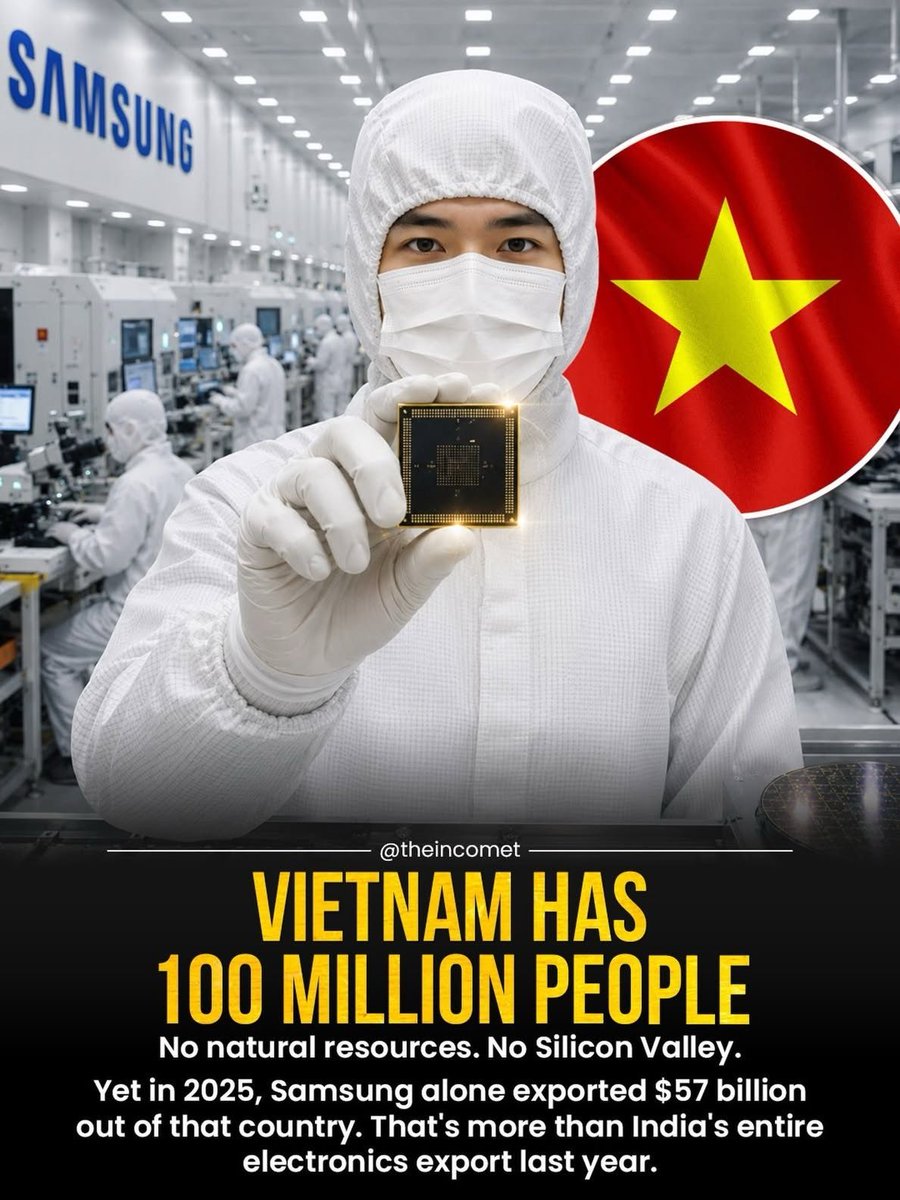
Vietnam is a much bigger manufacturing story than most people realise.
Look at the 2025 numbers:
🇻🇳 Vietnam: $107.8B in exports of computers, electronics and components
🇮🇳 India: ~$47B in electronics exports
🇻🇳 Samsung Vietnam alone: $57.1B in exports
Vietnam’s electronics exports grew 48.4% in one year and now account for roughly 23% of the country’s total exports. And Samsung alone exports more electronics from Vietnam than India’s entire electronics sector exports.
But the real lesson isn’t “Vietnam beats India”, it’s that Asia is becoming the world’s manufacturing battleground.
India is scaling rapidly, electronics exports jumped 37% in 2025, with smartphones accounting for roughly $30B. Vietnam has already built a deeply integrated export machine around global companies such as Samsung.
Malaysia has decades of semiconductor and electronics expertise, Thailand remains a major electronics and automotive manufacturing base, South Korea owns some of the world’s most important semiconductor and technology companies and China remains in another league entirely in manufacturing scale.
The interesting question for the next decade isn’t:
“Who has the cheapest labour?”
It is:
“Who can move fastest up the value chain?”
AI hardware.
Semiconductors.
Data centres.
Robotics.
Advanced electronics.
EVs.
Industrial automation.
This is where the next Asian economic giants will be built. Vietnam has shown that you don’t necessarily need a Silicon Valley. You need global supply chains, infrastructure, talent, capital, policy consistency and the ability to execute.
And AI is about to make that competition even more intense. The next industrial revolution may be built in Asia.
The cost of going for it is real but so is the cost of staying exactly where you are.
Years from now, you may regret the risks you took but you may regret even more the opportunities you never gave yourself permission to pursue.
Growth always has a price, so does staying comfortable. Choose the price that moves your life forward.
Competition just did what regulators never could.
Chinese AI labs are shipping comparable models at a fraction of the US R&D spend. When MiniMax and Zhipu can move at $0.25–0.5B while OpenAI burns ~$9B, the “premium = untouchable” story collapses.
Margins aren’t a birthright. Customers vote with their wallets, the ones who adapt will win. The ones who keep lecturing about “value” while ignoring the price gap will get disrupted.
That’s not ideology, that’s just markets doing their job.
Even at FOX Business they are now acknowledging the obvious.
Chinese AI companies have exposed a simple truth: many American AI products aren't nearly as untouchable as their price tags suggest.
Imagine building your entire business around premium subscriptions and expectations of huge margins only to watch the Chinese competitors offer similar capabilities at dramatically lower prices.
Suddenly all that talk about "premium value" sounds a lot less convincing.
Competition doesn't care about your bullshit business model.
😂😂😂😂
The energy race is the AI race.
China just hit 1.2 TW of solar and added more in 2025 alone than the US has built in its entire history. They now have more than the rest of the world combined.
Data centers and frontier models are already energy-constrained. The countries that can deliver cheap, abundant power at massive scale will train the next generation of AI. The ones that can’t will ration watts.
Solar is part of the answer, so is nuclear, transmission, and storage. But the scale and speed gap is real and compounding.
Abundant energy enables abundant intelligence. Right now China is treating that as obvious.
China now has 1.2 terawatts (TW) of solar capacity and built more solar in 2025 than the US has built in its entire history.
The US needs to build more solar, and fast.
Confidence is not the same as intelligence.
One of the biggest traps in life is assuming that the loudest, most certain person in the room must be the smartest.
Often, it’s the opposite.
Intelligent people understand complexity. They question their assumptions, they know what they don’t know… So they hesitate.
The lesson for me: Don’t confuse certainty with competence. Sometimes, saying “I might be wrong” is a sign of a stronger mind, not a weaker one.
This is exactly the kind of result that makes smart routing exciting.
Run the much cheaper, near-parity model (GLM-5.3) first, only escalate to the expensive frontier model when the tests actually fail. You keep most of the cost advantage while still capturing the hard cases the stronger model is better at.
The future of agentic coding isn’t one model to rule them all, it’s intelligent routing between them.
Give GLM-5.3 and Fable 5 the same $100 budget, and GLM-5.3 gets over 5x as much work done.
On DeepSWE, that works out to about 17 solved tasks with GLM-5.3 vs. 3 with Fable 5, even though they perform almost the same on the first try.
Economic superpowers don’t last forever.
- China started dominant (~29%), spent a century in relative decline, then roared back to ~22% today.
- The British Empire peaked high in the 1800s then faded.
- The US went from near-nothing to ~30% after WWII, the true “American Century”, and now sits at ~15%.
- India is climbing fast (~9%), the EU holds ~12%, and Russia is a shadow of the old USSR.
Relative power is a function of productivity growth, institutions, demographics, and tech adoption, not destiny. China’s rise is the biggest economic story of our lifetimes, but it’s not guaranteed to keep compounding. The US still punches above its weight on innovation and capital markets. India’s trajectory looks more interesting long-term than most people admit.
History doesn’t end, it just changes who sits at the top of the stack.
China’s AI is closing the gap with a fraction of the compute and without top-tier chips. That’s not a miracle, it’s forced efficiency, dense talent, and a laser focus on real-world deployment over pure scale.
US still owns the frontier hardware and capital intensity. But constraints are teaching China to squeeze more out of less. The race isn’t just who builds the biggest models anymore. It’s who extracts the most value from what they actually have.
China spends a fraction of what the US does on data centers, and lacks the most advanced AI chips.
Why, then, does its AI industry appear to be catching up, and rivaling Silicon Valley?
I asked @NewYorker staff writer @eosnos who lived in China for eight years, and just returned from another reporting trip there with some fresh insights:
AI isn’t one tool anymore.
It’s an ecosystem, models, agents, RAG, memory, security, automation, observability and vector databases all working together.
The real advantage in 2026 isn’t simply knowing ChatGPT, it’s knowing how to orchestrate the stack.
That’s where AI becomes a genuine force multiplier.
10xme — Master AI. Own the Future.
🔗https://t.co/I4zR8aXpsx