Huawei Built a European Palace for 35,000 Researchers, Then Spent $28 Billion on R&D in a Single Year
I walked into what looked like a European palace.
Marble floors. Crystal chandeliers. Gilded railings. Classical statues. Vaulted ceilings that belong in a ministry building in Vienna or Paris.
Then the giant screen lit up with the Huawei logo.
This is not a government building. This is Huawei’s Shanghai research campus.
A self-contained research city with lakes, landscaped grounds, modern laboratory blocks, elevated walkways, and its own internal light-rail system. Designed for 35,000 researchers. Current density is already extreme: roughly 80% hold a master’s degree or higher. About 10% are PhDs. Throw a stone and you hit advanced technical talent.
In 2025, Huawei generated CNY 880.9 billion in revenue.
It spent CNY 192.3 billion on R&D, 21.8% of total revenue, roughly US$27.9 billion.
That single-year R&D outlay exceeds the entire GDP of multiple countries with larger populations.
Total employees: ~213,000. R&D headcount: 114,000 (53.7% of the workforce).
Most companies and most nations still treat research as a residual. Huawei treats it as the core operating expense.
The result is not just beautiful architecture. It is sustained technological capacity under pressure.
This is the case study that matters.
Resource allocation at this intensity, sustained for more than a decade, produces outcomes that incremental budgets and short-term political cycles cannot match.
Have you visited a corporate campus that genuinely changed how you think about what’s possible?
Video produced and edited by Arianne, my beloved daughter 😍
China isn’t just building humanoid robots. It’s scaling production faster than the rest of the world.
The H1 2026 shipment estimates tell a striking story: Agibot at ~8,600 units, Unitree at ~5,000, while US-based Figure AI shipped only a few dozen.
The real race isn’t just about who builds the smartest robot. It’s about who can manufacture, deploy, and improve them at scale.
AI may create the intelligence, but manufacturing scale could determine who wins the robotics revolution.
The next industrial powerhouses may not look like traditional factories. They may look like fleets of humanoid robots.
Develop skills to the level that u can choose who u want to work or do business with.
Don’t let some cheap clients degrade your work. Good work comes with a price!
Pay peanuts and u get monkeys. 😁
Before AI, we had consultants making pretty slides, now we have AI making pretty slides in 30 seconds. 😂
This LinkedIn profile is brutally honest:
• Associate: Make pretty slides fast.
• Engagement Manager: Make other people make pretty slides fast.
• Associate Partner: Convince clients pretty slides will lead to real impact.
The career progression: From doing the work, to delegating the work, to selling the impact. 😂
AI might automate the slides but convincing everyone that the slides will change the world? That skill might survive another decade.
The future of consulting: Less PowerPoint. More actual power.
I’ve been watching MKBHD, Casey, Dave2D and Corridor since I was a student. They were some of my biggest inspirations and taught me what truly great content looks like.
So I really hope people won’t compare creators too much. Every creator has their own style and audience.
I genuinely hope more people become tech reviewers. The more creators we have, the more fun and exciting it gets!
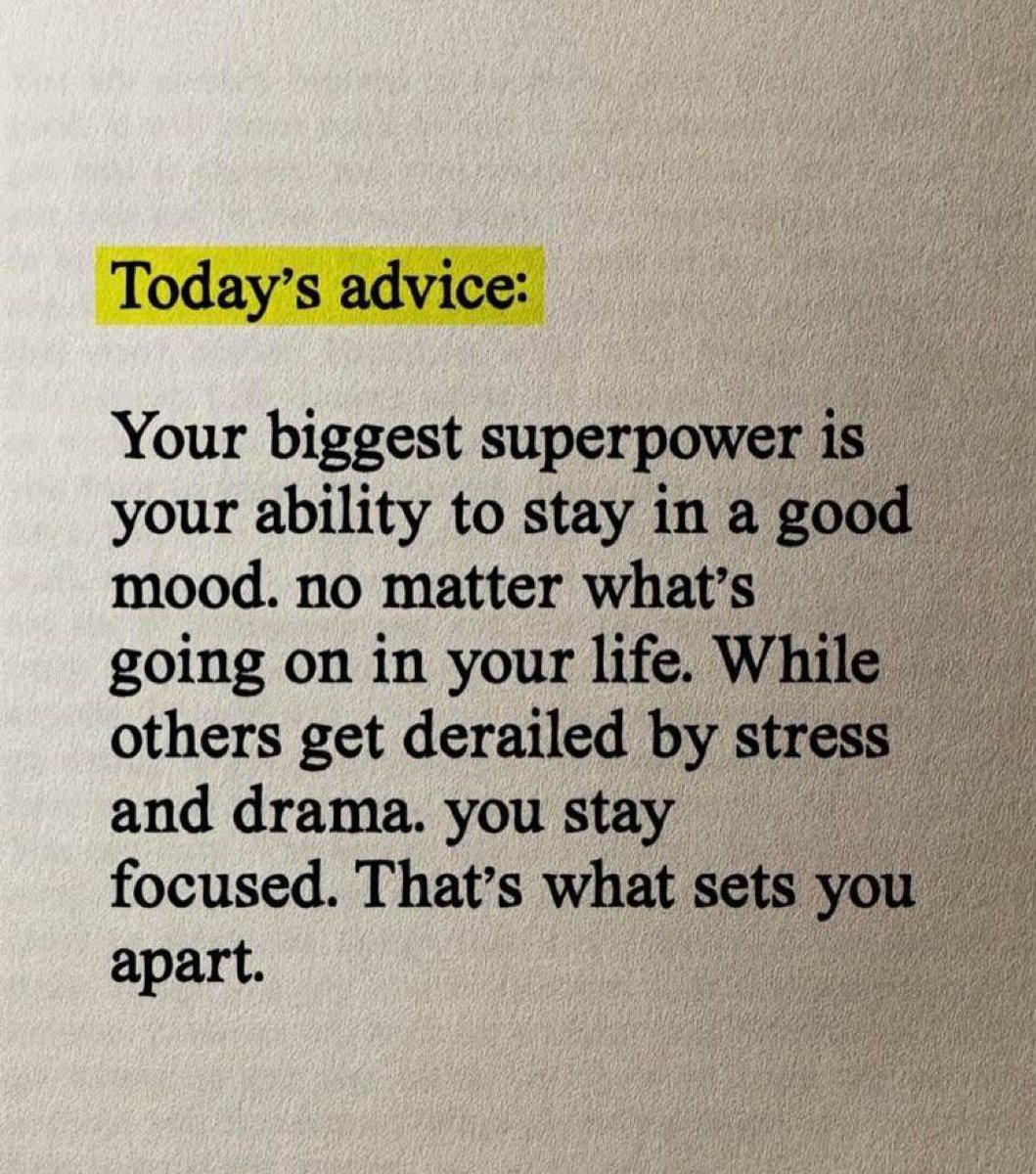
Your biggest superpower isn’t talent, intelligence, or luck, it’s your ability to stay in a good mood no matter what’s happening around you.
When others get caught up in stress, chaos, or drama, you choose calm. You stay focused, composed, and grounded.
That’s what separates leaders from the rest.
✨ Protect your energy.
✨ Guard your peace.
✨ Keep showing up with a clear mind and a good heart, that’s your true edge.
The world’s busiest ports tell us where global trade is heading.
Shanghai leads with 55.1 million TEUs, followed by Singapore at 44.7 million and Ningbo-Zhoushan at 43.9 million.
China’s dominance is clear, but Southeast Asia deserves attention. Port Klang and the Ports of Johor each handled 15.1 million TEUs, highlighting Malaysia’s growing importance in global supply chains.
Ports aren’t just moving containers. They’re shaping trade routes, manufacturing decisions and economic power.
As global supply chains evolve, the countries that connect the world efficiently will have a serious competitive advantage.
The American auto industry in the 70s and 80s didn’t lose on engineering. It lost on headcount.
Elon told this old joke on Rogan:
Japanese boat: eight people rowing, one steering.
American boat: one person rowing, eight steering.
They lose. Fire the rower.
That was Detroit. It’s also most companies now. Layers of people who want to decide, not enough people who just want to finish. Meetings pile up, the work slows, and the last person still doing something gets blamed.
The ones who actually row are usually the ones who end up gone.
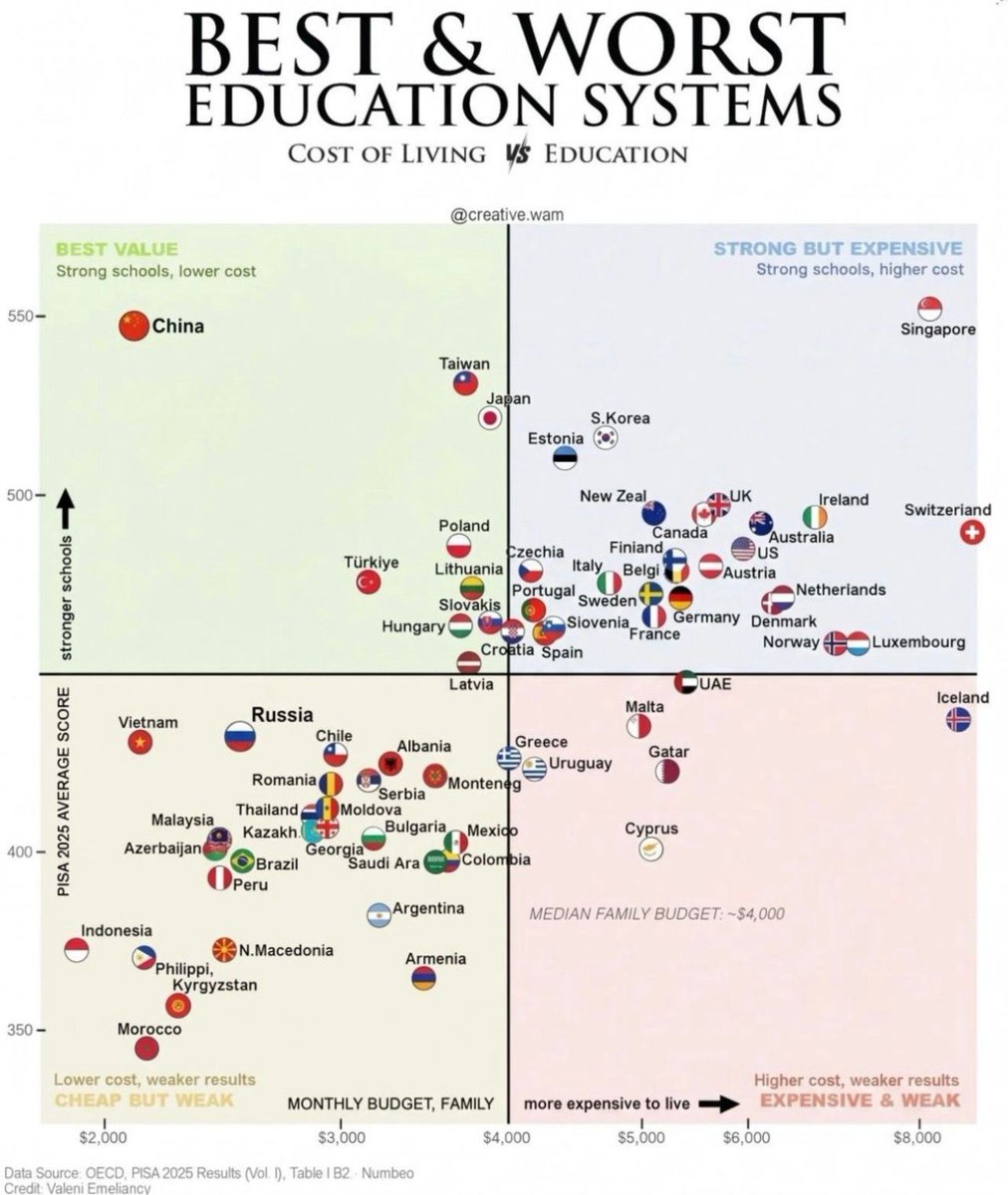
AI could make quality education accessible to everyone.
This chart highlights a global challenge: better education often comes at a higher cost, while affordability doesn’t always guarantee better outcomes.
AI could change the equation with personalised tutors, adaptive learning, and tools that help teachers do more.
The real opportunity isn’t to replace teachers. It’s to make better learning accessible to more people.
At 10xme, we believe the same principle applies beyond education: AI should be practical, accessible, and powerful enough to multiply human potential.
The future belongs to those who know how to work with AI, not just use it.
🚀 Learn to make AI that actually works for you.
👉 https://t.co/w94e8fUB3v
The clearest explanation I’ve seen of the difference between prediction markets and sportsbooks.
Amazing how much of the media still fails to understand the basic mechanics.
My parents paid $16,000 for the house I grew up in. It’s now worth $783,000 on Zillow.
Sounds like they made a fortune, right?
In gold terms, that house cost 450 ounces in 1962. At today’s gold price, it’s worth 250 ounces.
The house actually lost value.
Politicians get away with robbing working class people blind because most people don’t realize their nominal gains aren’t real gains.
They think they’re inflation-adjusted rich, but they’re not.
I don’t think people realize what Elon Musk is actually doing.
He’s not playing the game better than everyone else. He’s rewriting the rules of the game.
Every billionaire before him was offered the same deal: money for aura, silence for respectability. They all took it. He walked out.
I made a 4-minute video on the machine he’s fighting. Watch it before it gets buried.
Tesla has officially confirmed today that the Tesla board of directors has “formed a special committee to explore deepening Tesla’s relationship with @SpaceX, which could be through certain arrangements including without limitation a business combination.”
This is via Tesla’s new 10-Q filing with the SEC.
The biggest industrial irony in one photo.
Left: Oliver Blume, CEO of VW.
Right: Wan Gang, the man China calls the "Father of EVs."
In the 90s, Wan spent 11 years as an engineer at Audi. In 2000, he went back to Beijing and told the State Council: "We will never catch Germany on ICE. So let's change the game.”
He became Minister of Science and Technology and architected China's entire EV push.
Result in Q3 2025:
VW China sales: -38.5% to 405k
cars
The biggest drop since Covid.
The student didn't just beat the teacher, he rewrote the whole exam.
Credit : Philipp Raasch
Apple’s iPhone story in India is a plus and a minus.
FY26 production: $26 billion
Exports: $21.5 billion
Component imports: $22.3 billion
Electronics PLI incentives: ₹19,090 crore
Jobs generated: 1.67 lakh
The plus: jobs, exports, technology transfer and global supply-chain integration.
The minus: heavy subsidies, imported components and limited domestic value addition.
It will really make sense now to move from assembling iPhones to designing, engineering and inventing the technology inside them.