Anyone else feeling wrung out by relentless low-level student jackassery at the moment? I am so sick of the clicking, snapping, flicking, leaking, exploding, daubing, tattooing, flapping, slapping, whacking ‘n twanging. Not to mention the leaning, swinging, dangling and lolling.
Highly appreciative of the TFL worker this morning at Paddington SCHOOLING on good tube etiquette.
“I don’t want see you boarding before people have come off the tube you are getting on. That makes no sense”
“Get those backpacks off before you get on a crowded carriage everyone”
I taught remotely in covid and this is what I know.
We were *desperate* to get back into a classroom. All of us. Kids, teachers. We would wear any ridiculous mask to do it. We would stand on one leg if that was the rule.
This makes me sceptical that screens will replace teachers anytime soon.
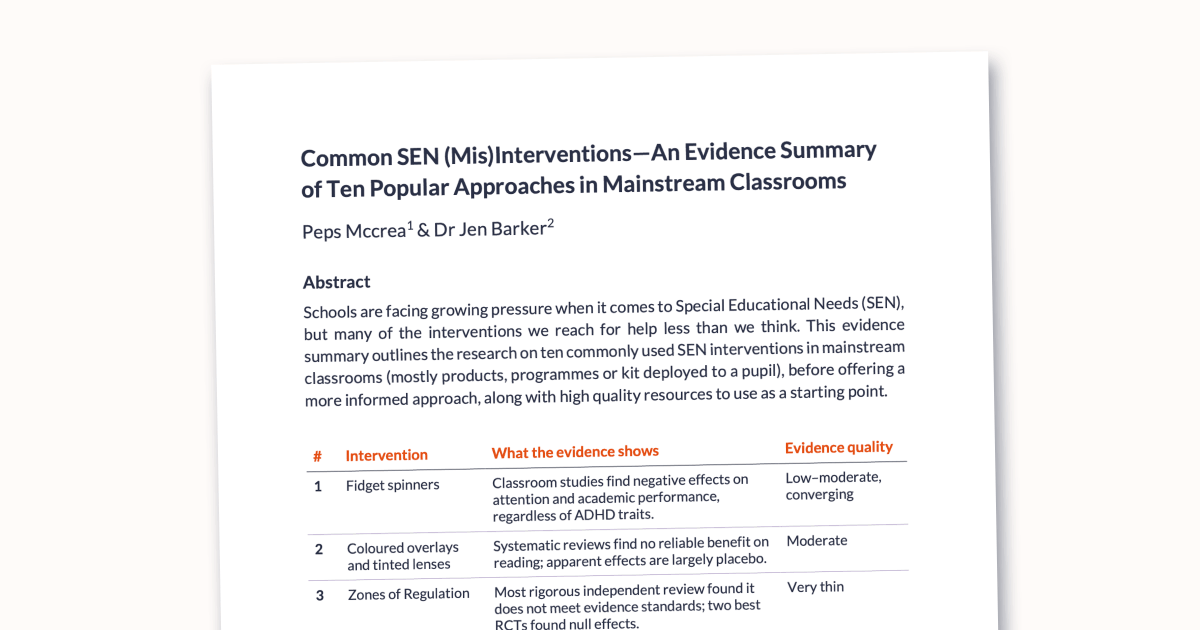
🚨New paper released today:
10 Common SEN Mis(Interventions)—An Evidence Summary
https://t.co/8lQNH00Co4
Supporting students with Special Educational Needs (SEN) is a vital and growing challenge for schools. But it’s not straightforward. Learning is complex, marketing claims are confident, and the evidence is often hard to access. As a result, we can sometimes end up adopting approaches which are less effective than we initially think.
For some, this may well be uncomfortable reading. As a profession, many of us have put time, effort and belief into these things, and lots will have seen students who looked like they were getting something from it. However, it’s essential that we temper our intuition with evidence, because ultimately: our most vulnerable students deserve it.
This new paper co-authored with @Barker_J is an attempt to raise the visibility of the best available evidence around several commonly used SEN interventions. For each, we provide an overview of what the research says, offer a more informed approach, and provide a suite of rigorous links to help you get started.
We hope it will serve as a useful resource and over time: push us to be even more 'evidence demanding' as a profession.
As ever, let me know what you think. If you have pushes or suggestions for how this paper could be better, hit reply and give it to me straight.
👊
I am a man just into his forties who always dreamed of having a convertible. Last year that became a reality, but I usually drive it with the roof up as I don't want everyone to hear me listening to my audiobook.
Literacy across the curriculum is not about every teacher becoming an English teacher.
It is about every teacher recognising that pupils cannot think deeply in a subject if they cannot access its language.
People working in schools are often going full tilt, constantly busy, always stimulated by their environment. I'm increasingly aware of this as a problem around three limitations that affect everyone:
a) Cognitive bandwidth- you can only think about so many things at once
b) Chronological bandwidth- your time is finite, and only so much can be done
c) Emotional bandwidth- you can only care about so much at once
Overloading any one of these three leads to that sinking sense of helplessness, stress, and being overwhelmed. We often conflate all of these as workload, but that collapses too many things into one. I also think that they play off against each other. Lack of time affects what you can think about; but having to juggle too many relationships can also exhaust what you can get done, etc.
Is study leave fair?
When I worked in middle class schools, Year 11 and 13 were gone from more or less the first week after Easter. By this point in the year, I probably would have had over 20 hours of "gain time" already.
I could have spent that time developing our curriculum, observing others, reading, arriving a bit later, leaving a bit earlier. Having a more relaxed time in lunch and break.
Now, I work in a school where we don't do that. Year 11 are in till the last exam. Year 13 are in till the last exam. The pace doesn't change, in fact it accelerates in this critical pre-exam period. And then, when they're gone, it'll be end of years for everyone else, and I won't have that nice relaxing time to catch up on all the jobs I never had time to do.
This, surely, is a systemic inequality. Schools with "study leave" already have a lot of perks, and get to offer their staff something that schools serving a poorer demographic don't. That doesn't seem fair to me.
Hi all,
Due to the increased workload caused by the 4 extra Year 11 GCSE mock exams, we have decided that it would be unfair to go ahead with Monday’s three hour twilight CPD. We have therefore, taken the decision to move it to Wednesday evening instead. #staffwellbeing
Thanks x