In DeFi, disruption creates simplicity.
Uniswap's x*y=k is minimal.
Even as the genius @haydenzadams perfects it, to users, it remains simply "swap."
Bitcoin is technically vast—miners, pools, Proof of Work, hashing algorithms...
yet 99% of users "buy and hold."
Greatness is simple.
AlwaysWin honors this legacy with:
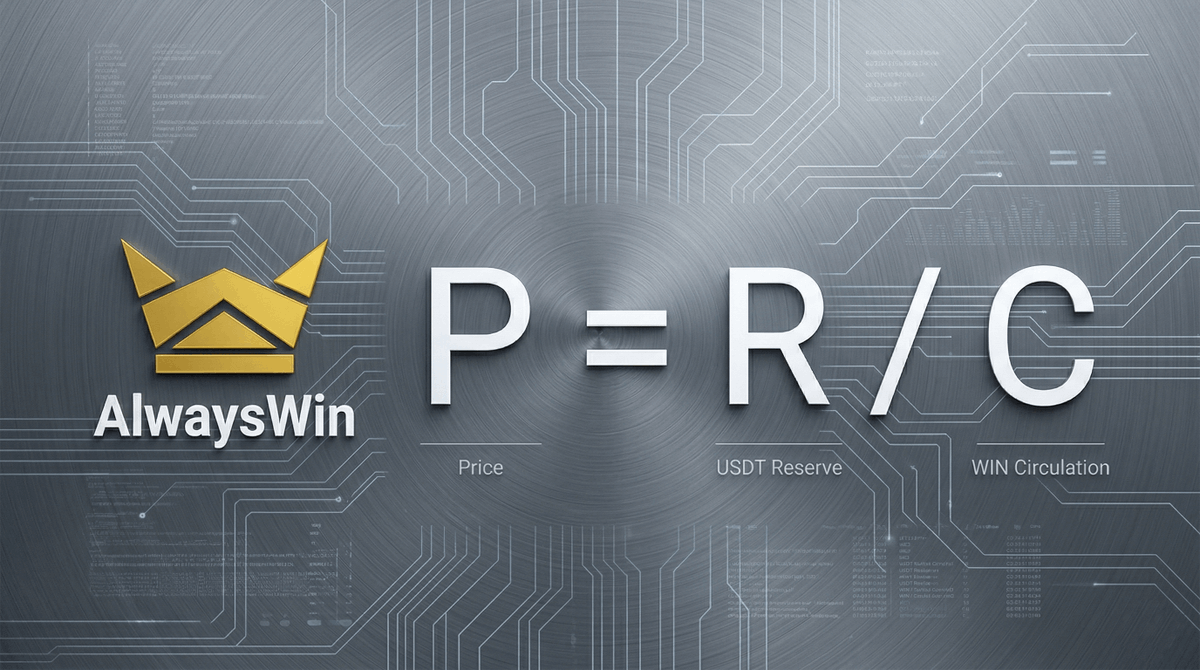
P=R/C (Price = Reserve / Circulation)
Lighter burned 6.3% of LIT supply on Friday. Token jumped 16%.
Market is screaming the obvious: burns work.
But LIT's was a one-time quarterly event. WIN burns up to 0.35% on every single trade — buying and selling.
No team decision required.
No governance vote.
Just math, running 24/7.
What happens when burn isn't an event
it's the protocol itself?
BONK DAO just lost $20M because one wallet bought enough votes to drain the treasury.
No code was hacked. The governance worked exactly as designed.
This is why AlwaysWin has no admin key, no treasury vote, and immutable smart contracts.
Trust the code. Not the committee.
AI isn't killing crypto. It's filtering it.
Bitcoin isn't competing with Nvidia. Stablecoins aren't competing with data centers. DeFi clearing isn't competing with AI copilots.
The projects that die in this environment were always going to die. AI just accelerated the timeline.
What's left standing after the capital rotation is what crypto was always supposed to be.
AI data center power usage is growing 50% year over year. IEA projects global data center electricity demand could hit 945 TWh by 2030. Nearly double today's levels.
That's where institutional capital is going. Real revenue. Real infrastructure. Real government support.
So yes, AI is pulling money away from crypto. But not the money you think.
What's leaving: speculative capital that used to rotate into altcoins because there was nothing better to bet on. Now there is.
What's staying: demand for non-sovereign assets, borderless settlement, permissionless finance, and speculative liquidity that traditional markets can't absorb.
AI wins the productivity race. Crypto wins the ownership race. They were never running on the same track.
What if meme season never feels satisfying again?
Not because it stops happening. It won't. There will always be another dog, another frog, another AI-themed coin that does 500x in a weekend.
The problem isn't the opportunity disappearing. It's the window shrinking.
2021 memes gave you weeks to enter and still profit. 2024 gave you days. The next cycle might give you minutes. And every cycle, the tooling gets sharper, the bots get faster, and the gap between "informed insider" and "regular participant" gets wider.
We keep celebrating meme culture like it's democratizing finance. But look at the actual distribution of returns. A smaller group is winning bigger. A larger group is funding those wins.
That's not a casino. At least casinos publish the odds.
Maybe the move isn't to get faster at a game that's designed to make you slower than the person who set it up. Maybe it's to find a different game entirely.
Your idea won't save you.
Every founder in crypto thinks they have the concept that changes everything. Most of them are right. The idea usually is good.
But ideas are just the opening sentence of a very long book. The chapters that matter are the ones nobody sees. The months spent breaking your own model before someone else does. The refusal to ship until the math actually holds. The decision to keep going when the market doesn't care yet.
AI can now generate a thousand ideas before lunch. Codex can scaffold a protocol by dinner.
So what's left that's hard?
Turning a concept into an engineered system that doesn't break under pressure. And then defending it, improving it, and showing up for it when there's no audience.
The future doesn't belong to people with ideas. It belongs to people who won't stop until the idea works.
You can write Bitcoin's entire genesis codebase in under 10 months.
14,000 lines. One developer. Straightforward C++.
So why did Satoshi start 18 months before launch?
Because coding is the cheapest part of building something that actually works.
The first reference in the Bitcoin whitepaper is a concept from 1998. Wei Dai's b-money. The gap between that idea and a working protocol was ten years. Not because the code was hard, but because the design problem was unsolved.
How do you align the incentives of every participant in a decentralized system so that no single actor can win by making others lose?
That question took a decade. The code took months.
And even after genesis, the market needed four years just to price Bitcoin at $100.
We hear the same thing about AlwaysWin: "This could've been built in weeks."
You're right. The code could have. But the code was never the product.
In an era where AI can generate a thousand tokens a day, the only scarce resource left is correct design. An economic architecture that survives contact with human nature.
That's what took the time. That's what always takes the time.
"Much more of the work was designing than coding."
— Satoshi Nakamoto
Fear & Greed Index at 12.
Funny how the market only asks "is crypto dead" when the people who were never building anything stop pretending they were.
The builders didn't leave.
They just got quieter.
That's actually bullish.
Unpopular opinion:
The next crypto breakthrough won't be a faster chain or a new L2.
It'll be a protocol where the guy who buys after you isn't your victim.
The World Cup. Every 4 years.
The Olympics. Every 4 years.
The U.S. presidential election. Every 4 years.
Bitcoin's halving. Every 4 years.
There's something about 4-year cycles.
They're long enough to build something real.
Short enough that your portfolio still hasn't made it back to where it started.
We started building AlwaysWin in 2022.
No VC. No payroll.
Just contributors across multiple time zones who believed a DeFi protocol could be designed where the token's price floor only goes up — by math, not marketing.
The best protocols in crypto history were built in the silence between cycles.
Not during the mania.
Not during the crash.
In the quiet after, when only the people who actually understand what they're looking at are still paying attention.
That's now.
AlwaysWin is preparing to launch.
Before we do, we're assembling a small group of global contributors. Not followers. Not investors. Builders and leaders who can see what a rising-floor token economy means before the rest of the market figures it out.
If you've survived a full cycle and you still believe DeFi can be built differently, you might be exactly who we're looking for.
Whitepaper in bio.
Read it.
If it changes how you think about tokenomics, reach out.
"Fully backed" in most projects means
"until the team unlocks."
Fully backed in AlwaysWin means
every $WIN in circulation has $USDT sitting behind it in the reserve and the ratio only improves because every trade burns supply.
No unlock schedule.
No trust required.
Just P = R / C.