JEREMY ALLAIRE: THE 2030s COULD REDEFINE HUMAN SOCIETY
He is 30-year pioneer across multiple waves of the internet and technology, believes AI is pushing humanity toward a new era of economic growth.
- AI diffusion is accelerating worldwide.
- We're entering a global renegotiation of the social contract.
- He believes the productivity gains from AI could be so significant that:
- Double-digit GDP growth in the 2030s is achievable across large parts of the world easily.
- Entire industries could experience discontinuous jumps in productive output.
- New AI-native and on-chain organizations may become the most productive institutions in economic history.
- The remaining barriers are increasingly bureaucratic, legal, and institutional rather than technical.
- AI agents, crypto networks, and on-chain organizations could create entirely new forms of economic coordination.
- Allaire compares today's transition to transformative periods such as the Enlightenment and the Industrial Revolution, when society developed entirely new social and economic systems.
"The biggest opportunity isn't just smarter AI."
It's creating new institutions that allow more people to participate in and benefit from the prosperity AI creates.
Industrial Revolution transformed how we work. AI Revolution will transform how society itself is organized.
This is an important breakthrough for computational biology.
Researchers at the Shanghai Institute of Organic Chemistry developed Void-X, a generative AI model that predicts protein interactions at the atomic level.
Unlike conventional protein design approaches that work from the top down, Void-X takes a bottom-up approach. The model learns how atoms pack together inside proteins and generates missing atomic structures by filling microscopic "voids" in protein interfaces.
It's trained on more than 8 million atomic clusters, Void-X achieved 78.3% accuracy on intra-chain structures and 68.2% accuracy on inter-chain protein interactions.
The significance is bigger than the numbers guys 👀
Many drugs, antibodies, biological enzymes, and other protein-based therapies depend on precise atomic interactions between proteins.
By learning these interactions directly, AI could help scientists design new therapeutics with greater speed and precision.
welcome to the fastest accelerating SciTech Era 🫡♥️!
This is insane.
For decades, developing hypersonic systems meant years of simulations, testing and engineering iterations.
This changes the pace entirely.
U.S. Air Force just unveiled Flyer, a next generation supercomputer built to accelerate hypersonic, aerospace and AI research.
"Flyer features approximately 186,000 processor cores, 800 TB of RAM, 18 PB of storage and delivers around 8.7 petaflops of computing performance."
"AFRL says the system can solve computational problems in a single day that would take a typical laptop roughly 500 years to complete."
Researchers will use Flyer for advanced computational fluid dynamics, hypersonic vehicle simulations, AI workloads, digital engineering and next generation defense research.
This is big. Breakthrough!
For decades, optical computing has promised a future where AI runs on light instead of electricity.
But one of its biggest challenges wasn't performance or hardware.
It was accessibility. But now.. a big news come arround it!
Chinese researchers just introduced a Digital Twin Optical Computing System (DT-OCS), a high-fidelity virtual replica of a real optical computer 👀
"The team developed a differentiable digital twin that accurately mirrors physical optical computing hardware, allowing systems to be trained and optimized entirely in software."
"Parameters optimized in the virtual DT-OCS transferred directly to a real silicon photonic computing platform, with experimental results closely matching simulation predictions."
The researchers validated the approach on image-classification and sequential decision-making tasks using a high-speed optical computing system and a silicon photonic feature computing chip.
Instead of waiting for access to costly photonic hardware, researchers could develop, test and refine optical AI systems virtually before deploying them to real machines.
If GPUs got their boost from software ecosystems like CUDA, optical computing may have just received something similar.
The future won't just have digital twins for factories and robots. It will have digital twins for computers themselves.
Acceleration is everywhere!
In this scitech era, compute is becoming the new capital.
Tokens are turning into a second layer of power, because they are the fuel for intelligence.
Now, companies are not just paying for effort anymore, they are measuring how much intelligence you can deploy.
AI usage itself is becoming economic value.
And people won’t just be judged by what they produce, but by how well they use intelligence to create it.
Money still handles the basics, but access to tokens at scale is the real multiplier in this era!
Wow
Perplexity just launches brain: a self-improving memory system for AI agents 👀
Perplexity has introduced Brain, a new memory architecture for its Computer AI agent that learns from completed tasks and workflows.
Brain learns from completed Al workflows, allowing the agent to start each new task with a deeper understanding of the user's projects, sources, and past decisions.
Instead of simply storing preferences, Brain logs user actions into a Context Graph and builds a personal LLM Wiki, creating a growing knowledge base that improves over time.
According to Perplexity, Brain improved answer accuracy by 25% and recall by 16% in internal testing.
We're entering the era of AI agents that don't just remember.. they learn from experience.
BIG ENERGY BREAKTHROUGH PROGRESS:
Bill Gates-backed TerraPower just took its next generation Natrium nuclear reactor to the UK.
Natrium combines a 345 MW sodium-cooled fast reactor with molten salt energy storage, allowing it to boost output to 500 MW when demand spikes.
Unlike traditional nuclear plants, Natrium can store energy and release it later. The system can deliver 500 MW of electricity for more than 5.5 hours using its integrated energy storage system.
TerraPower has launched TerraPower UK and entered Step 1 of the UK's GDA regulatory process, marking a major milestone for the technology.
Meanwhile, the first commercial Natrium plant is already under development in Kemmerer, Wyoming.
If successful, Natrium could help provide flexible, carbon-free power for future AI data centers, industry and renewable powered grids.
This is insane.
For the first time ever, 8 Codex AutoResearch agents brought a robot fleet to life, achieving end-to-end success on real-world tasks with NO HUMAN BRIDGE in between.
"NVIDIA's ENPIRE framework enables AI agents to analyze failures, rewrite code, retrain policies, read research papers, and launch new experiments autonomously."
"This system was powered by 8 Codex-based agents operating across a fleet of real robots."
"ENPIRE successfully learned challenging tasks including GPU installation, pin organization, zip-tie cutting, and Push-T manipulation."
"In one demonstration, robots learned to precisely insert a GPU into a motherboard with millimeter-level accuracy."
"The framework achieved up to 99% success rates through continuous self-improvement on real hardware."
"Researchers also discovered a new form of physical scaling, where larger robot fleets generate more real-world experience and accelerate learning."
"Instead of humans running the robotics research loop, AI agents can now perform much of the cycle themselves."
🚨 SCIENTISTS JUST CREATED INFRARED-GUIDED NANOROBOTS FOR PRECISE DRUG DELIVERY
Researchers developed NIR-IIb magnetic nanorobots that can be tracked and steered inside living bodies using fluorescence at ~1600 nm, creating a real-time "GPS-like" navigation system for medicine.
The nanorobots were successfully navigated through the liver, spleen, hindlimb, peritoneal cavity and lower gastrointestinal tract of live mice using external magnetic fields.
Loaded with the anti-inflammatory drug 5-aminosalicylic acid (5-ASA), the nanorobots remained stable in simulated pH 2 gastric fluid for over two weeks and achieved 100× faster locomotion with 30% higher drug delivery efficiency than previous approaches.
A step toward a future where doctors can guide treatments directly to diseased tissue instead of flooding the entire body with drugs.
One day, a child born on Mars will study Earth the way we study ancient Rome.. as the place where humanity first learned to dream beyond its horizon.
And that future is arriving faster than ever in this SciTech Era. 🫡♥️"
Longevity-related progress
"Scientists just analyzed more than 7,000 blood proteins from 60,542 people and discovered that different cell types throughout the body can age at completely different speeds."
"The team built AI-powered aging clocks for over 40 cell types, including neurons, astrocytes, immune cells, and endothelial cells, using nothing more than a blood sample."
"They found that accelerated aging of specific cells, particularly brain astrocytes and certain immune cells, was linked to higher risks of diseases such as Alzheimer's and increased mortality."
The future of aging medicine may not be measuring one biological age.
It may be identifying exactly which cells in your body are aging fastest years before disease appears.
We're moving toward a future where a simple blood test could reveal whether your brain, immune system, heart, or other tissues are aging faster than the rest of your body.
Aging is not one clock. Bro!
NVIDIA CEO JENSEN HUANG: we're near the "CHATGPT MOMENT" for biology.
- Physical AI is already a nearly $10 billion-per-year business for NVIDIA and growing exponentially.
- Jensen says Physical AI could transform a $50 trillion industry that has remained largely untouched by advanced technology.
- He believes Digital Biology is now approaching its own "ChatGPT moment."
- Jensen predicts Digital Biology could begin its major inflection point within the next 2-5 years.
- Huang said we're approaching a breakthrough where AI can understand the fundamental building blocks of life itself.
- AI is learning how to represent genes, understand chemicals and model the dynamics of biology.
He also highlighted Agriculture as another field already entering a powerful AI-driven transformation.
Just as ChatGPT made AI accessible to everyone, Digital Biology could help scientists design new medicines, engineer better crops, and unlock a deeper understanding of human health.
We're beginning to teach machines the language of life itself.
Wow. This seems big
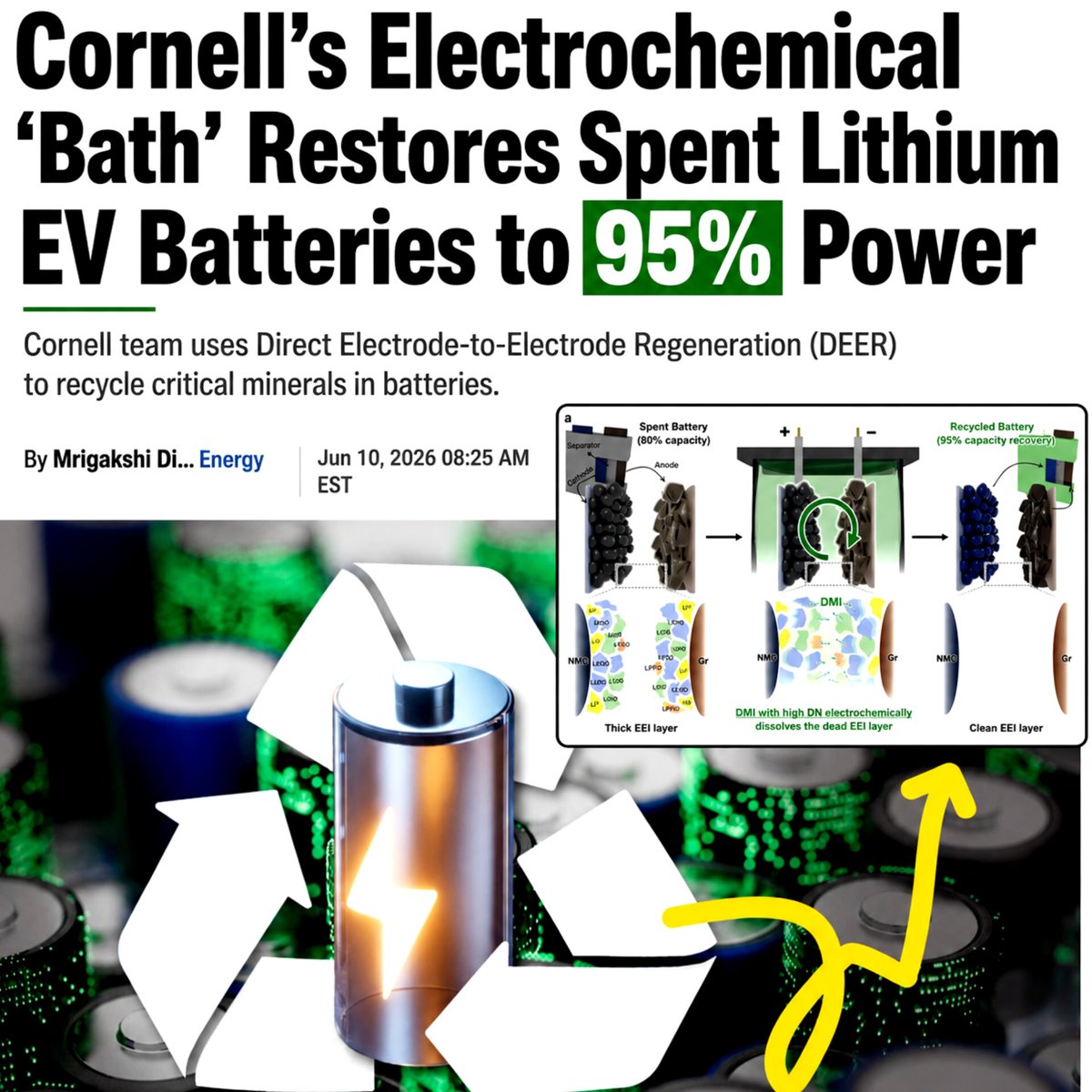
Scientists just found a way to revive "dead" EV batteries to 95% of their original performance.
Researchers developed a new recycling method called DEER that restores spent lithium-ion batteries instead of shredding or melting them.
The team used a special solvent called 1,3-Dimethyl-2-imidazolidinone (DMI) to dissolve the degraded Electrode-Electrolyte Interphase (EEI), a chemical layer that builds up inside batteries and reduces performance.
In laboratory tests, regenerated electrodes recovered up to 95% of their original capacity while reducing recycled-cell manufacturing costs by 56% compared to conventional recycling methods.
Rather than destroying batteries to recover raw materials, DEER directly repairs and reuses existing electrodes, creating a faster and more efficient recycling pathway.
We're moving from recycling batteries.. to regenerating them.
Scientists just disabled a single gene and erased 100% of colon tumors in mice 👀
Scientists identified NOTUM, a gene that helps microsatellite stable (MSS) colorectal cancer hide from the immune system. MSS tumors account for about 85% of colorectal cancer cases and are often resistant to immunotherapy.
When researchers deleted the NOTUM gene in mouse models, tumors became visible to immune cells again. The most remarkable result came when NOTUM deletion was combined with immunotherapy, achieving 100% tumor eradication in mice.
This is particularly significant because only about 15% of colon cancers currently respond to immunotherapy.
We are living through an important phase of scientific revolution ♥️🚀
Doctors just implanted the first long term wireless BCIs from Paradromics into a patient with motor neuron disease.
"The device, called Connexus®, contains 421 brain-penetrating microwire electrodes that record neural activity associated with speech."
"The system is designed to decode intended speech directly from brain signals and convert thoughts into text, synthesized voice or computer commands."
This implantation marks the start of the Connect-One clinical trial, which will evaluate the safety and effectiveness of restoring communication in people who can no longer speak.
Wow. This is huge.
Researchers from UC Berkeley, NVIDIA and Stanford introduced T-Rex, a framework that combines vision, language and touch so robots can react to physical contact in real time instead of relying on vision alone.
This system is trained on a 100-hour tactile-synchronized dataset spanning 200+ everyday objects and 22 motor primitives, teaching robots how to feel and manipulate the physical world.
Across 12 contact-rich manipulation tasks, T-Rex achieved over 30% higher average success rates than the strongest baseline models.
Wow. This is HUGE
A copper-based drug reduced toxic Alzheimer's proteins by 42% and improved memory by 44% in preclinical study.
"Scientists used a compound called Cu(ATSM) to repair the brain's natural waste-clearance system rather than directly targeting amyloid plaques."
"The treatment restored levels of P-glycoprotein (P-gp), a key transporter that helps remove toxic amyloid-beta proteins from the brain."
"After 56 days of treatment, P-gp abundance increased by 24.1%, helping the brain clear harmful protein buildup more effectively."
"This therapy reduced amyloid-beta (Aβ42) accumulation in the brain by 42.1% in a widely used Alzheimer's mouse model."
"Researchers also observed a 229.8% increase in copper levels within brain microvessels, suggesting improved blood-brain barrier function."
"Most importantly, treated mice showed a 43.8% improvement in learning and long-term spatial memory."
"Unlike many Alzheimer's therapies that focus on removing plaques directly, Cu(ATSM) aims to restore the brain's own waste-removal machinery."
"The findings suggest Alzheimer's may be partly a failure of protein clearance, opening a new therapeutic pathway beyond traditional anti-amyloid approaches."
"While the results were observed in mice and still require human clinical trials"
But this study showed a promising strategy for slowing or potentially reversing key aspects of Alzheimer's pathology 👀!
A new hair-loss pill could become one of the biggest breakthroughs in hair restoration in decades.
"Veradermics' extended-release oral minoxidil pill (VDPHL01) increased hair density by up to 33 hairs/cm² in a Phase 2/3 trial involving 519 men with male pattern hair loss."
"Researchers observed significant hair regrowth by Month 2, with improvements continuing throughout the 6-month study."
"By the end of the trial, 86% of participants taking VDPHL01 twice daily reported visible improvement, while no treatment-related serious adverse events or cardiac safety signals were observed."
If upcoming Phase 3 trials confirm these results, VDPHL01 could become the first FDA-approved oral hair-loss treatment in nearly 30 years.