Bitcoin ETFs saw record weekly outflows of approximately $1.79 billion, signaling a marked cooling in institutional demand and increased short-term selling pressure; however, this could represent either a sign of an approaching "capitulation phase" or merely a mid-trend correction. Whether a market bottom has been reached hinges on whether outflows slow and prices stabilize—a bottom has not yet been confirmed.
Bitcoin's current rally is primarily driven by leveraged capital, while spot buying remains weak, creating a distinct structural divergence; historically, such conditions often signal short-term market instability and a susceptibility to rapid pullbacks. Unless spot demand rebounds, the sustainability of the current uptrend will be called into question, and overall market sentiment remains cautious.
XRP has fallen below the critical $1.05 support level, while Bitcoin has also retreated below $59,000, signaling that the broader market has entered a phase of structural correction characterized by weakness. XRP has moved out of the high-volume $1.20–$1.90 zone, and its technical structure is weakening; the MACD is nearing a bearish crossover, indicating intensifying downward momentum. Regarding liquidity structure, the $0.88–$0.75 range below is characterized by thin trading volume—a potential "volume gap"—meaning that if the price enters this zone, a lack of buying support could trigger accelerated volatility. In the short term, the key factor is whether the price can reclaim the $1.05 level; failure to do so would maintain the bearish outlook, with stronger support levels situated at $0.88 or even extending down to $0.75. Overall, the market is currently in a phase defined by broken support, shifting liquidity, and a weak macro backdrop, with market direction awaiting confirmation at critical price levels.
After reclaiming liquidity from the lows during a pullback, Bitcoin is currently attempting to stabilize above $59,000. If this support level holds, the short-term market structure will lean toward recovery, potentially extending the rebound. A key upside target lies within the 4-hour FVG zone (approximately $62,900–$63,800), which will serve as the primary area of resistance and a critical test zone for the next phase. Overall, the market is currently in a "rebound and recovery phase following support confirmation," with future direction contingent on whether the $59,000 level remains firm.
After a pullback, Bitcoin has rebounded from its lows and is currently attempting to stabilize above the $59,000 level. Short-term market structure indicates a corrective phase; if this support holds, the rebound is likely to extend. A key upside target lies within the 4-hour FVG (Fair Value Gap) zone of approximately $62,900–$63,800, which will serve as a primary test area should momentum persist. Overall, BTC is currently in a "rebound and recovery phase following support confirmation," with its short-term direction contingent on the $59,000 level remaining firm.
XRP (currently trading around $1.03) is not only in a downtrend, but—more crucially—the quality of its rebounds is clearly deteriorating. Both the 30-day Sharpe ratio and Z-score are negative, indicating weak risk-adjusted performance where the volatility risk borne by traders has not yielded commensurate returns; meanwhile, the 7-day momentum is also negative, signaling a lack of sustainability in short-term rebounds. The overall market structure is characterized by "feeble rebounds, weakening momentum, and a lack of consensus on sentiment"; the market is neither gripped by extreme panic nor showing clear signs of undervaluation, but is instead caught in a typical range of uncertainty and fluctuation. Historically, such phases tend to persist for extended periods, yet they can also serve as a critical sentiment inflection point preceding the launch of the next major trend.
XRP continues to pull back after failing to break through the critical resistance zone of $1.85–$2.50; the weekly chart reveals a pattern of lower highs, with the price gradually approaching the long-term ascending trendline—a level that remains the core defense for the bullish structure. In the short term, the $1.45–$1.55 range has become a key resistance area; a breakdown below the trendline and a failure to hold support could trigger an accelerated decline toward the $0.85, $0.65, or even $0.50 levels. Conversely, if the price reclaims the $1.55 mark on the weekly chart, the bearish outlook would weaken, potentially reopening the path to $1.85. Overall, XRP is at a critical juncture—a battle between long-term trend support and cyclical pullback pressure—with its future direction hinging on whether the trendline holds.
BTC is currently consolidating around the $61,700 level, having reclaimed the critical $60,000 zone following a liquidity sweep during the prior decline. If the price can sustain its position above $60,000, the short-term structure may shift to the upside, gradually testing the liquidity target at $65,600; however, a drop back below $60,000 could see the asset return to a range-bound state or face renewed downward pressure.
BTC experienced significant volatility on the day PCE data was released; after briefly dipping to $59,000, it rebounded rapidly—showing a 24-hour price swing exceeding $4,000—as the market entered a high-volatility state driven by macroeconomic data and institutional portfolio adjustments. Currently trading around $61,500, the short-term price action is shaped by a combination of ETF capital flows, options expirations, and macroeconomic interest rate expectations, with the market clearly leaning toward a defensive stance and a phase of price recalibration. Although the price quickly recovered after briefly breaching key support levels (such as the area near the 200-week moving average), the sustainability of the short-term rebound remains in doubt due to persistent divergence in ETF flows and mounting pressure from upcoming options expirations. The June 26 options expiration and shifts in macroeconomic data will serve as critical milestones in determining whether the market has truly stabilized or is poised for a deeper correction.
The total global cryptocurrency market capitalization has retreated to approximately $3.2 trillion, with the market remaining under pressure due to tightening liquidity and macroeconomic headwinds. While BTC continues to consolidate near the key pivot level of $62,500—maintaining its dominant market position—this consolidation has exposed structural weakness across the altcoin sector. Major assets such as ETH, XRP, and BNB have generally pulled back to recent lows, reflecting a marked decline in market risk appetite. Current price discovery is driven more by order book depth and derivatives structures than by retail investor sentiment. Rising demand for downside hedging in the options market indicates that the market remains in a defensive posture. Overall, crypto assets are undergoing a liquidity-driven repricing cycle; beyond short-term volatility, the critical factors at play are the macroeconomic funding environment and the rebalancing of risk appetite.
Following a breakout above a key resistance zone and a subsequent retest to confirm the move, XRP’s price structure shows signs of further strengthening, suggesting the market may be entering a phase of price discovery. If the bulls can successfully hold the breakout zone and maintain liquidity support, it could pave the way for a move into a higher price range. The current structure reflects a "breakout and retest" pattern, with short-term sentiment clearly shifting toward a bullish extension.
Ripple has achieved a significant regulatory breakthrough in Europe, receiving preliminary approval for a major crypto payment license from Luxembourg. Combined with its EMI license, this allows it to provide collection, exchange, and payment services to banks, fintech companies, and businesses in 30 European Economic Area countries, marking a crucial step towards overall business compliance. However, market sentiment is not entirely optimistic, especially as XRP holders remain focused on a core issue: whether these payment flows will actually utilize XRP. While Ripple emphasizes the interoperability of XRP and RLUSD, if European settlements are primarily completed through the stablecoin RLUSD, XRP's actual participation in value capture remains to be seen.
BTC continues to be under pressure in the current range, with $62,200 and $61,000 becoming key short-term levels to watch. A significant price reaction is expected when the price touches these areas, and the market may choose its next direction around this support range.
Bitcoin's current price movement is seen as potentially replicating the cyclical structure of gold in the 1970s: an initial surge and emotional peak, followed by a period of pullback or even a significant drop as a "reset," before entering the main upward wave. Similar to gold's rapid rise followed by a nearly 50% pullback in the 1970s before entering a long-term parabolic trend, some analysts believe that BTC may also experience a short-term decline or consolidation before initiating a larger upward cycle.
XRP whales have increased their holdings by 1.53 billion tokens in the past six months, bringing exchange reserves to a seven-year low. Meanwhile, the XRP ETF continues to attract inflows, reflecting a growing trend of long-term holding and institutional investment. The market is gradually shifting from speculation to fundamentals and infrastructure-driven factors.
I believe that while XRP has long-term growth potential, it is unlikely to see a significant surge in the short term. Meanwhile, Ripple is working with Bitso to advance stablecoin settlement cooperation in Latin America, and I am also monitoring newly listed tokens in the market (such as BMNR and RIVN perpetual tokens) to observe overall market sentiment and opportunities.·
XRP Ledger received approximately $1.9 billion in net inflows in the RWA (Real-World Asset Tokenization) sector, indicating that funds are continuously flowing into the on-chain asset field; at the same time, the market used the SpaceX IPO as an analogy to emphasize that assets often complete their early rise before "going mainstream and becoming the focus of attention".
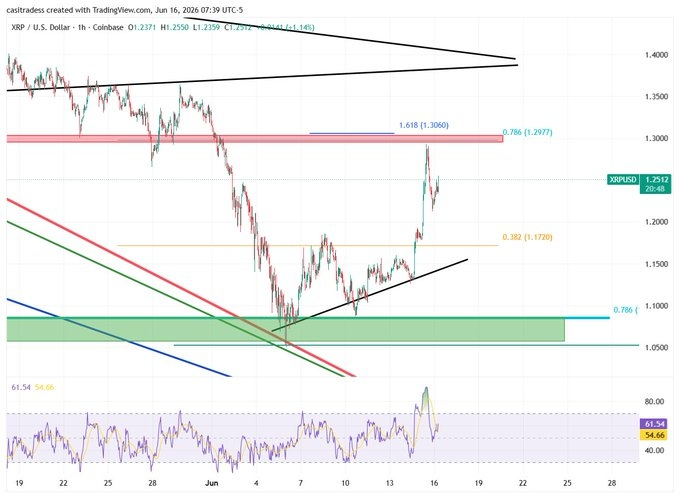
XRP Trading Recommendation: Go long in the 1.12–1.15 range, with targets at 1.22, 1.28, and 1.35, and a stop loss at 1.08. This is a bullish strategy betting on a continuation of the short-term rebound, but the strategy will be invalidated if the price falls below 1.08.
XRP is approaching a key resistance level. After consolidation, its structure is relatively strong. If it holds the support and continues its momentum, it may enter a new round of upward trend. However, the true strength or weakness will depend on its continued performance after the breakout.
XRP encountered resistance at the intermediate level and fell back, indicating a weak short-term trend, with market expectations suggesting further declines.