The AHR’s September 2024 issue is now available. It features articles and forums that rethink approaches to environmental, humanitarian, and welfare history, and includes collections on historical fiction, archives and libraries, and history education. https://t.co/IdgzJhAO1R
The inaugural Sinclair Workshop on Historical Podcasting at #AHA25 explores this exciting field with a panel discussion featuring history podcast practitioners Daniel J. Story, Kathryn Carpenter, Andrew J. Falk, Jessica Lynne, & Natalia Mehlman Petrzela. https://t.co/Q8RwJHEmwD
In his video essay “Visualizing Resilience from the Periphery” and textual essay “Setting History in Motion,” @DanMcDonaldDM explores the central role of the visual in social resistance in late 20th century Brazil during the civil-military dictatorship. https://t.co/CVvXuD4H54
Bob Reinhardt’s “Exploring Submerged Resilience” reflects on the Atlas of Drowned Towns, a public digital history project that provides a platform for exploring and recording the histories of US towns that moved or disappeared to make way for big dams. https://t.co/vNFJ80NCuj
In “Love, Joy, Hope,” @golcheski & Jess B. Ramey use the career of activist Kipp Dawson to examine how resilience can operate in social movements, with a focus on movement networks, interconnections, and affects. https://t.co/RsaPrRUjfr
Rachel Anderson explores an archive of petitions for poor assistance following plague outbreaks in England in her article “The Lancashire Plague Petitions,” using tools of micro-history to emphasize the importance of community and external assistance. https://t.co/nl5e84RU8w
In “Kenyan Nubians and the Myth of Nubian Resilience," Tammy Wilks traces claims for citizenship by a stateless Kenyan community in the late 19th century and unpacks how elders used their hybrid identities to claim both multistate origins and statelessness.https://t.co/h2foplFTEw
In this episode of our “Historians On” series on #HistoryInFocus, David speaks with Katharina Matro, @jmcclurken, @kalanicraig, @joguldi, @JohannNeem, Kevin Gannon, and @nolauren on the topic of AI and its implications for history teaching and research.https://t.co/wyuqPQCn2M
In “State-Led Development and Migrants’ Resilience in the City of the Forest,” Thaís R. S. de Sant’Ana analyzes strategies of resilience deployed by early 20th century Brazilian workers to avoid state-controlled labor projects. https://t.co/hlOwK4neKs
@MeganRenoir & Shelly Covert’s “Recognition as Resilience” features the Nevada City Rancheria Nisenan Tribe (NCRNT), a nation not federally recognized, and how their resilience creates a “new normal” that reflects tribal self-determination. https://t.co/AIZuAupmsx
In @AmHistReview, Anne Berg’s archival investigation of prison camps in Nazi Germany reveals an extensive economy built on recycling previously used materials.
https://t.co/JNGutsKwMQ
In “History on the Lost Coast,” Kathleen C. Whiteley shows how historians can use a resilience framework to highlight Indigenous agency, spotlighting the Wiyot Nation’s reclamation of 200+ acres on Tuluwat Island, the site of an 1860 catastrophic massacre.https://t.co/tM3gSD9Mtf
In exploring the history of Miyagi Prefecture’s tsunami memorial halls in Japan, Alex Jania investigates the challenges of using memorials and collective memory to build resilience in his article “Between the Emergency and the Everyday.” https://t.co/tJmQGfwfqF
Check out the Dec 2024 issue, the first of an annual special themed issue of the AHR. The contributions that make up this special issue offer rich understandings of how historical context and contingency shape and inflect a variety of forms of resilience.https://t.co/IdgzJhAO1R
In the collection “How to Make Peace with History While Making History with Peace,” authors address questions of war and peace from their own historiographical perspectives and consider the potential peace history has to offer the historical discipline. https://t.co/benb9Wg3Mj
In “Resilience in Environmental History Discourse” @LeeMordechai & John Haldon rethink the use of resilience in histories of environmental and climatic change, offering a review of resilience as a paradigm of institutionalized knowledge across disciplines.https://t.co/5T5RcyrA2H
We are so proud to see in the latest issue of The American Historical Review (@ahahistorians) an outstanding collective review essay, "Birthing a Better Nation," written by 8 of our stellar grad students during their Spring 2024 seminar with the estimable Dr. Bianca Premo.
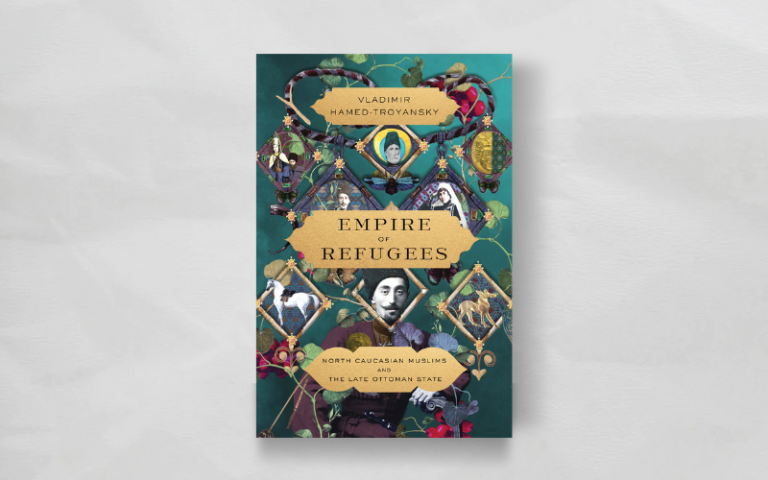
Thrilled to have Empire of Refugees (@stanfordpress, 2024) reviewed in @AmHistReview. Many thanks to @BedrossDM for critical engagement with the book’s arguments and highlighting my focus on refugee agency.
Here is my review of @VHTroyansky book Empire of Refugees: North Caucasian Muslims and the Late Ottoman State, published by @stanfordpress that just appeared in the latest issue of @AmHistReview
Link: https://t.co/W2jCQU5cbO