A Visual Guide to Common Woods
From Log to Lumber
Today we are sold furniture made of birch. Birch is cheap because it grows exceptionally fast and is incredibly abundant. While classified as a hardwood, the birch tree acts more like a weed in nature.
Sadly, it is a mass-market solution engineered for profit and efficiency: money, not art.
In contrast, antique furniture made from old-growth mahogany and walnut was a true product of time. Those ancient trees matured slowly over centuries, giving their timber a natural density and tight grain practically impossible to find today. That is why those heirloom pieces have survived for generations without warping or rotting, maintaining structural integrity and elegance that modern fast-grown furniture cannot replicate.
The Switch to Birch
For businessmen, it was pure profit. Birch allowed for cheap flat-pack shipping and replaced expensive master craftsmen with automated factory machines.
Profit margins are what truly drove high-quality solid wood out of the average home.
The Roman Scourge: A Brutal Instrument of Ancient Rome
In ancient Rome, scourging was a severe form of corporal punishment, often inflicted before execution. One instrument associated with this practice was the flagrum, a whip designed to cause intense pain and serious physical injuries.
Unlike an ordinary whip, some Roman scourges featured multiple leather thongs, sometimes fitted with knots, bone fragments or metal weights. These attachments could produce deep bruising, cuts and extensive tissue damage.
Scourging was used against enslaved people, prisoners and others subjected to Roman punishment. The Gospels also record that Jesus was scourged under the authority of Pontius Pilate before his crucifixion.
However, an important historical distinction remains: no surviving evidence establishes the exact construction or dimensions of the instrument used on Jesus. The flagrum shown here is a historical reconstruction based on ancient descriptions, not a confirmed original artifact.
It offers a glimpse into one of the harsher realities of Roman justice, where physical punishment was used to demonstrate power, enforce authority and break resistance.
How did ancient desert dwellers enjoy ice-cold treats and preserve food during scorching 40°C summers? Long before modern refrigerators, Persian engineers built the Yakhchāl subterranean ice houses that could freeze water and store massive ice blocks in the middle of a blazing desert.
First developed around 400 BC, this ingenious system didn’t require any electricity or fuel. It relied on pure thermodynamics and natural environmental patterns:
1. Conical Insulation: The massive above-ground dome was built using a specialized, heat-resistant mortar called sarooj. Made of sand, clay, egg whites, goat hair, and ash, this mixture was completely waterproof and heavily insulated, keeping the sweltering heat from penetrating.
2. Nighttime Freezing: To the north, tall shade walls blocked the winter sun from reaching the long, shallow water trenches (Yakh-Band). At night, cold mountain water channeled into these shaded trenches would freeze, and workers would quickly pack the harvested ice into the deep underground storage pit before sunrise.
3. Natural Thermodynamics: Hot air inside the dome would naturally rise and escape through an opening at the very top (the oculus), while the cold air being much heavier remained trapped in the massive subterranean storage room below.
Through brilliant passive cooling, these ancient "refrigerators" kept ice frozen year-round, enabling desert communities to preserve perishable goods and beat the brutal heat.
👑 The tomb of Tutankhamun (c. 1345–1323 BCE; reign c. 1332–1323 BCE), located in the Valley of the Kings, offers a rare and largely intact snapshot of royal burial practice during Egypt’s New Kingdom (c. 1550–1070 BCE).
✍🏼 Infographic created by Simeon Netchev.
#Egypt#History
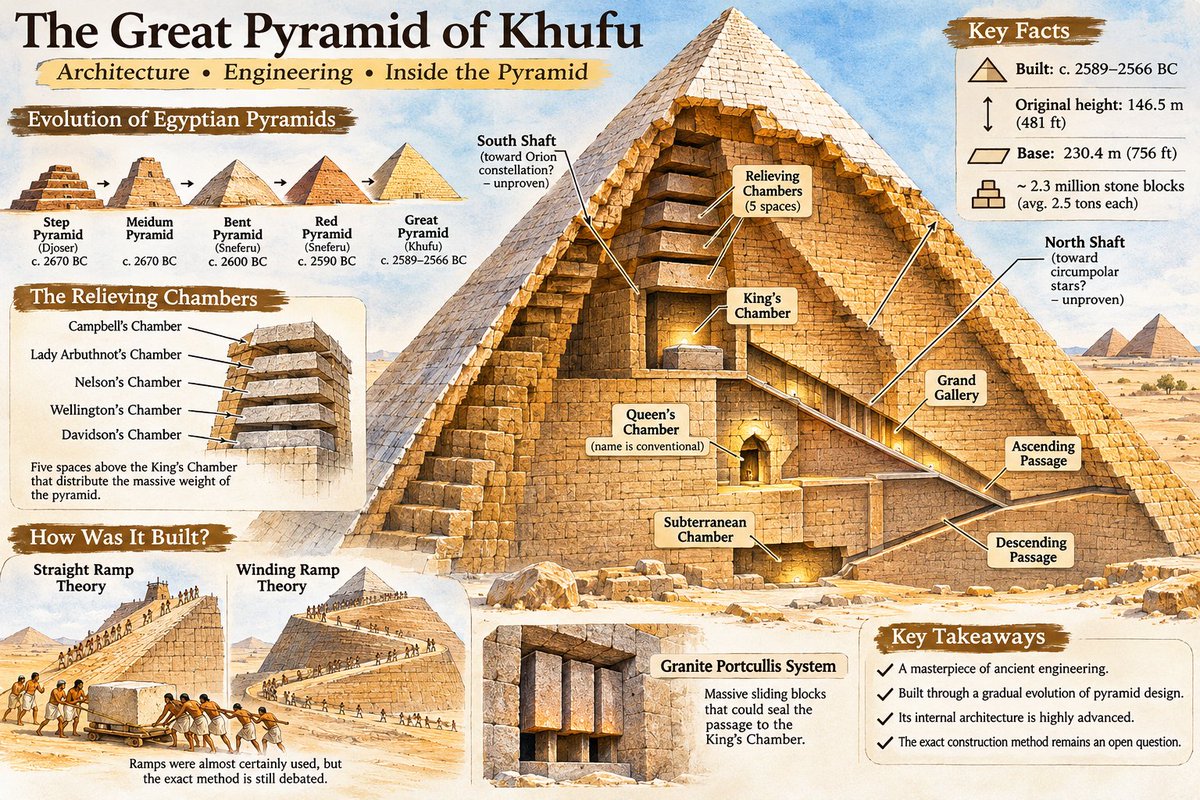
The Great Pyramid of Giza is far more than a monumental tomb. It is one of the most remarkable engineering achievements of the ancient world.
Built for Pharaoh Khufu around 2589–2566 BC, it originally stood approximately 146.5 metres (481 feet) tall, with a square base measuring about 230.4 metres on each side.
But its real fascination lies inside.
The pyramid contains a network of passages and chambers, including the Grand Gallery, King's Chamber, Queen's Chamber and an unfinished subterranean chamber. Above the King's Chamber, five relieving spaces were constructed to help manage the enormous weight of the masonry above.
Its narrow shafts have inspired astronomical theories, although their exact purpose remains debated.
Even more fascinating is the construction process. Archaeological evidence supports the use of ramps, sledges and organised labour, but the precise arrangement used to raise millions of stone blocks remains uncertain.
What amazes me most is how Egyptian builders developed such sophisticated architectural solutions more than 4,500 years ago, using the materials and technology available to them.
The pyramid is ancient, but the engineering questions it raises are still alive today.
Built around 350 BC, the Mausoleum at Halicarnassus was far more than a royal tomb. It was an extraordinary combination of architecture, sculpture and engineering.
Located in present-day Bodrum, Türkiye, it was commissioned for Mausolus, the ruler of Caria. After his death, his wife Artemisia II continued the project.
Standing approximately 45 metres tall, the monument featured a massive rectangular podium, an Ionic colonnade, a 24-stepped pyramidal roof and a marble chariot drawn by four horses at its summit.
Its decoration included elaborate sculptural friezes, statues and reliefs created by some of the finest Greek artists of the period. Architects Pytheos and Satyros are traditionally associated with its design.
Centuries of earthquakes eventually brought the structure down. Later, some of its stones were reused in Bodrum Castle, while important surviving sculptures were taken to the British Museum.
Today, only foundations and scattered architectural fragments remain at the original site.
It is remarkable that although the monument disappeared, its legacy survived. The very word mausoleum comes from the name of Mausolus.
It remains one of the Seven Wonders of the Ancient World.
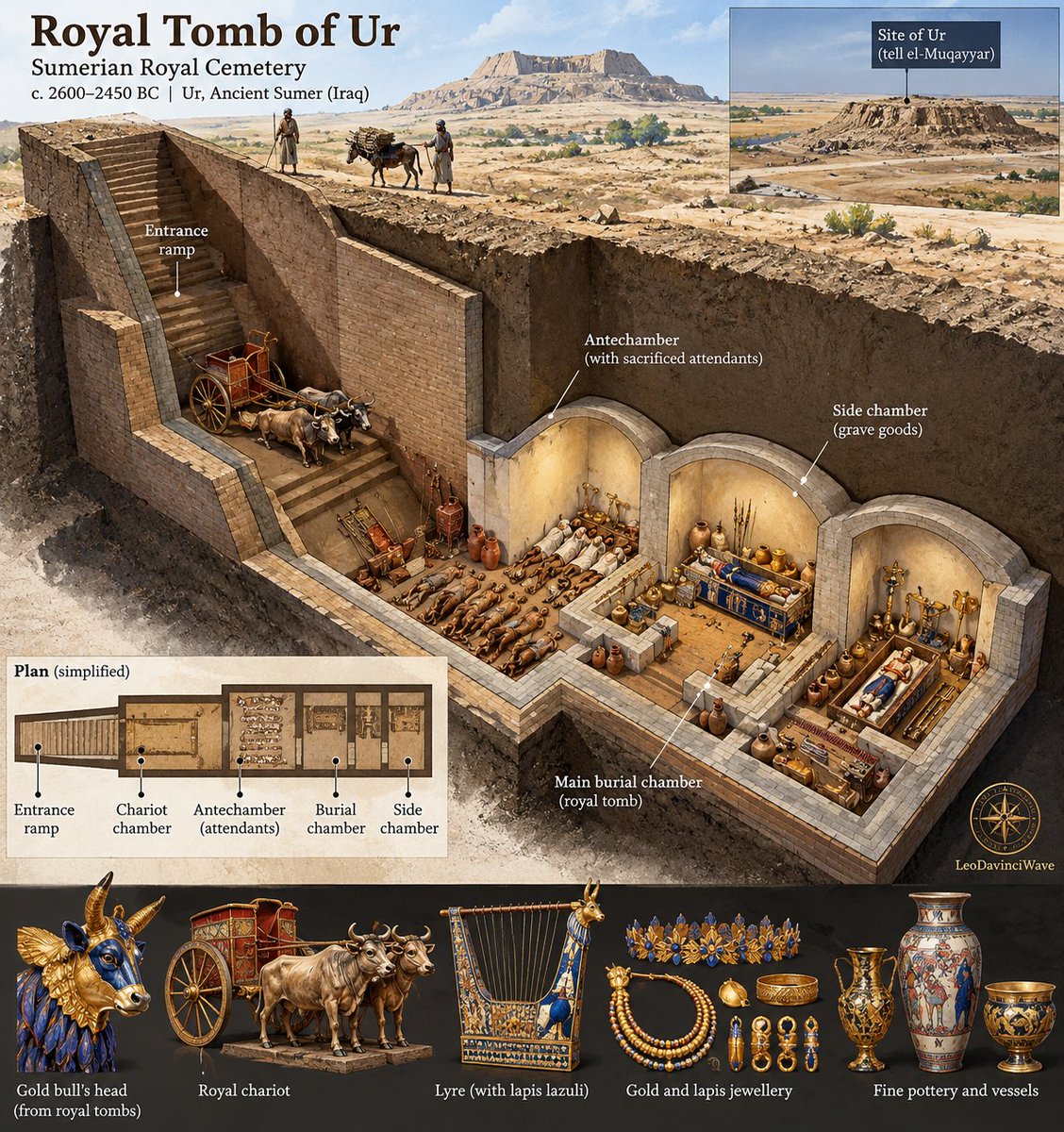
THE ROYAL CEMETERY OF UR – A WINDOW INTO ANCIENT SUMER
More than 4,500 years ago, the ancient Sumerian city of Ur, in present-day southern Iraq, was home to one of the most extraordinary burial grounds ever discovered.
The Royal Cemetery of Ur was excavated by British archaeologist Sir Leonard Woolley between 1922 and 1934. The excavations revealed around 1,800 burials, including 16 exceptionally rich tombs that Woolley identified as royal.
These tombs contained remarkable objects: gold and silver jewellery, lapis lazuli ornaments, decorated vessels, musical instruments and remains of wheeled vehicles.
One of the most fascinating discoveries was the famous Standard of Ur, along with the elaborate musical instruments and jewellery associated with the cemetery.
Some royal burials also contained groups of attendants, indicating that human sacrifice formed part of certain elite funerary ceremonies.
These discoveries provide valuable evidence of Sumerian craftsmanship, social hierarchy, wealth and beliefs about death.
The Royal Cemetery is not simply a collection of ancient graves. It is an extraordinary archaeological record of life, power and death in early Mesopotamian civilisation.