Bowen Pan: corporations extract efficiency. Exploration/innovation fights that, what he calls corporate antibodies. The fix is structure that protects the behaviour, with buffer so exploration survives. It is not natural work for people whose day job is something else.
We have a group of leaders at #DeloitteCONNECT in Auckland today, focused on where technologies like agentic AI and robotics are already delivering value, and what it takes to land them at scale in NZ.
I’ll share a few insights from the day as it unfolds below.
Bowen Pan: AI is this era’s factory electrification.
In the 1890s, factories swapped steam for an electric motor and kept the rest. Productivity barely moved.
By the 1920s, a motor sat on each machine, layouts changed, productivity lifted.
What operating model is possible now?
How do engineers reduce GenAI hallucinations?
Ask multiple LLMs the same question + compare consensus.
Dev technique, now surfacing in consumer tools: Model Council shows 3-model outputs side-by-side (paywall).
Empowers human critical thinking.
Need this elsewhere too.
Introducing Model Council in Perplexity.
Run three frontier models at once, compare outputs, and get a more accurate, higher‑confidence answer.
Available now on web only for Perplexity Max subscribers.
Physical AI is the form of AI I'm most excited about for NZ's economy 🤖
Our unique pastoral systems create technical challenges that, once solved, could better serve global markets.
If current momentum holds, this AI could represent the kind of step-change NZ has been seeking
Most NZ orgs are underpreparing workers for AI.
Some offer generic training.
Others deploy tools and expect people to figure it out.
The people thriving? Making it a personal mission to upskill first, then helping their teams navigate.
via Oracle Data & AI Forum, Auckland
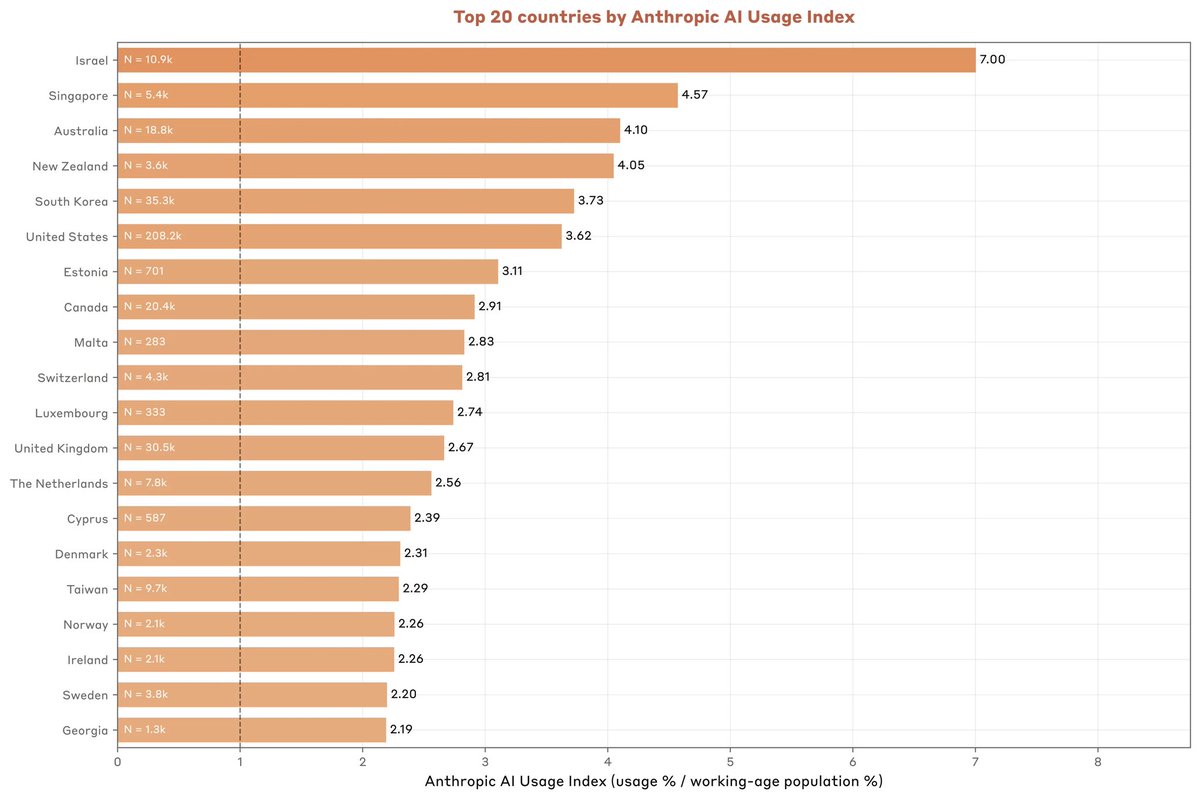
Source:
Anthropic Economic Index report: Uneven geographic and enterprise AI adoption (Sept 15, 2025) by Ruth Appel, Peter McCrory, Alex Tamkin, Michael Stern, Miles McCain, and Tyler Neylon.
NZers still favour collaborative workflows over full delegation, for now.
But this shift toward automation deserves attention.
As agentic AI systems become mainstream, these platforms will handle more complex work, often without most end users understanding their reasoning.
Advertisers are teaching robots to sell toothpaste. Where the industry is going is alarming.
3 Signals That Matter:
→ Stack Overflow down 70% since ChatGPT
→ Virtual influencers hit $6B in 2024
→ Platforms now monetise your desires
Explained here:
https://t.co/yxA3IhzTul
"The AI Gap" - my @TEDx talk about why some orgs have cutting-edge AI while our most critical services lag behind.
Filmed while my father was in ICU. He never got to see it, but I hope it helps someone, even a tiny bit, think about bridging this divide ❤️
https://t.co/5WhZyigOv5
AI is accelerating—but a recent report indicates that boards are not keeping pace, suggesting that:
📚 79% of boards have minimal knowledge of AI.
🚫 Fewer than 40% of their workforce have access to approved AI tools.
🤖 8% of boards are starting to include AI specialists.
What immediate steps can boards consider taking to accelerate the pace of AI and Generative AI adoption in their organisations? Read the Deloitte Global Boardroom Program survey here - https://t.co/JUs08MAevz
I heard someone say, "LLMs always hallucinate. There's nothing we can do about it."
There are ways to improve LLM accuracy:
Retrieval Augmented Generation
Multi-Model Verification
Advanced Reasoning Techniques
+ others
Not perfect, but it's not nothing!
https://t.co/WIKdDDUhEm