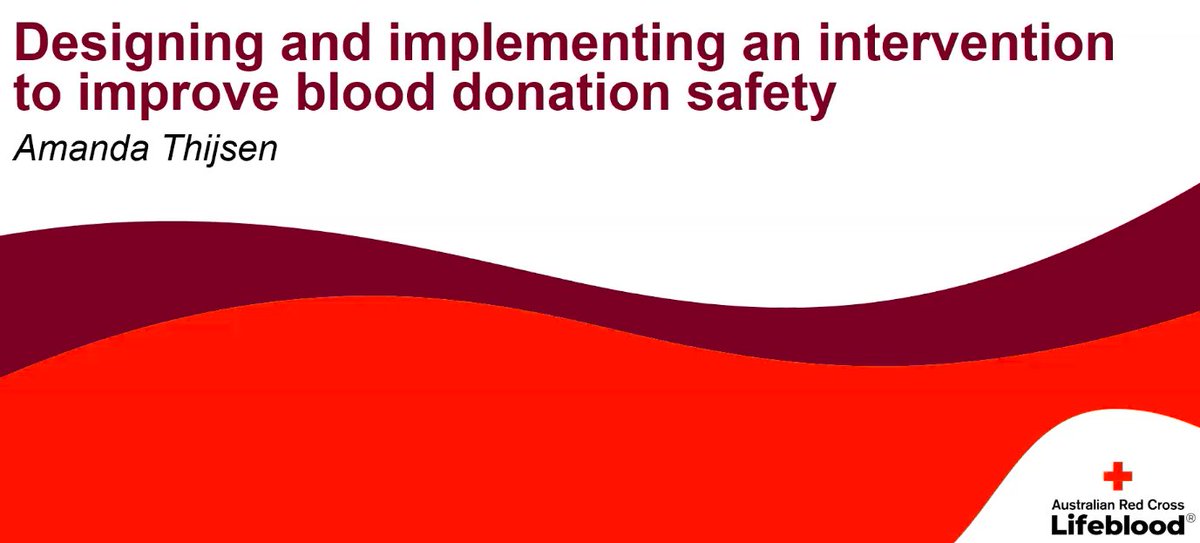
From our 2022 #donor#research network symposium series: Watch @AmandaThijsen@lifebloodRnD talk about “Encouraging donor return following the experience of a vasovagal reaction.” Pls RT! https://t.co/cIVtlN5BmW
This paper introduces the concept of the HOW (i.e., implementation strategies) – one of the essential components of an intervention.
▶️Relevant for #ImpSci and #ImpPractice as we all try to improve the uptake of interventions (i.e., WHAT/ the thing).
When #blood donors' donations are postponed, they're more likely to return if we give them clear messaging and support.
New #clusterrandomised#trial led by Carley Gemelli from our team, with @AmandaThijsen@surenkarki@AABB https://t.co/lz8tccIaaw
📢 JOB ALERT! Pls RT!
Exciting opportunity for a biostatistician or epidemiologist to work with @DonorHealthBTRU and @NHSBT_RD. You will have access to internationally unique datasets to address questions of relevance to the needs of blood services. https://t.co/0eE8HfT7kZ
DoRN’s Symposium Series will bring together Early Career Researchers (ECRs) from around the globe for our ECR day on June 8. Hear FREE talks from @HammKatie (egg) @loez23 (plasma) @gjagelav (stem cell) @AmandaThijsen (blood) + many more. DM or✉️[email protected] for access!
📣📣ICYMI: Listen to @AmandaThijsen talk about developing a study to better understand fainting in donors and to create solutions acceptable to blood donors and blood services. https://t.co/fPsIuIOR0N @NHSBT_RD
Do you work in #transfusion medicine? We’d love to hear your thoughts on using research evidence in #blooddonation policy and practice. Please help by completing a short survey: https://t.co/SFS1AC96TH Thank you!
Register by May 9 for our FREE #DoRN Symposium Series! We have a great line up of speakers on substance of human origin donor research across the 3-days of our virtual series in May, June & July. Register here: https://t.co/3Ue62wpKrf
Does the emotional experience during the blood donation process influence donor return?
"A trajectory of medium- high/increasing joy, high calm, and low/decreasing stress was associated with a significantly greater probability of return"
https://t.co/z4FnNGPPqT
Can text messages save lives?
In a large‐scale field experiment, we randomized donors such that half are sent a text message when their donation was used. Messages increased subsequent donations by 3.6% compared with donors who did not get the message
https://t.co/wnYXl3FlU4
What determines blood donor behaviour during the COVID19 pandemic?
@barbaramasser@DrMelHyde "Self‐efficacy and approval from others, underpinned by coping appraisals and organizational trust, play a critical role in intentions to donate"
open access📰https://t.co/sMY55k07FZ