A monetary order that treats the unit of account as an instrument of policy rather than a measure of stored work teaches its users that obligations can be revised after the fact.
#BTC
Just landed in NYC!
Mark Normand is on my flight which is cool. One of my favorite comedians.
Let me know if you wanna hang out tonight!
BITCOIN IS INEVITABLE.
The funniest part about Bitcoin is watching people spend 15 years calling it fake money while their real money loses 60% of its purchasing power.
Brother, one of these things is pretending.
The world is totally asleep to the fact that Bitcoin is the greatest collateral to ever exist and now is the time to front run.
The implications of this asymmetry are staggering.
Future historians are going to read that we had an absolutely scarce monetary asset available globally 24/7 and millions of people said:
“Seems risky.”
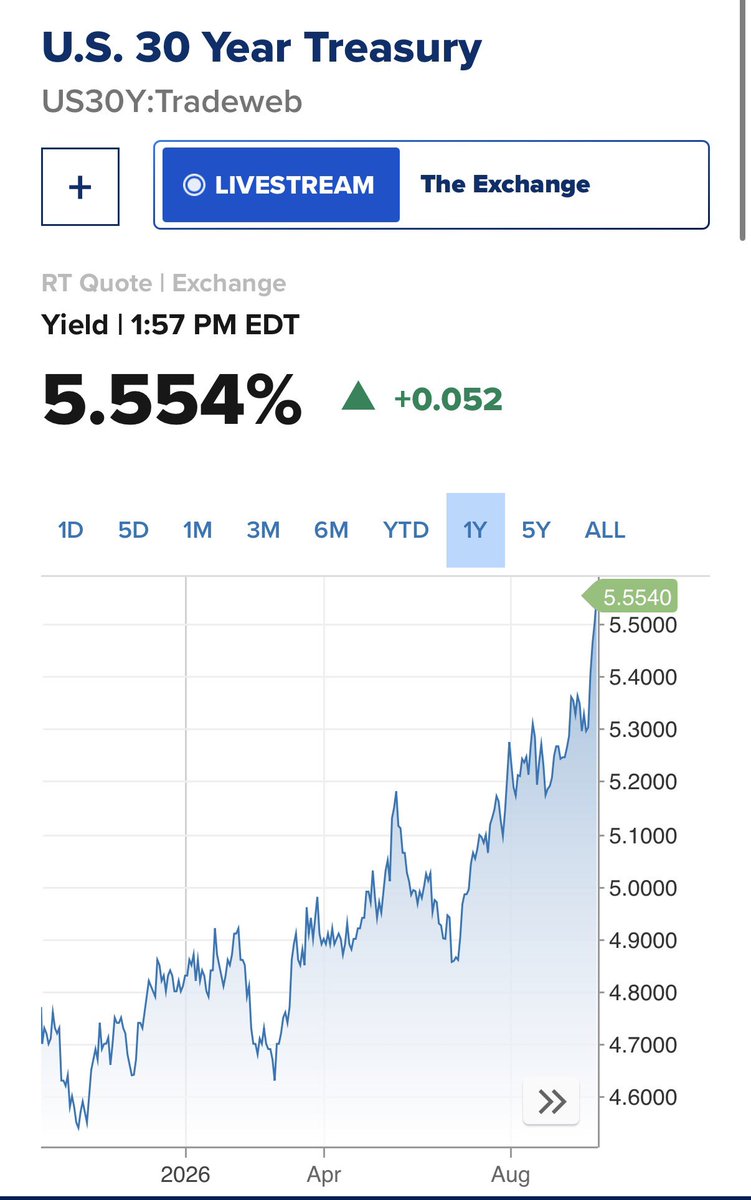
Then they bought 30-year government bonds.
It is impossible for me to not be bullish on Bitcoin right now.
Bitcoin is RISING through a real-yield regime it has literally never seen before.
The 10Y real Treasury yield hit 2.68% this week - the highest level of the entire Bitcoin era.
But the crazier number is 2.44%.
That’s the average 10Y real yield over the last 40 Treasury sessions.
The highest sustained 10Y real-yield regime in Bitcoin history.
Bitcoin is up 17.4% over those same 40 sessions.
This matters because real yields are the hurdle rate.
When the government will pay you ~2.5% above inflation to sit in Treasuries, the opportunity cost of owning a non-yielding monetary asset is enormous.
For much of Bitcoin’s history, collapsing or negative real yields were gasoline.
Right now the gasoline is gone.
The macro headwind is sitting at a record.
And Bitcoin is going up anyway.
The lazy model that “Bitcoin only goes up when money is cheap” just ran into a very inconvenient chart:
The amount of capital about to flood into Bitcoin over the next five years is going to make the last 15 years look like a bake sale.
Wall Street competing with sovereigns.
There are 21 million Bitcoin.
Good luck everybody.
To put this in perspective: buying a $412k median US home at today's 7.17% interest rate (with 20% down) requires borrowing $329.6k. Over a 30-year term, your monthly principal & interest payment lands at $2,231. By the time the mortgage is paid off, you will have paid $473,610 in interest alone, meaning you end up paying $885,610 in total nominal cash.
Every prior gold-backed credit system eventually subordinated the metal to the credit layer and to the hegemon who needed to finance war and deficits. The base layer that cannot be summoned or seized is the one on which the next century of credit will have to be built. That layer is already live. That layer is Bitcoin.
#DigitalCredit $STRC $SATA
2/15
STRC is doing something historically strange: turning a volatile, non-yielding reserve asset into perpetual dollar income without pledging the BTC itself.
That matters.
Strategy gets amplification.
STRC gets residual asset coverage.
The Bitcoin remains unencumbered.
1/15
Strategy’s next capital-markets product?
I think the real opportunity comes AFTER STRC—and launching it too early could destroy value.
The next flywheel may be Bitcoin-secured senior credit.
But only after STRC earns the market’s trust.
This Bitcoin rally is great and all but we have so much room left to run.
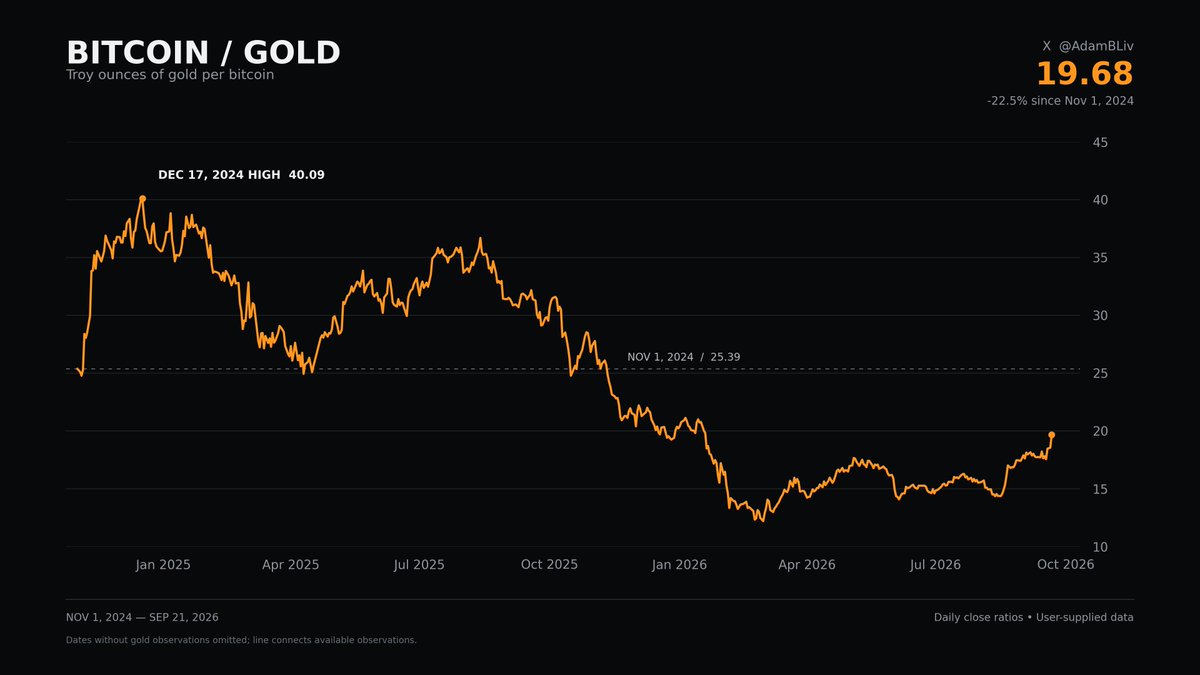
Bitcoin currently buys 19.68 ounces of gold, down from 25.39 ounces on November 1, 2024.
If gold stays flat at $4,338 and BTC merely recovers that ratio, the implied Bitcoin price is $110,145.
If BTC/Gold returns to its December 2024 all-time high of 40.09, the implied Bitcoin price is $173,921.
What if gold goes higher?
And what if Bitcoin claims a higher ratio?
You are not bullish enough:
For a Bitcoin treasury company underwriting a bullish thesis through 2030, the price at which it adds preferred-funded Bitcoin exposure can have an enormous effect on the returns for the common stock shareholders.
The mechanism is straightforward: a preferred claim does not grow with Bitcoin.
After funding its dividends, the remaining appreciation belongs to the common.
Buying more Bitcoin per dollar of that claim gives common shareholders more of that residual upside.
Consider two hypothetical companies with identical starting balance sheets:
1. $100 million of Bitcoin
2. $50 million of cash just raised through one perpetual preferred class
3. $100 million of common NAV
4. Both have the same common share count.
5. Both preferreds carry a fixed $50 million liquidation claim and an assumed 13% annual dividend.
Company A deploys its $50 million immediately at $85,867 per BTC, buying approximately 582 BTC.
That price is 30.4% above the $65,845 200-week moving average in the supplied partial-week snapshot.
Company A now has $150 million of Bitcoin exposure supporting $100 million of common NAV: 1.50× initial amplification, or 50% additional exposure.
Company B holds its $50 million until Bitcoin reaches $131,689, then buys approximately 380 BTC.
That entry is twice the SAME starting moving-average reference; this example does not project the future 200-week average.
Now assume Bitcoin compounds smoothly at 50% annually for 51 months, from the September 2026 model baseline through December 2030.
Bitcoin reaches approximately $481,075.
B’s purchase occurs about 12.7 months into that shared price path.
Both companies pay every dividend through monthly Bitcoin sales. Both pay $27.6 million in total dividends. B’s waiting cash earns an assumed 0%. Neither issues additional common shares.
After those payments and subtracting the outstanding $50 million preferred claim, December 2030 common NAV is:
Company A: $717.8 million, up 617.8%.
Company B: $620.4 million, up 520.4%.
The earlier buyer finishes with $97.5 million more common NAV, a 15.7% advantage. With identical, unchanged share counts, the same advantage exists per share.
The explanation is approximately 203 additional BTC acquired against the same preferred claim.
At the assumed terminal price, those additional coins account for the entire $97.5 million difference.
This is why a treasury company with a durable bullish thesis can rationally prefer adding amplification at a smaller premium to its long-term valuation reference.
Each new preferred-funded purchase should be underwritten against its entry price, financing cost, senior coverage, and ability to fund dividends through a difficult market.
Issuing capital creates value only when its deployment earns enough to justify the claims attached to it.
A smooth 50% growth path favors earlier buying by construction; this is an illustration of residual capture, not proof that today’s price is cheap.
Company A starts with greater Bitcoin exposure and therefore greater downside: an immediate 20% Bitcoin decline would cut its common NAV by 30%, before dividends.
This comparison holds financing identical and changes deployment timing. B does not avoid dividends while waiting, and neither company maintains a constant 1.50× amplification ratio. These are hypothetical NAV outcomes, not stock-price forecasts; taxes, fees, and operating costs are excluded.
The discipline is to accumulate more Bitcoin for each dollar of senior claim while preserving the liquidity to carry the thesis through the cycle.
Common shareholders capture the residual only if the company can stay the course:
Bitcoin vs. Amplified Bitcoin
I ran 500,000 paired Monte Carlo simulations over four years.
Bitcoin starts at $86,000, with a 40% geometric CAGR assumption and 40% annualized volatility.
The amplified model takes 1.5× each simulated daily Bitcoin return, producing roughly 60% volatility.
Same Bitcoin shocks. Same $86,000 starting investment. Different sensitivity.
Median ending value:
Bitcoin: $330,057 - 3.84×
Amplified Bitcoin: $508,584 - 5.91×
At the 95th percentile:
Bitcoin: $1.235 million
Amplified Bitcoin: $3.676 million
At the 99th percentile:
Bitcoin: $2.132 million
Amplified Bitcoin: $8.327 million
The probability of finishing at 10× or more rises from 11.6% to 33.1%.
Amplified Bitcoin finishes ahead in 85.9% of the paired simulations.
But the wider upside distribution comes with a materially rougher ride.
Median maximum drawdown increases from 42.2% to 57.7%. The probability of finishing below the starting investment rises from 4.7% to 7.0%.
A company targeting sustained amplified exposure needs to actively manage its capital structure and Bitcoin exposure. Issuing preferred equity once does not permanently lock in 1.5× stock-price sensitivity, and balance-sheet amplification is not the same as market beta.
These are the mathematical results of a maintained-sensitivity projection, not a forecast for any company.
Financing costs, preferred dividends, dilution, valuation changes, and company-specific risks are excluded.
Volatility is vitality:
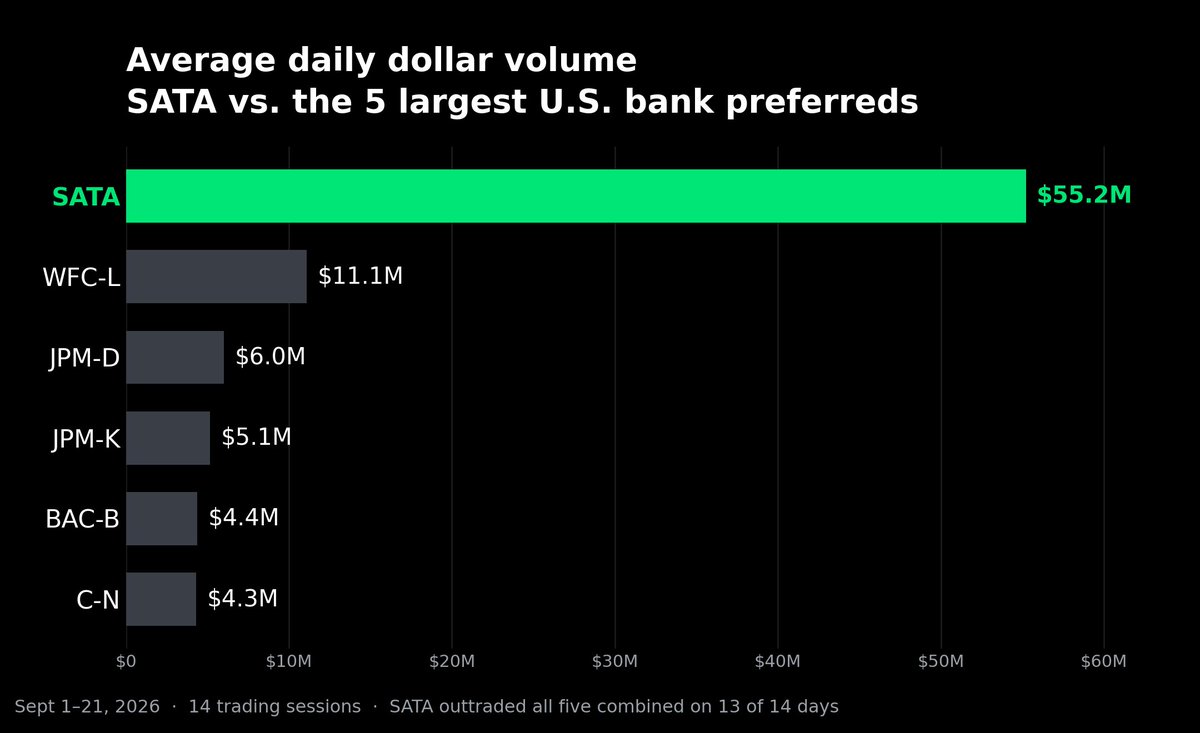
$SATA is trading more dollar volume than the five largest bank preferreds combined.
Avg daily, Sept 1–21, 2026:
SATA - $55.2M
WFC-L - $11.1M
JPM-D - $6.0M
JPM-K - $5.2M
BAC-B - $4.4M
C-N - $4.3M
Top 5 combined: $30.9M.
Traded more than all 5 combined in 13 of 14 trading sessions in September.