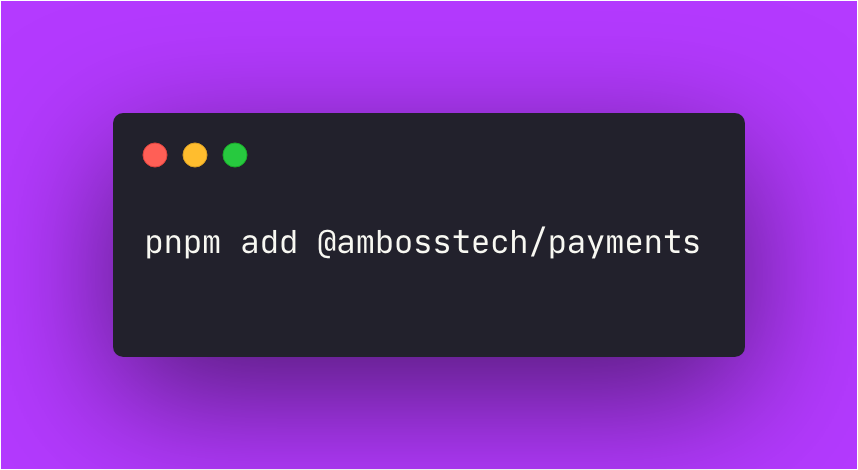
Introducing the official Amboss TypeScript SDK.
Send and receive money in USDT, USDC, and Bitcoin over Lightning, straight from your backend. Sub-second settlement, no chargebacks, 24/7.
Here is what it changes for your business. 🧵
🚨
due to CVE-2026-111943 (eMudhra CA compromise: ⓸㆕), we strongly recommend all lnd/btcd/tapd/litd users to either update to the release binaries below, or re-build their binaries with Go 1.27.3:
* lnd: https://t.co/nASK8lSYdU
* tapd: https://t.co/EgsAOpiqPS
* btcd: https://t.co/5hGvEAI6Mg
* litd: https://t.co/6zhZDkiD1J
Announcing LayerTree: a new tree-based scaling solution for Bitcoin that permits O(1), independent of the number of users in the system: https://t.co/RtARIow733
A single UTXO can hold the balance of millions of users as an off-chain Merkle-sum tree.
Transaction introspection techniques permit batched exit from the system in a single transaction w/o any pre-signing: https://t.co/AqvaZqkvyW
If I'm successful with this, lightning will become the default layer for agentic payments and users will save on tokens.
The machine economy won't be winner-take-all because specialized models/scripts are more efficient. Lightning's efficiency means more distributed winners.
100 BTC of Lightning liquidity is for sale right now. Most of it is cheap.
98% of the book is at 4% APR or less. $439K is at 0% APR.
Median lease: 30 days. 95 offers.
Phase two of our 19 September disclosure: a public page that follows the stolen coins, updated as they move.
Follow-up post:
https://t.co/ttmCcSfmbB
Tracking page:
https://t.co/wQxXehXSIK
Bounty terms:
https://t.co/aF8d2L29Kv
On 3 October we published the post-mortem of the attack and a 50% bounty on the stolen funds. That was about what happened inside Blink. This is about where the money went.
The page lists every address, transaction and Lightning channel we can tie to the attacker. Anyone can check each one on the public blockchain.
Why public:
We want everyone working on the bounty to have the same data we have, as up to date as ours, so they can be as effective as possible. The page is that data: we update it when the coins move and when we confirm something new.
We are unlikely to catch him on our own. He is careful: his main Lightning node is reachable only over Tor, and his activity is spread across all hours of the day. What he cannot hide is the coins. Every time they move, they move in public.
He already knows he is being watched, so publishing tells him nothing new. Formal channels matter and we use them, but they take weeks. A public page reaches exchanges, analysts and other teams the same day.
He is still active:
He prepared for weeks. He set up his Lightning node ten days before the attack, and nine days before it he already controlled about 14 BTC. He has not stopped: in the first week of October his main node opened a new channel, a second node of his showed itself, and he moved coins again.
In the same week, on 5 October, he attacked @secondhq, a company that builds its own version of Ark (a new way to make Bitcoin payments), called Bark. He exploited a bug in Second's Ark server and took 0.75 BTC of their own funds; no user funds were affected (their disclosure: https://t.co/eWjqwLtz8D).
He paid for it from the same wallet that received the coins stolen from Blink, and at least partly with those very coins.
We believe he may be preparing a cascading attack: using what he takes from each target to fund the next. If you build on Bitcoin as everyday money, there may be extra reason to be vigilant. If you run a Lightning node, a federation, a swap service or an exchange, check the page against what you see.
What the page shows:
The theft, how the coins moved after it, the coins he held before the attack, his Lightning nodes, his attack on Second's Ark server, and a Lightning wallet that is probably his. Every item is labelled proven, traced or probable. Transactions by exchanges or swap services are marked third-party: they are not accused of anything.
About 0.87 BTC still sits untouched at five of the original addresses, 4.84 BTC at an address that is probably his, and 1.64 BTC at addresses he used in the attack on Second. The whole list downloads as a CSV.
What stays off it:
Anything partners told us in confidence. Personal data. Open security issues. Addresses whose owner we cannot establish. Other teams' incidents, until those teams agree or make them public.
How you can help:
Watch the addresses. If coins move, especially toward an exchange or any service that knows its customers, tell us straight away. Freezes depend on reaching the platform within hours.
Report privately to [email protected] with BOUNTY in the subject. Please don't post leads publicly: it warns him, and it does not establish your priority.
If you run a service and listed coins reach you, contact us before acting. If you control a listed address and are not involved, write to us and we will correct the page.
The 50% bounty stands. 25% of what is recovered goes to whoever provides the information that leads to it, and another 25% to Bitcoin Beach, Bitcoin Ekasi, Afribit Kibera and the circular economies they choose. Everything on the page was already known to us, so re-tracing it does not qualify. Where the coins go next can.
Live updates:
Corrections appear as dated notes; we do not silently rewrite it. Spot an error? Write to [email protected] with CORRECTION in the subject.
We timestamp the page's data on the Bitcoin blockchain with @opentimestamps at launch and with every update.
One more thing:
Blink never charges a fee to recover funds and never asks for keys, seed phrases or payments. Anyone offering "recovery services" in our name is not acting for Blink.
Everyone has been talking about agentic payments and the machine economy, but I haven't seen anyone really make it clear what that is or what it looks like.
So, I'm pleased to share with you Amazap: a storefront for economic agents.
https://t.co/Y7OW7UP8Av
It's not about hyping up an upcoming feature; it's about delivering.
Amboss just delivered seamless stablecoin <> Bitcoin payments over Lightning.
What's more, is it is wayyy simpler using our SDK 😂
https://t.co/WF69GaHIHg
💥 NEW: First stablecoin payment over Lightning buys a Coke in Vancouver 👀
> @LeoAW pays 2.14 USDTL for a Coca-Cola at DCTRL hackspace
> Setup: litd with Taproot Assets, $3,000 USDTL channel opened by @ambosstech
> Amboss swaps sats to USDTL at the last hop, any Lightning wallet works
> Same stack paid for @mullvadnet VPN, an eSIM, and a Safeway gift card
> Setup still needs your own node and CLI, but payments are seamless
#Bitcoin #USDTL
What's built on Taproot Assets? Four things you can use today:
1) Issuance: mint and burn in @thunderhubio
2) Spot trading: pick your peer and price
3) Liquidity providing: Taproot LSP on Rails
4) Cross-asset payments: Payments API + TypeScript SDK
https://t.co/ohlrqEgpwg
What Mike @lightningenable helped me realize is that stablecoins + L402 is the most powerful combination for AI Agents.
Here's what we achieved together between @ambosstech and @lightningenable.
We added a new case study showing Lightning Enable + @ambosstech in action.
An AI agent purchased API access over Lightning using both bitcoin and USDT-L, with the payment preimage returned to prove payment and unlock the resource via L402.
Thanks to the AMBOSS team for working with us to test the flow and get it running in production.
See what you can build with Amboss + Lightning Enable:
https://t.co/dJbE9lJKIp
Come join us 🔜 at SBC Lisbon!
We're at Booth A101 where we're showing the best payment experience in the industry.
Learn how you can accept Bitcoin instantly, but still deal in dollars.