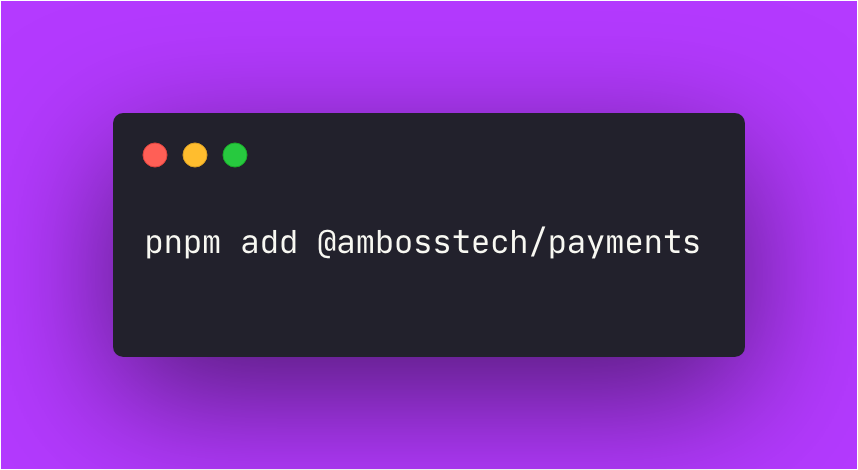
Introducing the official Amboss TypeScript SDK.
Send and receive money in USDT, USDC, and Bitcoin over Lightning, straight from your backend. Sub-second settlement, no chargebacks, 24/7.
Here is what it changes for your business. 🧵
Black Friday is in two days. If your store wants a bitcoin checkout for the weekend, you can start today.
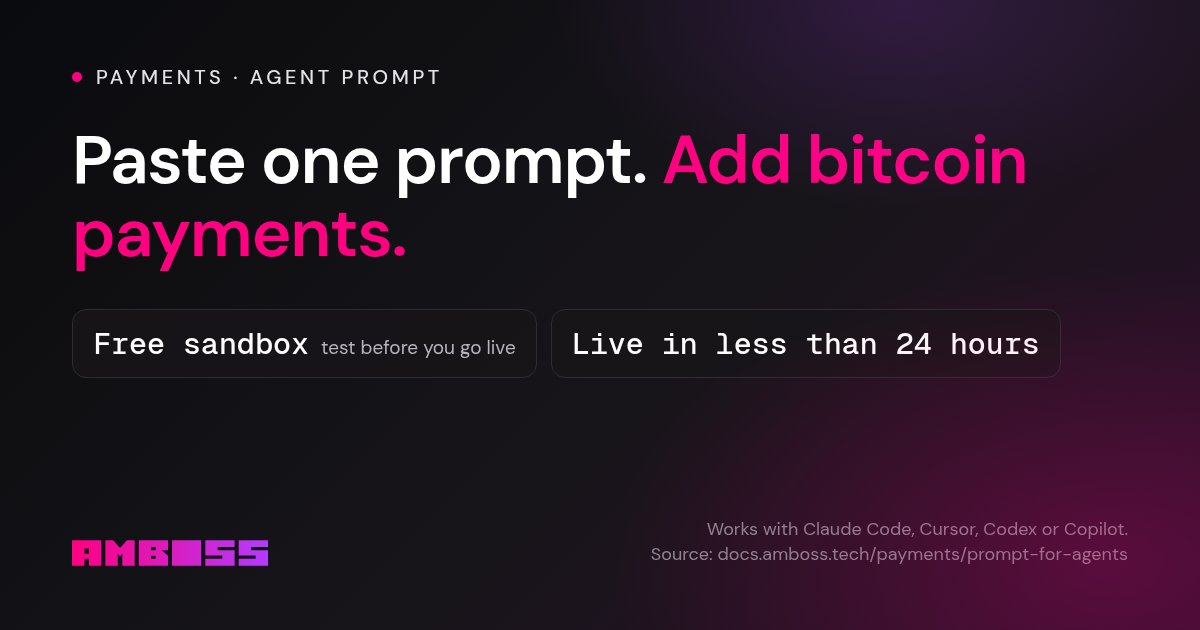
The Amboss docs have one prompt you can paste into Claude Code, Cursor, Codex, Copilot or any coding agent. It tells your AI how to add Amboss Payments to your store.
You still sign up and create a key in the dashboard, then test in the free sandbox. A store can be live in less than 24 hours.
Customers pay from Cash App or any Lightning wallet. You receive bitcoin or dollar stablecoins.
Your WooCommerce store already has a checkout. Adding bitcoin or dollar stablecoins does not have to mean building a new one.
Customers can pay with bitcoin or dollar stablecoins. They can also pay from Cash App or any Lightning wallet. A store can be live in less than 24 hours.
Amboss Payments for WooCommerce is a free plugin. You can add it to your store in a few minutes. The customer chooses a method, pays on the Amboss checkout page, and returns to your store. A signed webhook marks the order paid, and the order status changes automatically. You do not need to check payments by hand.
You receive bitcoin or dollar stablecoins. You get your own Lightning node, managed by Amboss. Completed payments are final, with no card chargebacks.
Your existing WooCommerce checkout stays in place.
Building an app with AI? Bitcoin can be the first payment method you turn on.
Ask your coding agent to add Amboss Payments. Amboss hosts the checkout page, so there's no payment screen to build.
Customers pay from Cash App or any Lightning wallet. You receive bitcoin or dollar stablecoins.
Try it free in the sandbox. Add cards later.
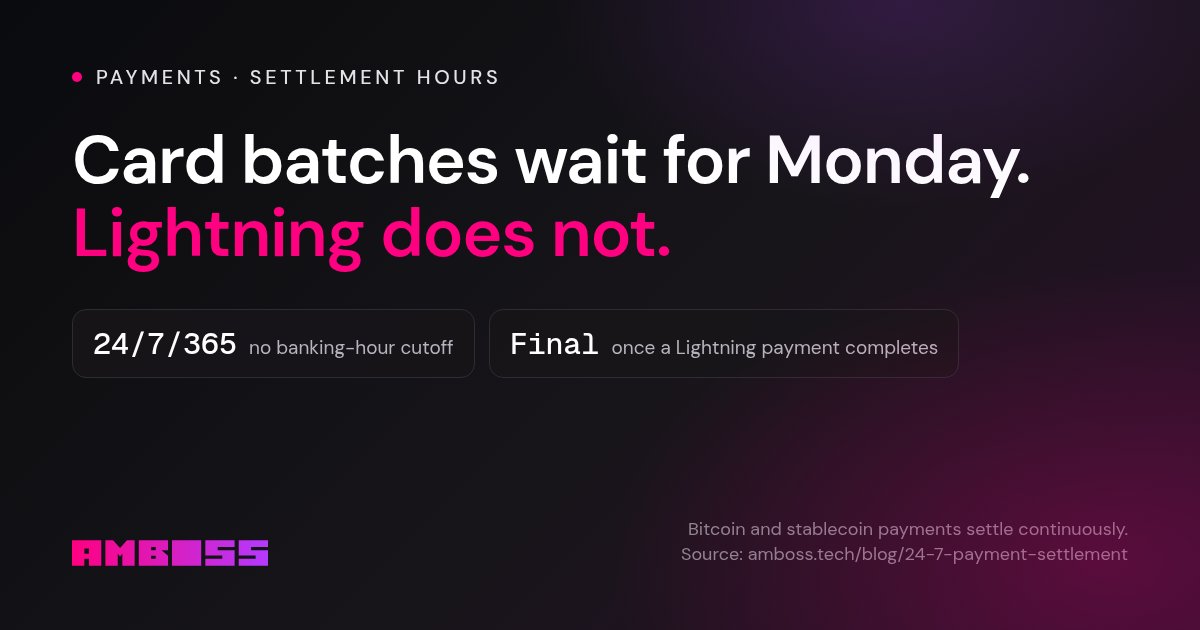
A card payment captured late on Saturday often sits until the next banking batch. In many corridors that means Monday or Tuesday before the money is actually usable.
Bitcoin and stablecoin payments over Lightning settle continuously. There is no batch cutoff and no banking-hour dependency. A payment at 2am on a holiday settles the same way as one at 10am on a Tuesday.
Completed Lightning payments are final, so there are no card chargebacks on those rails. Refunds, when you owe one, are new payments you send under your own policy.
One rail waits for Monday. The other does not.
when you feel beaten down by the price
wonder what are the next layers of financial products that will be unlocked on top of bitcoin in the next years
Block is working on human-readable bitcoin addresses
Branta is making it easier to read and authenticate bitcoin payments
Arkade is unlocking options natively on bitcoin, with a demo live on a test network
Bark is making self-custodial bitcoin ridiculously easy, with no channels or liquidity to manage
BitGo and Amboss are bringing institutional bitcoin into lightning, adding liquidity
what is coming next? i'm bullish on what we're building
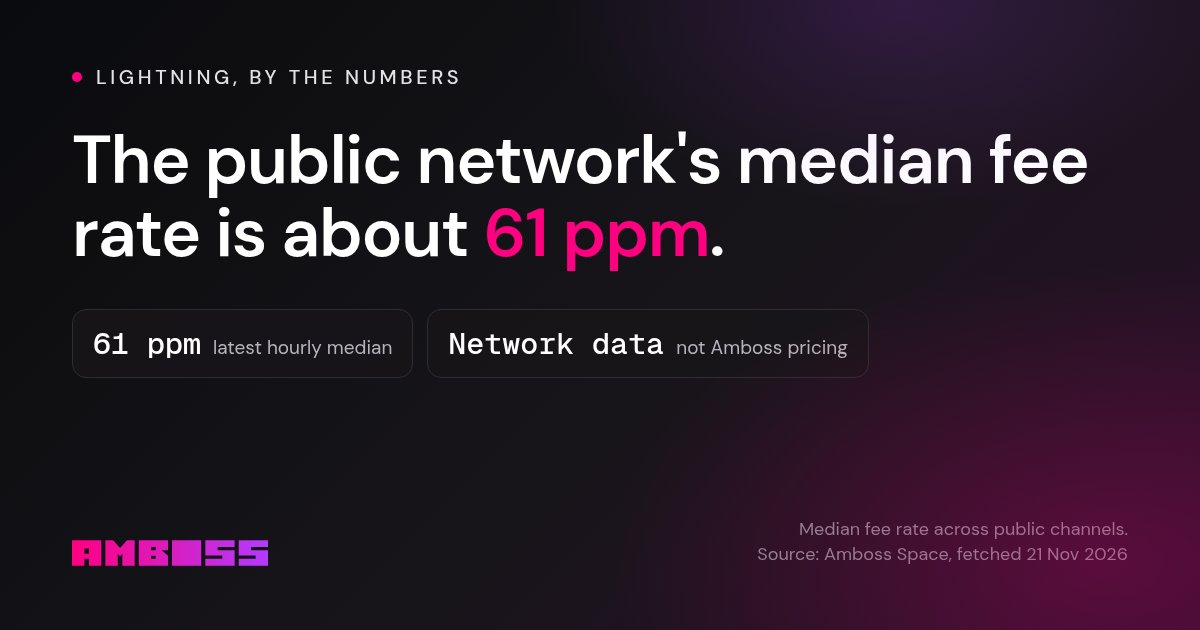
The public Lightning Network's median fee rate is about 61 ppm on the latest Amboss Space hourly snapshot.
That figure is network data. It describes what public channels advertise, not what Amboss charges a business for Payments. Amboss pricing is tailored to volume and is separate from the network fee rate.
61 ppm is 0.0061%. On a $100 payment, that advertised median is a fraction of a cent before any conversion at the edges.
Network fee data stays in the data column. Business pricing stays on a different page.
The best inbound channel for a receive-only node may never appear on the public graph.
Not every node wants to route. Some only need to receive. Magma offers private, non-routing channels: inbound liquidity for payments coming in, with the channel kept out of the public graph.
You pick the option when you buy liquidity. Magma remains a peer-to-peer marketplace: a seller opens a channel to your node for a fee agreed up front.
If your node should receive without advertising a routing position, that option is built for it.
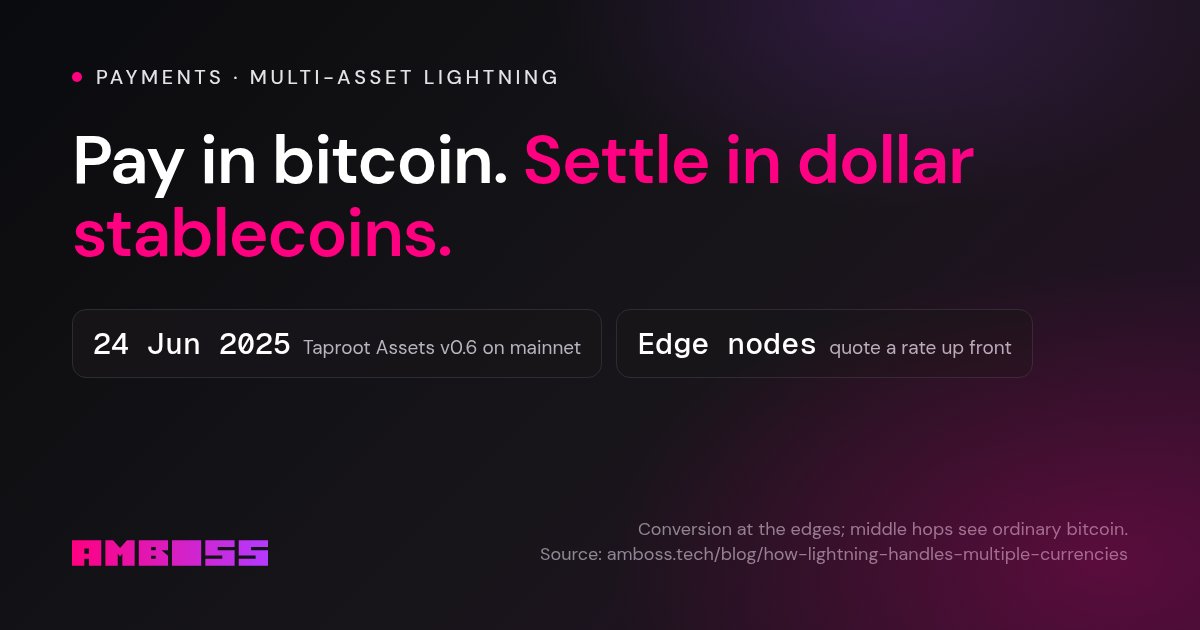
Before: a customer wants to pay in bitcoin, and your treasury wants dollar stablecoins. Those used to be two separate problems.
After Taproot Assets v0.6 went live on mainnet on 24 June 2025, both can ride the same Lightning payment. Edge nodes quote a rate up front and convert at the edges. Routing nodes in the middle only see an ordinary bitcoin payment.
For a business, the pattern stays plain. Create a fixed-amount invoice and receive that amount. The payer covers routing and conversion.
Pay in one asset. Settle in another. One Lightning rail.
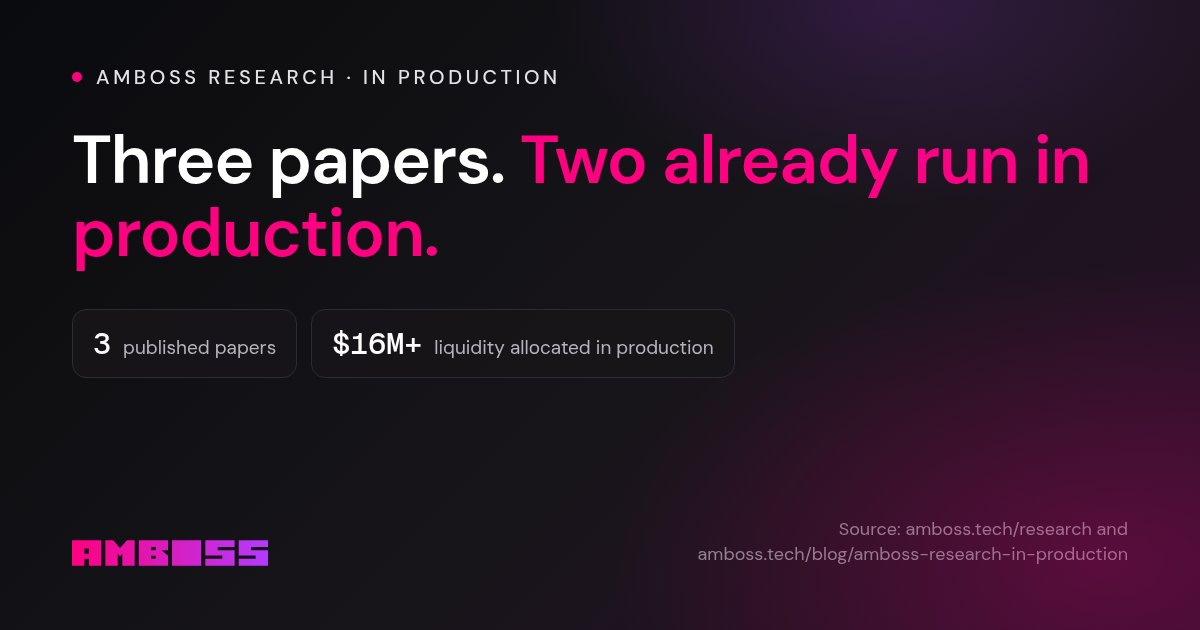
What happens when Lightning research leaves the paper and runs on live nodes? Amboss has published three machine learning papers on routing and liquidity. Two of them already run in production, and the work behind them has allocated over $16 million of liquidity across managed nodes.
Each paper targets a reason payments fail or take a longer path: where to place liquidity, how to probe a hidden balance with fewer tries, and how to estimate a channel's split from public data alone.
For a payments team, that is the test that matters. Research earns its place when it improves first-try success on the live network.
Three papers. Two in production. Over $16 million of liquidity placed.
Lightning Network, week of 9 to 15 November: node operators committed 603 BTC to new public channels, 14% more than the week before. They opened fewer channels, 1,396 against 1,473, but each one was larger. The average new channel held 0.43 BTC, up from 0.36 BTC.
So the growth came from size, not count. More bitcoin went into each new channel.
Closes also settled back after 8 November, when 1,549 channels were force-closed in a single day. This week forced closes fell from 1,723 to 357, and 78.9% of all closes were cooperative, up from 47.6%. Monday 9 November still saw 201 forced closes; from Tuesday to Sunday the cooperative share was 88.5%, against 86.1% across October.
Public capacity held at 3,238 BTC on 15 November.
Last week, small channels closed. This week, larger ones opened: 603 BTC committed at 0.43 BTC each.