FOMC MINUTES SUMMARY – DEC 2024 MEETING: OFFICIALS EXPECTED TO SLOW PACE OF RATE CUTS
RATE POLICY:
— A 25bps rate cut was broadly supported, with the majority favoring a cautious approach to further easing.
— Many participants suggested that a variety of factors underlined the need for a careful approach to monetary policy decisions over coming
quarters
— Some participants noted it might be prudent to pause rate cuts if inflation readings remain above target or economic momentum persists.
— A few officials highlighted potential scenarios to accelerate cuts if inflation trends lower or labor market softens more than expected.
— Many emphasized the importance of carefully assessing the neutral rate and moving gradually to avoid policy missteps.
RISK OUTLOOK:
— Inflation risks remain balanced, though higher-than-expected recent readings warrant close monitoring.
— Labor market risks were deemed manageable, with no rapid deterioration expected.
ECONOMIC CONTEXT:
— Inflation progress has slowed but remains on a downward path; core PCE inflation was noted at 2.8% in October.
— Labor market conditions have eased slightly, but unemployment remains low at 4.2%.
— Participants expect solid GDP growth to continue, though some noted financial strains for lower-income households.
BALANCE SHEET AND TECHNICAL ADJUSTMENTS:
— Continued reduction in Treasury and mortgage-backed securities reaffirmed, with caps set at $25B and $35B per month, respectively.
— Discussed adjusting the overnight reverse repo (ON RRP) rate to align with the bottom of the federal funds rate range.
ADDITIONAL NOTES:
— Fed emphasizes data-dependent decision-making, balancing risks to inflation and employment.
— Gradual easing remains the likely path, with flexibility to adapt if economic or inflation conditions shift.
The US economy added 227,000 jobs in November
The unemployment rate was 4.2%
Positive revisions: September is now +255,000 (vs +223,000)
October was revised up to +36,000 from +12,000
Here are tables of the ten largest ETFs with inflows (top) and outflows (bottom). The trends are interesting, and they tell us a lot about investor preferences in 2024.
Inflows
* Four of the top ten are S&P 500 trackers (VOO, IVV, SPY, SPLG). Another three are closely related (VTI, QQQ, and RSP)
* Two are the largest ETF bond funds by assets (BND and AGG)
* The only alternative is Bitcoin IBIT (Note that FBTC just missed this list at 14)
* These ten funds have almost $3 trillion in assets and over $300 Billion in flows (over $1 billion a business day this year).
Outflows
* Grayscale's GBTC and ETHE are on this list. Why? Fees matter!
* TQQQ is on this list despite being up ~59% YTD. But QQQ is in the top ten inflow but is up ~25%. Go figure
* Three are short-term Treasury funds (TFLO, SHY, VGSH), another two are credit (LQD and HYG)
* Two are value-oriented (IWD and USMV)
* These ten funds have $500 billion in assets and have seen outflows of $56 billion YTD
@EricBalchunas@JSeyff@NateGeraci
Why is silver soaring? The banks are in trouble. These details are public: Berkshire (BRK) sold 260 million shares of $BAC at $41, for proceeds of $10.6B. But Berkshire still owns more than $30 billion worth of $BAC. But probably not for long: here's what's not public, yet.
It is Fed day & everyone is focused on whether the Fed will cut today or not. As I have said forever,it doesn't matter what Fed does today because the bond market determines rates & rates are heading lower.I expect 10yr yields to fall to 2 1/2% this yr.Bullish for stocks & metals
The market is easing for the Fed on the heels of a mild June CPI, where the big story is shelter disinflation.
A September cut is mostly priced in, as is a second cut by December. Market-implied probabilities of a third rate cut this year are rising https://t.co/WPw6LcWmsZ
My Bloomberg Interview Notes - "Can The Rally Hold?"
Bloomberg hosts, Vonnie Quinn and Abigail Doolittle, have invited me on to talk about the macro backdrop I see forming as we head into the 2nd half of 2024.
In a 7 minute segment, no way can I get my perspective across, but in preparation for the interview Tuesday, I put together the following notes which I had sent to clients.
Here's the interview; Below the notes 🧵
https://t.co/h8rIY3gRGL
Key Events This Week:
1. May Retail Sales data - Tuesday
2. Stock Market Closed, Juneteenth - Wednesday
3. June Philly Fed Manufacturing Index - Thursday
4. S&P US Manufacturing/Services PMI data - Friday
5. May Existing Homes Sales data - Friday
6. A total of 10 Fed speaker events this week
We have a short but busy week ahead.
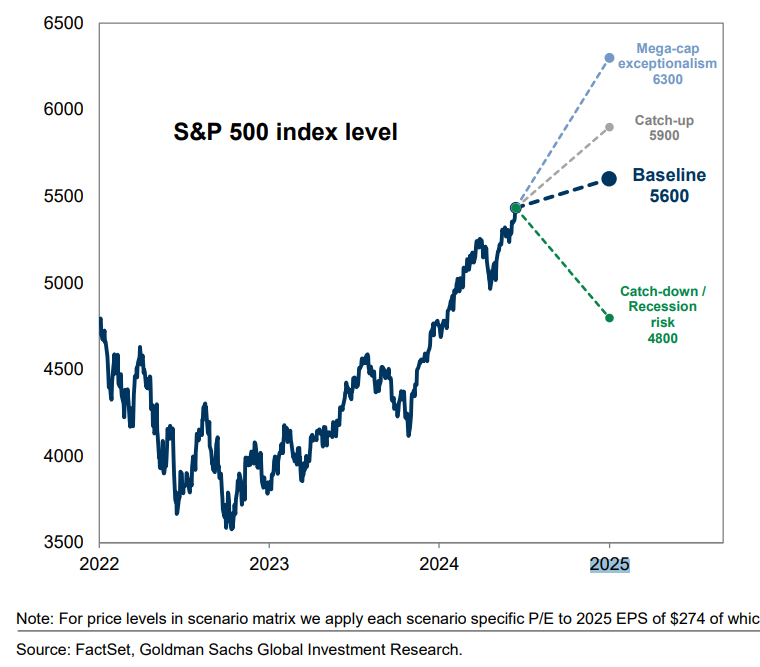
Goldman: S&P 500 path and valuation matrix: S&P 500 baseline forecast and four alternative scenarios
“Catch up,” the S&P 500 would end the year at 5900 (+9% from today)
• “Catch-down,” the S&P 500 would fall to 4700 (-13%)
• Continued mega-cap exceptionalism would lift the index to 6300 (+16%)
• Recession fears would push the index down to 4800 (-12%)
To translate this:
Four Fed officials see no rate cuts this year, up from two officials in the March projections
Seven see one cut, while eight see two cuts.
This means a narrow majority sees no more than one cut this year as a base-case.
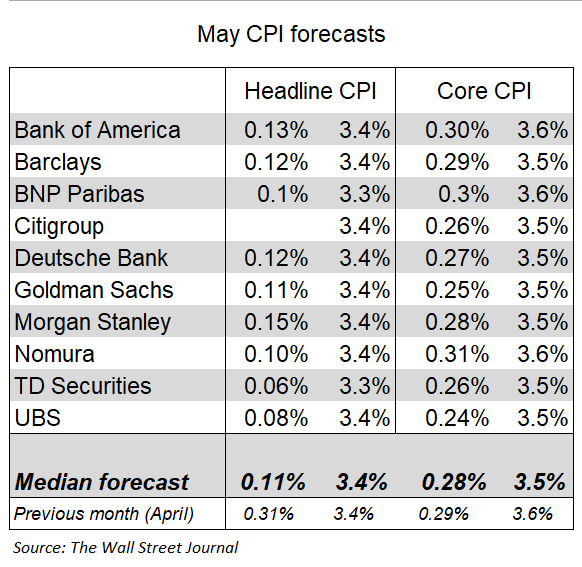
Inflation forecasters (the ones who sweat the second and sometimes third decimal place) see the core CPI posting roughly a similar increase in May as in April
An increase of 0.28% in the core CPI would lower the y/y rate to 3.5%
BREAKING: Federal regulators made a deal allowing them to proceed with antitrust investigations into Microsoft, $MSFT, OpenAI and Nvidia, $NVDA, in the AI industry, per NYT.
The NY Fed's measure of inflation persistence (the "multivariate core trend" rate) saw a big upward revision in Q1
This series has been prone to some large revisions
Jan is now +3.3% (vs prev 3%)
Feb: +3.1% (vs 2.7%)
Mar: +2.9 (vs 2.6%)
April was 2.8% https://t.co/84wzo4Vk6i
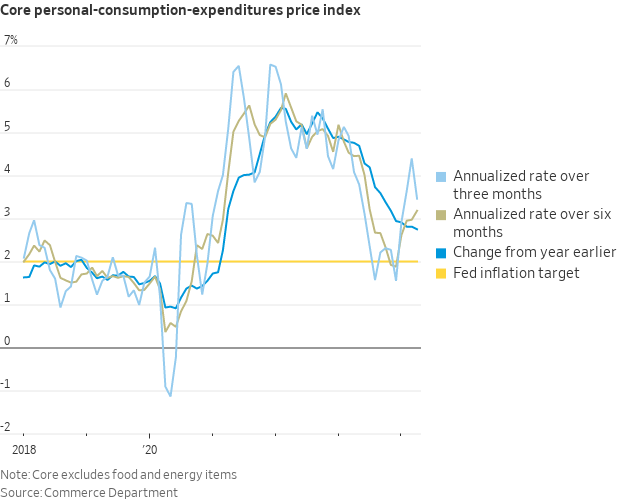
The core PCE price index rose 0.25% in April (it rounded down to 0.2% because it was 0.249%)
Jan-March figures were revised down ever so slightly.
The 12-month change was 2.75%, a three-year low
The 6-month annualized rate was 3.18%, the highest since July