#Pakistan country statement at #COP25Madrid - the world is on a warpath with #Nature - a collective retreat is needed and #Nature has to be taken on board to address #ClimateChange https://t.co/zQ4WzHdJoe
A friend got it downloaded from insta and shared with me in inbox.
An awesome video about the Indus Valley Civilization, Pakistan
Proud of our heritage 🇵🇰❤️
This years climate budget reflects a “suicidal story”with a massive decrease in climate allocations over 5 years.
“The funding or project stream for addressing climate adaptation issues, in particular heat stress, is totally missing.”
https://t.co/FwpRM3lWPT
We are closer to a peace deal than ever before. With finalisation likely expected in the next 24 hours, Pakistan is preparing for the electronic signing of the peace deal immediately after, followed by technical level talks next week.
We would like to thank United States of America and Islamic Republic of Iran for their ongoing commitment during the negotiations, and we extend our sincere appreciation to our brothers in the region for their support. We are confident that this historic peace deal will form a strong foundation for lasting peace.
@realDonaldTrump@JDVance@SecRubio@SteveWitkoff@SEPeaceMissions@drpezeshkian@araghchi
While Pakistan’s climate vulnerability dramatically increases in this Super El-Nino year the focal @ClimateChangePK remains devoid of new ideas or new funding - PSDP slashed by 83% in last 5 years (Rs 14.3 to 2.4 bn) and 95% goes to only ONE project, the renamed @Plant4Pak
"ورلڈ بینک کی ایک رپورٹ کے مطابق جنوبی پنجاب اور سندھ کے 9 ایسے اضلاع ہیں جو 2030 تک گرمی کی وجہ سے رہنے کے قابل نہیں ہوں گے ۔ شکاگو یونیورسٹی کی ایک اسٹڈی کے مطابق دنیا کے ٹاپ 15 ہیٹ ویو سے متاثرہ شہروں میں سے 8 شہر پاکستان کے ہیں ، ان شہروں میں ہیٹ کی وجہ سے ون تھرڈ اموات بڑھ جائیں گی ۔ یہ پاکستان کیلئے بہت بڑا چیلنج ہے"۔ ملک امین اسلم خان
@aminattock
سورس جاننے کیلئے QR Code سکین کریں
Pakistan’s grid is doing something rare. Fossil has fallen from 66% to 44%. Nuclear is scaling. Solar is breaking out, wind is joining in & decentralised rooftop solar is scaling at an unprecedented pace. Meanwhile, hydro holds the system together as the generational shift begins.
For two decades, Pakistan’s power mix barely moved. Fossil sat around 60–70%, hydro carried ~30%, and everything else was marginal. Then the energy transition began, and it didn’t follow the usual script.
Nuclear moved first. From ~2% in 2000 to ~17% by 2025, it’s one of the few systems globally where nuclear share is clearly rising. That growth is deliberate, built, and running at high capacity, quietly strengthening the backbone of the grid.
Wind edged in gradually. But the real disruption came from solar. From effectively zero to ~8% in a short window, driven less by policy and more by economics. High tariffs, unreliable supply, and cheap panels triggered a massive surge in behind-the-meter installs.
That’s the key nuance. A large share of Pakistan’s solar boom sits off-grid and isn’t fully captured in official generation data. It makes the system look slower to change than it actually is, and makes building a clean dataset far more challenging than in most countries.
Two very different forces are now moving together. Nuclear is scaling from the top down, engineered and centralised. Solar is spreading from the bottom up, reactive and decentralised. They’re not competing. They’re stacking.
Hydro sits in the middle, doing what it has always done, balancing and stabilising the system. Fossil is still large and still necessary, but it’s no longer growing. From ~66% down to ~44%, it’s clearly losing ground.
Pakistan hasn’t followed a clean transition pathway. It’s been pushed into change by cost, constraints, and demand. The result isn’t one technology replacing another. It’s a system being reshaped from multiple directions at once.
Hydro anchors. Nuclear scales. Solar breaks out. Wind warms up. Fossil fills what’s left.
Not merely a transition. A system under pressure, starting to bend.
Great data backed pitch for Pakistan in #China - by Omar Saeed for SLM Tyres - LM China invested $35 mln in 2001 and now after only 5 years valued by PSX at $235 mln. The best and largest FDI over the last decade Mashallah - #Pakistan Zindabad
BREAKING!
Trump announces, after having had phone calls with the leaders of Saudi, UAE, Qatar, Pakistan, Turkey, Egypt, Jordan, and Bahrain - and separately with Israel - a deal between the US and Iran, subject to final approval, has essentially been reached.
If you were wondering why warmongers in Washington have been freaking out, it's because of this: Peace is their nightmare.
A few points:
1. Trump knows he will be attacked for this deal. The regional anchoring of this deal is not only important for its viability on the ground, but it also gives him a degree of protection in Washington. Obama managed to get massive international backing for his deal, but limited to lukewarm anchoring in the region.
2. Trump uses "The Islamic Republic of Iran," instead of just Iran, which will be noticed in Tehran.
3. Trump says he also spoke to Netanyahu and that the call "went well." The absence of details is interesting here.
In summary: The two sides have not crossed the finishing line yet, but it is now visible and within reach.
Do we Pakistanis realise what we have given to the world?
1. Pakistan’s fingerprints are everywhere on this peace
2. Million dead – prevented
3. Global oil chaos – prevented
4. Global economic shock – prevented
5. Islamabad is no longer merely a capital
6. Islamabad is the heartbeat of global peace
7. THAT IS WHAT PAKISTAN HAS GIVEN THE WORLD
@mrubin1971 Pakistan shall continue to boldly play the role of a global peace maker - while racist rabbids like yourself can drown in your painful frustration
No doubt a huge opportunity to be capitalized - also with its rising global credibility as a trustworthy mediator for #peace - #Pakistan is also well positioned to frame a possible #Debt4Peace swap to bail it out of its economic morass
Iran without sanctions: Pakistan’s $36b upside
PAKISTAN shares a 900-kilometre border with one of the world’s largest energy endowments: 208 billion barrels of proven oil — about 12 per cent of global reserves, the third largest in the world — and nearly 1,200 trillion cubic feet of natural gas, the second largest after Russia. Combined, this resource base carries an estimated market value of around $20 trillion.
The 900-km border is the most under-traded, under-piped, under-utilised asset Pakistan has. What can move across it? One: crude oil — 8–10 million tonnes a year, worth $4–6 billion. Two: diesel, petrol, furnace oil — $2–3 billion. Three: LPG, ethane, naphtha — $1–2 billion. Four: fertilizer and downstream chemicals — $1–2 billion. Five: cross-border electricity — 1,000–2,000 MW, worth $1–1.5 billion. Total tradable energy basket: $9–14 billion a year.
Red alert: Pakistan’s most valuable corridor is not blocked by geography—it is blocked by policy. What can be piped? Natural gas — 750 to 1,000 mmcfd through the Iran–Pakistan pipeline — replacing imported LNG and saving $5–7 billion a year. Refined fuels through product pipelines — diesel, petrol — cutting logistics costs and import leakages by another $1–2 billion. Add it up: $6–9 billion annually. Not from new discoveries. From moving molecules more intelligently.
How can the 900-km border be monetised? Start with Gwadar — storage, blending, transshipment — a $1–2 billion opportunity. Add transit: Iran–Pakistan–China flows, pipelines and trucking corridors, another $2–3 billion annually. Then the real prize — petrochemicals. Feed cheap ethane, LPG, and naphtha into fertilizer, plastics, and polymers. Export more. Import less. That’s $5–8 billion. Add it up: $8–13 billion a year.
Add it up. At the low end: $9 billion plus $6 billion plus $8 billion — $23 billion a year. At the high end: $14 billion plus $9 billion plus $13 billion — $36 billion a year. A $23–36 billion opportunity. The menu is large. Execution has been negligible. Red alert: This is not theoretical. This is not distant. This is sitting on a 900-km border. Pakistan’s balance-of-payments problem is, at its core, an energy problem (annual energy imports $20–25 billion). Every dollar saved on LNG, oil, and diesel is a dollar earned. Stack those savings — gas substitution, crude discounts, imported electricity — and they begin to behave like revenue. This is Pakistan’s energy arbitrage margin.
Remember: Pakistan does not run out of rupees — it runs out of dollars. And those dollars leave for three things: oil, LNG, and petroleum products. Why hasn’t Pakistan monetised the 900-km border? Three reasons. One: sanctions risk — banks, insurers, and contractors step back. Two: contract credibility — investors fear policy reversals and payment delays. Three: fragmented decision-making — multiple ministries, regulators, and provinces, each with veto power.
Red alert: Capital does not wait. It walks away. The day sanctions lift, capital will not queue — it will race. China will move from Gwadar inward. Turkey will position itself as a westward hub. Gulf players will secure upstream stakes. The first mover captures the corridor. The late mover pays transit. What does Pakistan need to do? Pakistan needs three decisions. One: ring-fence energy contracts with sovereign guarantees. Two: create a single-window authority with binding timelines. Three: pre-negotiate pipeline, refinery, and grid agreements before sanctions lift. Yes, sanctions may persist. Yes, geopolitics can shift. But Pakistan must prepare for upside, not just manage downside. Countries that wait for certainty miss opportunity.
Total impact: up to $36 billion – roughly 10 percent of Pakistan’s GDP. That’s nearly one-tenth of the entire economy. That’s equivalent to most of Pakistan’s annual export earnings. That’s a large chunk of total federal revenues. This is not a marginal opportunity—it is a balance-sheet event. Pakistan is not energy-poor. It is policy-poor. Fix the 900-km border — and the dollars will follow.
https://t.co/JyoUNuqBBG
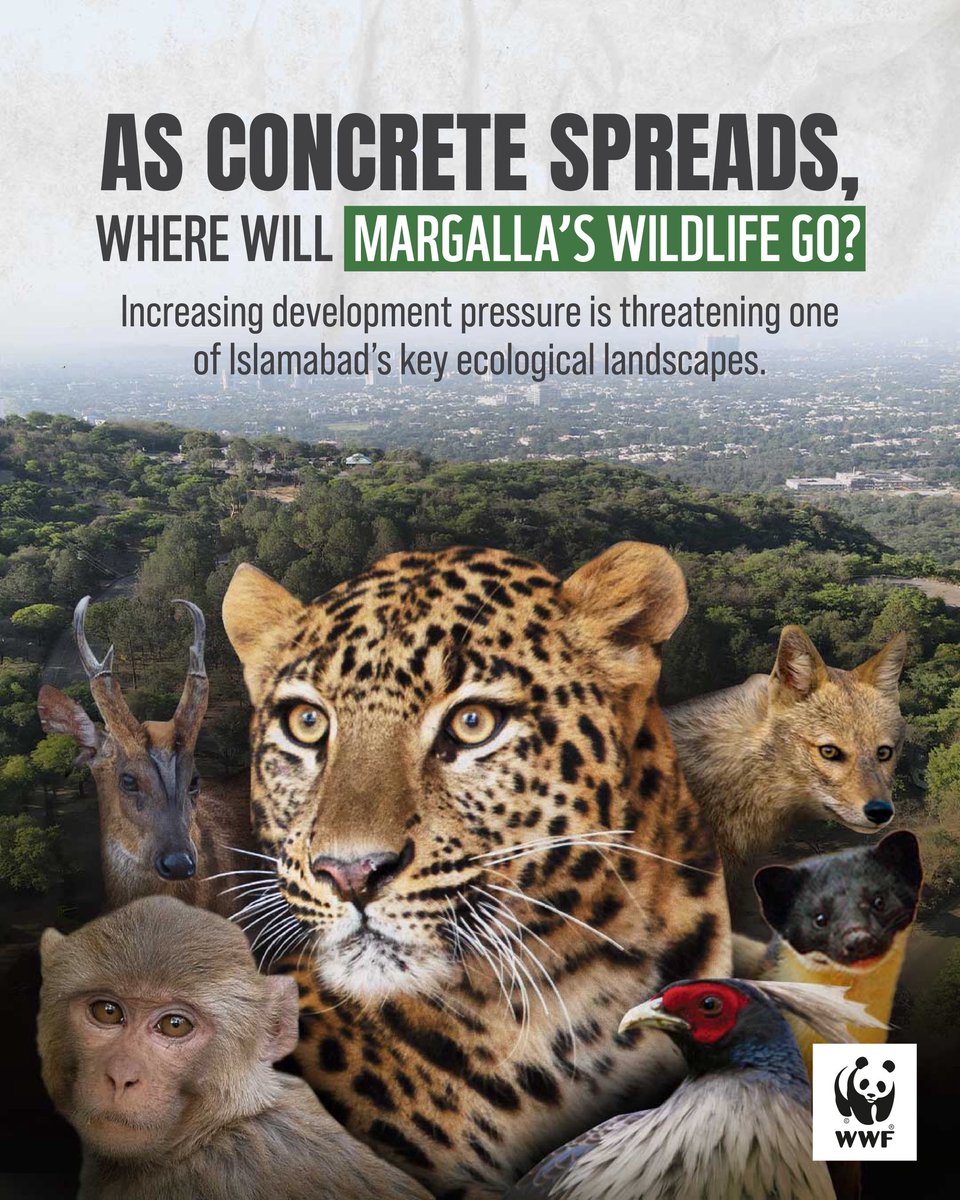
WWF-Pakistan expresses serious concern regarding ongoing and proposed development activities in areas adjoining Margalla Hills National Park, particularly within ecologically sensitive foothill zones.
These activities raise significant risks for one of Islamabad’s most important ecological landscapes, including habitat fragmentation, disruption of wildlife movement corridors, and long-term degradation of ecosystem services.
Given the ecological sensitivity of the Margalla Hills, WWF-Pakistan urges that all development activities follow strict environmental safeguards, transparent assessment processes, and science-based planning.
Read the full statement here: https://t.co/QrNvJ3HebX
Margalla Hills is part of Pakistans most prominent #NationalPark and the #Astolla Island is part of Pakistans first announced #MarineProtectedArea - @MohsinnaqviC42 kindly take steps to protect and preserve these natural treasures and not announce schemes to destroy them
🚨 A new park will be built on 1,000 acres at the foot of the Margalla Hills, and five-star hotels will be built in 🇵🇰 Islamabad under joint ventures with international-standard firms.
- Mohsin Naqvi