@AbdulElSayed is not even a Senator yet, but he is still more on message than the majority of the Democratic caucus.
WELKER: Would you support Democrats if they shut down the government to defund the war with Iran? EL-
SAYED: Let's be clear -- it wouldn't be Democrats shutting down the government. It would be Donald Trump choosing his war over a functional government.
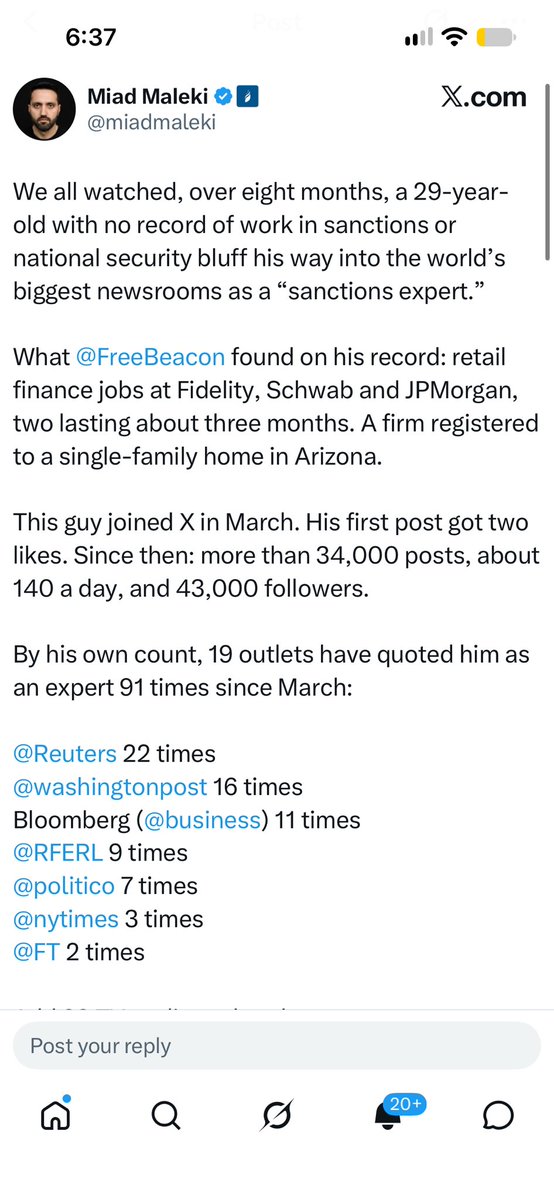
Maybe The Foundation For Defense of Democracy should release information on their OWN funders, Clifford.
Here’s a deal, I’ll let you look into my bank records if you let me look into FDD’s.
I have nothing to hide, do you?
Late on Friday, one senior Iranian political source denied to @amwajmedia that a final decision had been made on any tanker convoy being dispatched to challenge the US blockade.
Separately, an informed political insider in Tehran maintained that ambiguity remains over what may come next—even as top officials warn that “no war, no peace” will not last.
The idea of dispatching a convoy and then striking GCC energy infrastructure if the US intervenes was floated in IRGC media affiliate Fars before the weekend.
Hardliners welcome the idea, while others posit that loading oil on Chinese vessels to China would be a more clever move..
With no warning, explanation, or recourse available, @X suspended @TheCradleMedia's account. We are a MEDIA organization, ffs. We're not on this platform spouting offensive drivel. Check our feed and tell us what frigging rule we "violated." And then get some DISCIPLINE back into your business.
Strait of Hormuz attacks have increased to highest level since Iran war began
Reported attacks in and around the Strait of Hormuz have been higher in number in October and November than any previous months since the war between the U.S., Israel and Iran began in late February, according to data compiled by maritime organizations.
https://t.co/4zCCgZKdzb
Spoke in depth with @MarioNawfal about Iranian calculations re a potential challenge to Trump's blockade.
A fundamental concern is that the war cannot be allowed to end with the normalization of a blockade that didn't exist before the war began.
https://t.co/WzOddm5eEf
MUST READ: Can a Country Be Guilty of Genocide? Finally, the Answer Is Yes.
"The decision, by nine of the 15 judges, strikes a blow for the rule of law as much as in any international case in which I have been involved. It reinforces the legal meaning and practical effect of the term, which has been deeply contested — as reflected by the six sharply dissenting judges, who argued that Myanmar may have committed human rights violations and war crimes, but not genocide. The debate over the meaning of the term, both within the court and in public discourse, will no doubt continue as the court addresses the other genocide case before it: South Africa’s claim that Israel has committed genocide in Gaza."
https://t.co/hzMsRctVMY
🇮🇱🇺🇸 Israel's ambassador told Americans their troops come home "when Iran is defeated"... then spent the next day walking it back
Thousands of military families are setting a Thanksgiving table with an empty chair, and on Thursday a foreign diplomat went on American TV to tell them when it gets filled.
Eli Clifton noticed what the answer skipped, which was any mention that the decision belongs to the American president.
That part arrived a day later as a clarification.
The Quincy Institute analyst, speaking as a Jewish American, wanted an apology with it, because he says remarks like this feed a false and ugly trope about who steers US wars and leave American Jews to absorb the backlash.
His case for keeping the two countries' goals separate starts with a superpower and a mid-sized state 6,000 miles apart:
"Why would they have synonymous interests."
Allies can want different endings to the same war.
@EliClifton@WeTheBrandon
If Trump rejects another round of war, he is still more likely to walk away and declare victory than to strike a deal. But for that walk-away option to work, he must allow the blockade to wither away.
Told @AJEnglish that even Israel may grudgingly accept this option, as it helps avoid Israel's worst-case scenario: A US-Iran deal that ends the enmity and formally lifts sanctions.
Tehran is showcasing its missiles to deter the US, signaling that contrary to Israel's argument that Iran's retaliatory capabilities can be eliminated in seven or so days, Iran retains a formidable arsenal and that Israel's latest proposal is just another misguided fantasy.
Told @AJEnglish that though many in the Trump admin would like to withdraw from the Middle East militarily, there is a difference between leaving the region proactively and doing so because the Iranians have blown up your bases.
Pressed on whether HE would have started the Iran war, Vance once again answers the question by avoiding it, and instead repeats that his job as VP is "to support the President of the United States."
Meaning, he wouldn't.
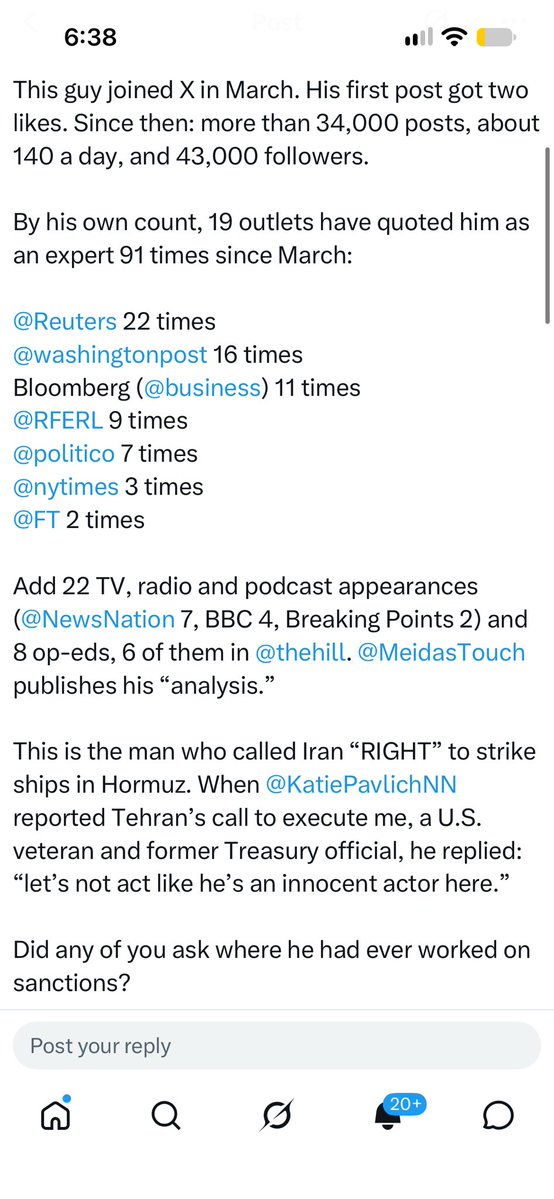
Miad,
You pushed “13 days to oil well shut-ins” and published that within weeks of the blockade being imposed, Iran would experience a food and medical supply crisis.
Maybe you should sit this one out.
Tehran is taking a significant step to change the status quo and the red lines that uphold it, in line with Mojtaba Khamenei's edict that there has to be either war or peace, but nothing in between.
The status quo pre-midterm was that the US turned a bit of a blind eye to Tehran bypassing the US blockade—via STS.
After the midterms, having rejected military options, Trump ordered an intensification of Bessent's economic warfare, including clamping down on Tehran's use of STS to get its oil out. This also entailed more attacks on Iranian radar and missile sites.
Iran has responded by striking US bases in Kuwait and Bahrain, as well as further targeting ships transiting the Strait of Hormuz without Iranian approval.
Now, Tehran is apparently taking a major step to shift the status in its favor: Tehran is going to send oil tankers (not just STS) through the Strait in defiance of Trump's blockade - but with the threat that if the US blocks the ships, Iran will strike at oil facilities in GCC states.
That is, Tehran is shifting the fault lines: The blockade is an act of war, and if it is implemented, there will be war, not just occasional strikes.
Tehran is doing this partly because it has observed Trump's many empty threats and prolonged hesitation to restart the third round of war and concluded that Trump knows that he has no good military options. If, in his mind, good military options existed, Trump would have exercised them by now, Tehran believes.
As a result, the calculation is that Tehran can shift the fault lines through the threat of escalation, i.e., striking GCC oil facilities if Iran cannot sell its oil.
It's unclear whether this gamble will work, but in my assessment, it increases the likelihood of Trump gravitating toward the Swiss Cheese option I have written about. That is, Trump declares victory, walks away, but in order to make the new status quo somewhat stable and disincentivize Iran from escalating, Trump slowly ceases to implement the blockade and oil sanctions.
I wrote about this option earlier today:
https://t.co/bKuq5tK676
Rumor in NY this week was that the P3 had agreed on a Secretary General (Lana) during the summit in China.
Clearly this was not the case as she received three negative P5 votes (!)
I am furious that Section 219 fuses our military with Israel’s.
Today, I led a letter calling for the repeal of Section 219 from our defense bill.
I will talk to every House colleague to get this out.
That utterly preposterous CNN story on chemical weapons and dirty bombs, which scared Scott Bessent into a bunker, is revealed by the NYT to have been fed to us by Israel.
CNN must have known that but clearly left that detail out because it would have completely undermined the story. Everyone assumed it anyway.
Is the Israel lobby losing its grip on America?
For decades, the Israel lobby has wielded enormous influence over American politics, shaping elections and setting the terms of US policy towards Israel. But as public opinion turns against Israel over the genocide in Gaza, is that influence beginning to slip?
As the dust settles on the 2026 midterms, the lobby faces an uncomfortable question: can its millions still buy political influence as the tide turns?
This week on The Tea, investigative journalist Eli Clifton joins us to unpack the money, donors and political networks behind America's Israel lobby. He spent 15 years following the money in politics. His latest book, co-authored with Ian Lustick, Israel's Lobby: America in the Grip of a Foreign Power, investigates how the far-right government of a small Middle Eastern country came to hold a controlling interest in United States foreign policy.
Out now!
https://t.co/QiAFZbFpM3
It’s a novel-worthy irony that at the end of the Trump era, the only people who will be happy with him are the neoconservatives and omni-hawks — who initially fought hardest against his rise.