“We live in a culture that is psychologically illiterate; that elects psychopaths and malignant narcissists to political office; that falls for mental health snake oil and fads; that is fooled by performative Insta-therapists and mistakes self-promotion & marketing for knowledge;
Few novels have captured the experience of adolescence as powerfully as The Catcher in the Rye.
And its final line has become one of the most quoted in modern literature:
"Don't ever tell anybody anything. If you do, you start missing everybody."
What did Holden mean?
🧵
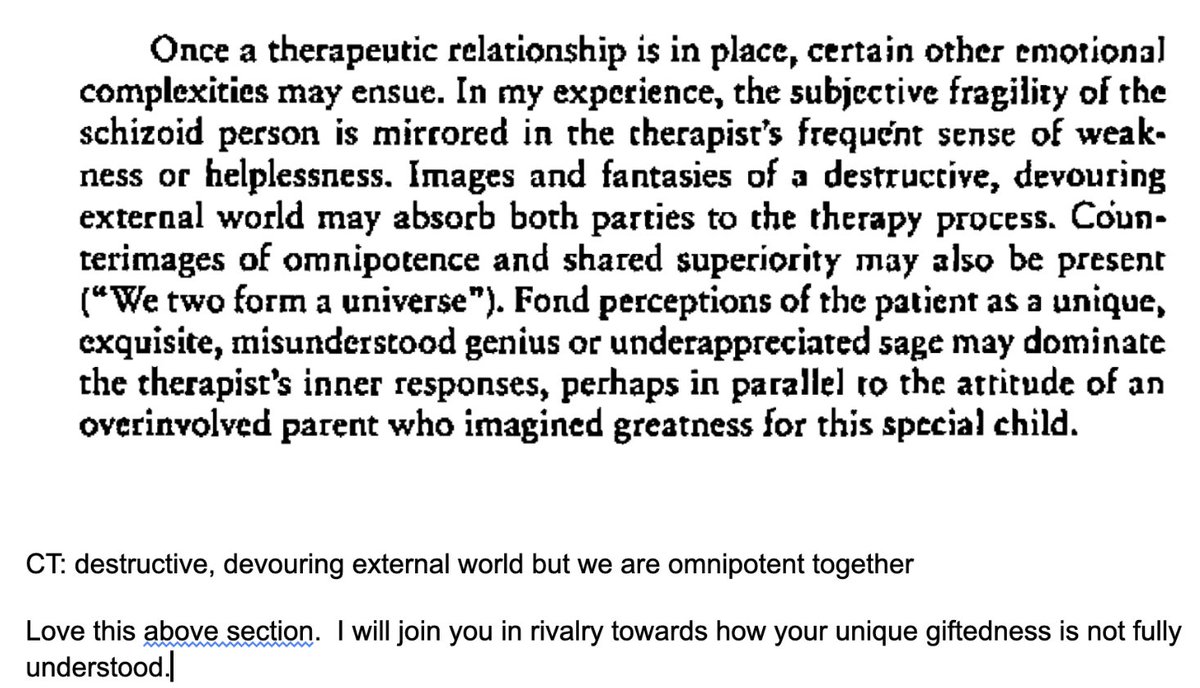
The more I study Nancy McWilliams' personality wisdom, the more I have empathy for the experience of people different from myself.
Making notes slowly. I have read this chapter about 5 times on schizoid but still picking up new things.
The fundamental insight of psychoanalysis is that the mind is divided against itself.
We are of many minds. We have conflicting and contradictory motives. That was Freud, circa 1900. No living person originated this insight. It does not belong to any therapy "brand."
Generations of psychotherapists have refined this understanding and developed ways of applying it in psychotherapy to help patients become more self-aware and whole.
It is not proprietary knowledge, you don’t need to become a devotee of a therapy acronym, and you don’t need a certification from a for-profit business.
This insight goes back to the early 1900s and is the starting point of all psychotherapy approaches that work toward greater self-awareness and wholeness.
The tragedy of the psychotherapy professions:
Serious clinicians do their work in private and focus on developing their clinical skills.
Therapy influencers seek the public spotlight. Their skillset is self-promotion and digital marketing. They are often showmen and profiteers giving a cultural performance of “expert” for a public audience.
Because real psychotherapists work in private while influencers seek the spotlight and consume the oxygen, public perceptions of "therapy" are now shaped by profiteers.
The public is losing the ability to distinguish knowledge from marketing, and so are some in the therapy professions. Many therapy trainees who sincerely want to become skilled psychotherapists and strive for excellence don't know where to turn for quality training or who to trust.
This is the tragedy of the psychotherapy professions. I fear things are only going to get worse.
“The more narcissistic version of masochistic personality dynamics, sometimes called moral masochism, applies to people who equate self-renunciation and suffering with virtue.
Self-esteem is tied to deprivation and suffering: the greater the deprivation, the greater the sense of virtue. Such people hold the conviction, often unconscious, that their suffering makes them morally superior. They may self-righteously seek to demonstrate their moral superiority to others…
Moral masochism is relatively prevalent in the mental health and other helping professions. These professions offer ample opportunities for self-sacrifice, for example, by attending to others’ needs at the expense of one’s own. Disavowed sadism is often revealed through intolerance, harshly critical attitudes, or outright aggression toward others who fail the moral masochist’s purity tests. Thus, moral superiority, self-righteousness, self-sacrifice, and sadistic cruelty can coexist.”
—N McWilliams & J Shedler, Psychodynamic Diagnostic Manual, 3rd edition (PDM-3; 2026)
This wasn’t “therapy.” Kids who had no identified mental health problem got a classroom training program pushed on them that they didn’t ask for and couldn’t opt out of.
So sick of people calling anything and everything “therapy.”
Real psychotherapy
1) happens *in private*,
2) is always voluntary
3) is meant to address a personal MH concern that therapist and patient both agree about.
None of these conditions were met. Stop misleading people by describing it as “therapy.”
This is how AI creates the illusion of being helpful. People typically ask AI about things they *don’t* know, not what they do know. The model’s priority to generate output that *sounds* good, not to be accurate. Ask about your own area of expertise and the illusion shatters.
What I say to patients in situations like this is: let’s put aside the labels for now and determine if we have a shared understanding of what the relevant problems are. Is there a longstanding pattern of mood instability and reactivity, intense, volatile attachments, unstable self-image, and impulsive self-destructive behaviors? If so, let’s not lose sight of that, and let’s explore it, including its connection to trauma and social communication difficulties and substance use, and let’s figure out what we can do to remedy this.
It can be very easy for people who have never professionally sat with people (and their families) who experience the devastation of mental illness to pontificate about its existence and treatment from an armchair.
Here is the problem when people point to “studies” to advocate for their views (especially on social media).
Unless they are themselves expert researchers in the subject area, they do not know what the published findings mean, how to evaluate their credibility, or whether they are consistent with established knowledge.
Research studies then become a form of rhetoric (or less kindly, propaganda), without concern for scientific merit.
“The end result of being driven by electronic devices is a form of... relatedness where we expect others to give us immediate responses and meet our narcissistic needs. Relationships become more superficial.”
—Glen Gabbard
“More and more people are in individual talk therapy, learning a new vocabulary to apply to their lives.”
—Olga Khazan, The Atlantic
This is exactly what should NOT happen in psychotherapy. If a patient comes out of therapy with a slew of new vocabulary words or speaking in “therapy speak,” something has gone terribly wrong.
Skilled therapists sound like people, not like therapists. People who get good therapy come out of it sounding more like themselves, not more like someone else.
Our choices of marital partners, our vocational interests, and even our leisure-time pursuits are not randomly selected; they are shaped by unconscious forces that are in dynamic relationship with one another.
Glen O. Gabbard
“Endless feelings and validation” is not psychotherapy. It’s what “therapists” do when they don’t know how to do psychotherapy.
The psychiatrists’ comments are dismaying. They have an obligation to know what competent psychotherapy is, whether or not they offer it themselves.
Narcissistically structured people may use a whole range of defenses, but the ones they depend on most fundamentally are idealization & devaluation..This grandiosity may be felt internally, or it may be projected. Realistic advantages & disadvantages may be completely overridden by concerns about comparative prestige.
Nancy McWilliams
“It used to be that a socially avoidant woman would come for therapy saying something like, ‘I’m a painfully shy person and I need help learning how to deal better with people in social situations.’ Now a person with that concern is likely to tell me that she ‘has’ social phobia—as if an alien affliction has invaded her otherwise problem-free subjective life.”
People talk about themselves in acronyms oddly dissociated from their lived experience: ‘my OCD,’ ‘my eating disorder,’ ‘my bipolar.’
There is an odd estrangement from one’s sense of an agentic self… and consequently one’s possibilities for solving a problem.”
—Nancy McWilliams (Diagnosis and Its Discontents: Reflections on Our Current Dilemma, 2021)