Turning the Wheel: There’s Room for Your Story
In Parshas Vayeitzei, we hear Leah’s longing in the names she gives her sons. We hear Rachel’s in the words she says to Yaakov. Two sisters in the same home, and the Torah makes room for both of their stories.
You can grow up sharing a room with a sibling and only find out years later what it was like for them.
There’s room for your story, there’s room for your pain, and there’s room for your healing.
If you’ve been holding on to your story, we’re here to listen. Amudim’s case management services are free, and you can reach out whenever you’re ready.
Good Shabbos 💜
@zgluck
Sometimes the hardest part of telling someone you're struggling is wondering how they’ll see you once they know.
You finally say it out loud and watch for their reaction. Then they look at you with the same love they always have. And for a moment, the darkness inside becomes a little lighter.
If you find yourself in the darkness, you are not alone.
Our caseworkers can help you find your path forward.
Call Amudim. (646) 517-0222
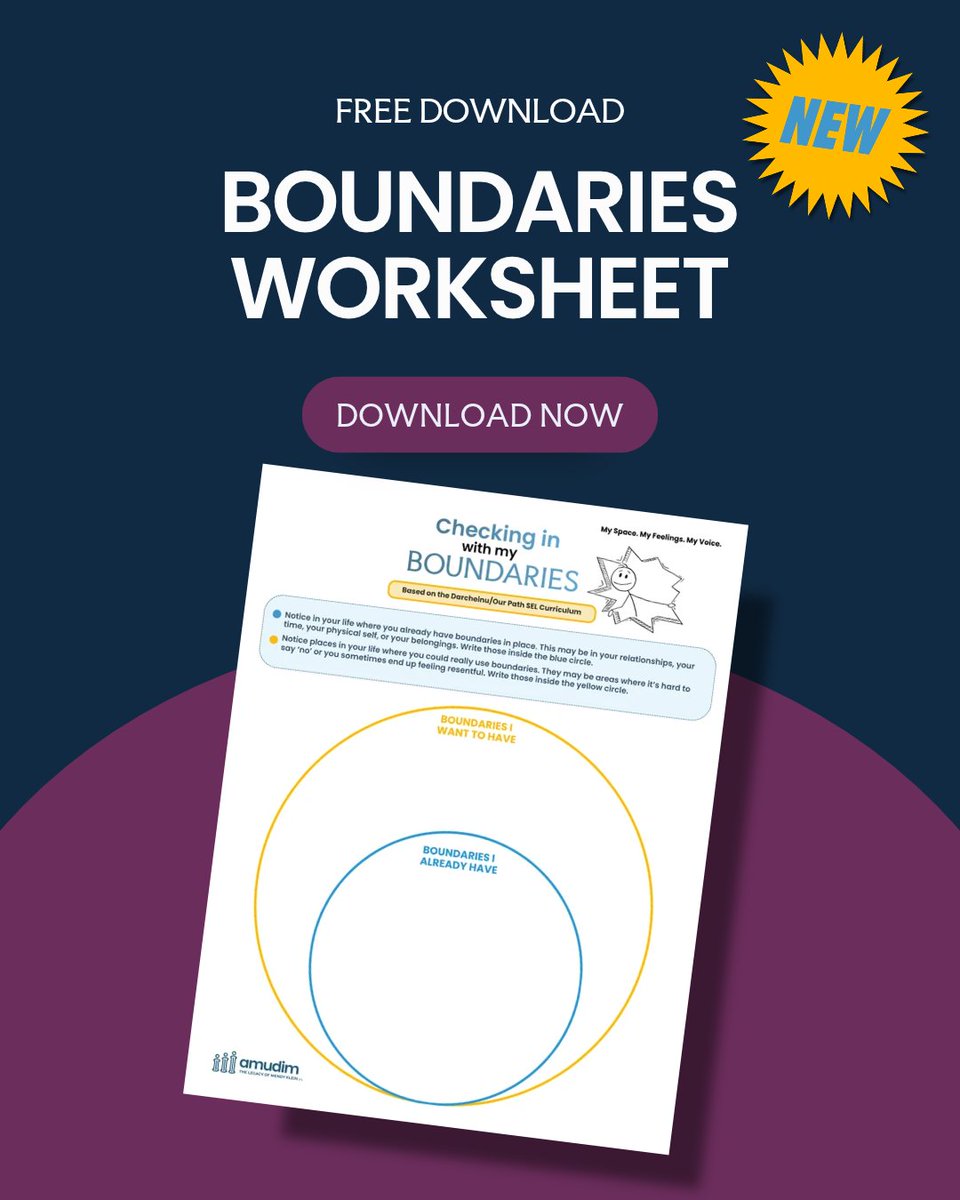
Introducing Checking In With My Boundaries, a free downloadable worksheet that gives us a chance to sit with our kids and notice the boundaries they already have.
From there, we can ask where they’d like to set a new one and give them time to tell us, in their own words, what that might look like. 💜
Download the worksheet: https://t.co/dcl7uG2Uo2
Turning the Wheel: A giving heart still needs somewhere to turn. In Parshas Toldos, Rivkah reminds us that caring for others leaves room to care for ourselves.
As we head into Shabbos, if something is weighing on you, reach out to a friend, a family member, a therapist, or Amudim. You don’t have to carry it alone.
Good Shabbos 💜
@zgluck
Yesterday, we shared a scenario inspired by a student’s question about caring for a friend while making room for her own needs.
Mrs. Shira Berkowitz, LCSW, Director of Darcheinu/Our Path SEL, holds both with such care: the giving heart we want to nurture and the child learning to understand where and how they can establish boundaries.
Chesed helps our children discover the good they can bring into someone else’s life. Our part is helping them learn to reach with their feet still steady beneath them. 💜
We teach our children to notice what others need. But what do we say when they feel their own needs disappearing?
A student in one of our Darcheinu social-emotional learning classes brought a question like this to her teacher. We changed the details to protect her privacy, but the heart of it remains.
If your child came to you with this, what would you say?👇
It’s a beautiful thing when a child wants to be someone others can count on. We want them to feel just as comfortable speaking up when it becomes too much.
Rabbi Grossberg, Ms. Ed. of Darcheinu/Our Path SEL reminds us that teaching emotional boundaries means making room for that honesty, especially when a child doesn’t want to let anyone down.
We can help them keep that generous heart without losing sight of their own needs.💛
Turning the Wheel: What siyata d’Shmaya that after a week of talking about boundaries under our own roofs, Parshas Chayei Sarah brings us right into Sarah Imeinu’s tent.
So much of the love that goes into raising children shows up in moments only our families see. In Sarah Imeinu’s zechus, may we all be blessed with shalom in our homes, laughter around our tables, and so much nachas from one another.
Help fund Amudim’s life-changing work: https://t.co/1btAOrjN0g
@zgluck
If you’ve ever heard “He won’t let me play!” and “I was playing by myself first!” land on you at the exact same time, you already have a place to start.
This week’s Under One Roof worksheets help us talk with our kids about boundaries in those everyday family moments.
Download all three FREE worksheets and see where the conversation goes: https://t.co/dcl7uG2Uo2
These everyday moments give children something to carry into their friendships, their classrooms, and the lives they’ll build: the experience of being understood and practice offering that to someone else.
We can put safeguards in place even when everything feels fine. They help give our children room to play, connect, and grow with boundaries that protect their privacy and personal space.
Today, our SEL team talks about being attentive to what happens under our roof and helping our children know that whatever happens, there’s room to tell us. 💛
This week we are diving into boundaries in our homes.
Our children grow up sharing everything: a room, a bathroom, the back seat, the last cookie. It’s where they learn to love people up close. It’s also where they practice boundaries on each other all day long. And they take their cues from us: what we do the second someone in our house says stop.
Week 3: *Under One Roof.* Part of _My Space. My Feelings. My Voice._, a parenting series by Amudim.
As parents, we all stumble from time to time over what to say in the moment. After all, we’re human.
A few thoughtful words, followed by the space to hear our children out, can make a world of difference.
And the words we offer them can become the ones they reach for when someone they care about is hurting and needs to be heard. 💜
Shavua Tov! ✨
Did you know our parenting series also has an email edition? Once a week, straight to your inbox, with practical ideas and free printables like “Flip the Script” and “Ask Me First” to try together at home.
Sign up at https://t.co/kf1NsAGPab, or scroll to the bottom of the page for this month’s free printables!
We learn empathy from Hashem Himself.
In Parshas Vayeira, Hashem hears Yishmael ba’asher hu sham—right where he is.
Our children need us to meet them there, too. To pause, listen, and make room for what they’re feeling. How we respond today helps them decide whether to come to us tomorrow. @zgluck
It takes practice.
Sometimes disappointment, big feelings, and a few deep breaths together. Having us beside them makes a difference.
What we practice with them today becomes what they carry into their relationships tomorrow. We’re raising children who know their voice matters, and so does someone else’s.
That is no small feat. 👏🏻
Wishing you and your family a Shabbos filled with joy and connection. 💛
We’ve spent this week talking about empathy. How to teach it to our kids, how to hold it together with boundaries, how hard it actually is to do well.
It takes a lot of empathy to do this work. To pick up the phone and sit with someone on the worst day of their life and see a brother, a sister, a neighbor, not a case.
So today we would like to show our gratitude. To the Amudim staff and case managers, the ones who carry that empathy into every day. To every person who has followed this series and brought it home to their own family. And to every donor who makes it possible for us to keep showing up.
“Empathy minus boundaries is not empathy.”
That quote comes from Brené Brown, and it’s where the 10th-grade Darcheinu unit on boundaries begins. Mrs. Shira Berkowitz, LCSW, opens the class by writing it on the board because the two can’t be separated. We want to feel what our kids are feeling. But if we’re so enmeshed that their hurt becomes ours, we can’t help them anymore. We’re not separate.
Boundaries aren’t division. They’re respect. Here’s what’s okay for me, and here’s what’s not.
And as Rabbi Yisroel Grossberg, M.S.Ed., puts it, when a child feels heard and understood and is still told no, it makes a much deeper impression.
It can be hard to stay with someone else’s feelings when so much is coming up in us.
When our child comes home saying they had a terrible day, we can take a breath and set down what’s weighing on us before deciding what happens next.