Go outside for a walk, get some fresh air, eat some grass 🍀, and stop staring at the screen all the time.
If you're still there, you already have an advantage over many others
survive the boring and the painful part, the next move usually rewards patience
$BTC
🚨Latest News:
US-IRAN MOU PUSHES BRENT BELOW $80 AS TRADERS PRICE IN STRAIT OF HORMUZ REOPENING
Global oil prices hit a two month low on June 16, with Brent crude briefly dropping below $80 a barrel and WTI crude falling 4% to $77.43, driven by enthusiasm over a U.S.Iran memorandum of understanding (MoU) to reopen the Strait of Hormuz
Key Takeaways:
•
• Brent fell below $80 on June 16 as the U.S.-Iran MoU lifted Hormuz reopening hopes
•
• WTI dropped 4% to $77.43, but IEA damage data point to tight Gulf supply
•
• Bull Theory sees a 30 day Hormuz restart, with inflation risk over 12 to 24 months
•
Severe Infrastructure Damage Hinders Recovery
Oil price declines continued Tuesday, with Brent crude briefly dropping below $80 a barrel hitting a two month low as enthusiasm grows over a memorandum of understanding (MoU) between the U.S. and Iran. Market data showed the global benchmark fell to an intraday low of $79.63 a barrel before rising back above the $80 threshold
The U.S. benchmark, West Texas Intermediate (WTI) crude, fell 4% to $77.43 a barrel. WTI crude has plunged by nearly 20% since the beginning of June, underlining the Strait of Hormuz’s continued importance to the oil market
While details of the MoU have not been formally released, widespread reports say the deal compels Iran to reopen the Strait of Hormuz. In exchange, the country will reportedly receive sanctions relief, billions of dollars in unfrozen assets and potentially billions of dollars in investment
Although the release of oil stranded in the Persian Gulf may temporarily weigh on prices, analysts caution that restoring Middle East output to prewar levels could take years, leaving the market structurally tighter than it appears
According to a social media post by market research platform Bull Theory, while the MoU could end the conflict that impacted nearly all oil-producing Gulf states, $58 billion in oil infrastructure damage remains. The International Energy Agency (IEA) estimated that more than half of the 80 energy facilities attacked during the war were severely damaged
The Bull Theory analysis outlines the harsh realities the global energy industry must grapple with once the agreement takes effect.
“Equipment needs to be inspected and certified safe before restart,” Bull Theory explained. Workers need to return to facilities that were recently under attack. Insurance markets do not immediately return to cover a region that was at war last week
Adding to these structural concerns, energy investment firm HFI Research noted that the current sell-off exposes a massive disconnect between algorithmic “paper” trading and physical reality. The firm points out that while financial markets are aggressively pricing in peace, global oil inventories have already plummeted to critical lows due to the prolonged outage of roughly 11 million barrels per day during the conflict. Once traders realize that paper promises cannot immediately conjure physical barrels from depleted reserves, a sharp upward reversal is likely
Furthermore, while the MoU dictates that the Strait of Hormuz will reopen within 30 days, the physical supply slated to flow through it will likely take months or even years to return to full capacity
“That gap between oil prices falling and energy supply actually recovering is where the inflation problem sits for the next 12 to 24 months,” Bull Theory added
🚨 bitcoin:native
Profit taking across bitcoin, ether, solana as traders wait on the Iran signing
AU.S.-Iran deal pulled oil lower and lifted stocks, but bitcoin's bounce is hesitant. ETF outflows just paused after a record run, and analysts say the market wants the deal signed before pricing it in
What to Know
• Bitcoin briefly topped $67,000 but is lagging the broader relief rally in stocks and oil as traders treat the tentative Iran peace deal with caution.
• Analysts say crypto investors are wary after two prior cease-fire rallies quickly reversed, and many are waiting for the June 19 signing and this week’s Federal Reserve decision before committing.
• Spot bitcoin ETFs have just emerged from four weeks of heavy outflows, suggesting institutional demand remains muted even as coins quietly move off exchanges into cold storage
Bitcoin (BTC) briefly traded above $67,000 late Monday before slipping back under $66,000 in a move that is indicative of how cautiously crypto is treating the Iran peace deal that has rallied other markets
The token changed hands at $65,845 on Tuesday, up 0.3% over 24 hours and 4.8% on the week, per CoinDesk data. It touched a 24-hour high of $67,217 before fading. Ether held up better, rising 2.8% on the day to $1,764 and 5.8% on the week. Solana gained 3.2% to $73, XRP added 3.2% to $1.22 and Hyperliquid's HYPE led the majors again, up 6.3% to $69
The macro backdrop turned sharply friendlier on Monday. President Donald Trump and Vice President JD Vance signed an electronic copy of a memorandum of understanding with Iran, and Trump said the Strait of Hormuz, already partially open, will fully reopen on Friday
solana:4ikwYoNvoGEwtMbziUyYBTz1zRM6nmxspsfw9G7Bpump
If America wants to lead in crypto, it must protect the people who build it
Despite the Clarity Act's advancement toward the finish line, there's one provision under threat for builders that can't be overlooked, argues Smith. tv
The crypto industry’s leading founders, CEOs and investors recently signed a single letter to Senate leaders with one request: do not weaken the Clarity Act's protections for software developers. These are competitors, rivals for talent, capital and market share. Yet they agree on this because they understand what is at stake. Strip the developer protections out of the bill, and the United States risks pushing the people who build this technology offshore and forfeiting its lead in the next era of finance
Congress is closer than it has ever been to giving digital assets a real regulatory framework. The Senate Banking Committee advanced the Clarity Act with bipartisan support, and the bill is now poised to move to the Senate floor for a full vote
But one provision is under threat. The Blockchain Regulatory Certainty Act, or BRCA, is the foundation everything else rests on. It draws a bright line: if you write open-source software, run a node, or help validate transactions, and you never take custody or control of anyone's money, you are not a money transmitter under federal law
Bitcoin hits a two-week high above $65,500 as the US Iran deal sends oil sliding
A peace agreement that reopens the Strait of Hormuz pulled the geopolitical premium out of oil and put back into risk assets
What to Know
• Bitcoin rose about 2% to roughly $65,800, its highest level in nearly two weeks, after the United States and Iran reached a deal to end hostilities and reopen the Strait of Hormuz
• The agreement eased energy-supply fears, sending Brent crude down more than 4% toward $83 a barrel and lifting global risk assets, including major cryptocurrencies and Asian stocks
• Analysts say bitcoin’s rebound may be limited by ongoing concerns over institutional demand, including ETF outflows and recent sales by Strategy, even as the Iran-related risk premium fades
Bitcoin climbed to its highest level in nearly two weeks after the US and Iran reached a deal to end hostilities and reopen the Strait of Hormuz, removing the energy-supply fear that had weighed on markets for months.
The token traded around $65,844 on Monday, up 2.1% over 24 hours, after touching a low near $63,722 in the early hours of Asian trading before the deal news broke, per CoinDesk data
The move puts bitcoin about 9% above the sub-$60,000 low it hit last week, its weakest level since October 2024
🚨 $Bitcoin
Bitcoin could crash to $48,000, if this historical pattern is triggered
A pattern stretching back to bitcoin's earliest days has held through every market cycle. It has yet to be tested in the current one
What to Know
• Every bitcoin bear market has retraced more than 61.8% of the move from near zero in early 2010 to the latest bull market peak.
• With bitcoin’s latest peak above $126,000, that 61.8% retracement now sits around $48,215, implying prices could fall sharply from current levels near $64,000 if the historical pattern holds.
Bitcoin (BTC) has a unique pattern, and it has held across every major bullish cycle since the cryptocurrency began trading near zero 16 years ago. This pattern suggests that prices could crash to at least $48,000.
The pattern works like this. Draw Fibonacci retracements from near zero – BTC began trading at $0.003 in February 2010 – to bull market peaks reached in June 2011, November 2013, December 2017, and November 2021.
The bear markets that followed these peaks saw prices crash well below the 61.8% retracement of the entire move from near zero to the bull peaks. This has happened every time, as seen in the charts below
Bitcoin is no longer just a retail narrative.
We’re watching it slowly transition into a macro asset that reacts more to liquidity cycles than to hype cycles.
After the 2024 halving, supply issuance dropped again, but the bigger story isn’t the halving itself it’s what came after: institutional positioning.
ETF flows changed the structure of demand. This is no longer a who’s buying the dip market. It’s now “who is allocating capital at scale, and when.
What’s interesting right now is how Bitcoin is behaving less like a risk-on tech asset and more like a liquidity barometer. When liquidity expands, BTC moves first. When it tightens, BTC feels it immediately.
Short-term price action will always look noisy, but the underlying structure is becoming more rigid:
Fixed supply
Increasing institutional access
Reduced retail dominance in marginal flows
People still try to value BTC like a speculative asset, but the market is slowly forcing a reclassification.
The real question going forward isn’t “how high can it go,” but:
What happens when every major allocator is already structurally exposed to it?
That’s where things get interesting
$BTC #BTC
SEC's big swing to clear tokenization path isn't likely to get resilience of full rule
Former SEC lawyers say that using its power to grant tokenization "innovation" efforts an exemption from securities law isn't as strong as a full fledged rule
What to Know
• The U.S. Securities and Exchange Commission's forthcoming "innovation exemption" for tokenization isn't expected to rate at the top of the agency's hierarchy of policy durability, despite the crypto sector's years-long wait to get U.S. rules set in stone.
• Former SEC lawyers say the agency's power to exempt activity from securities laws would still be difficult to reverse, though agency leaders have said this initial policy will be narrow and time limited
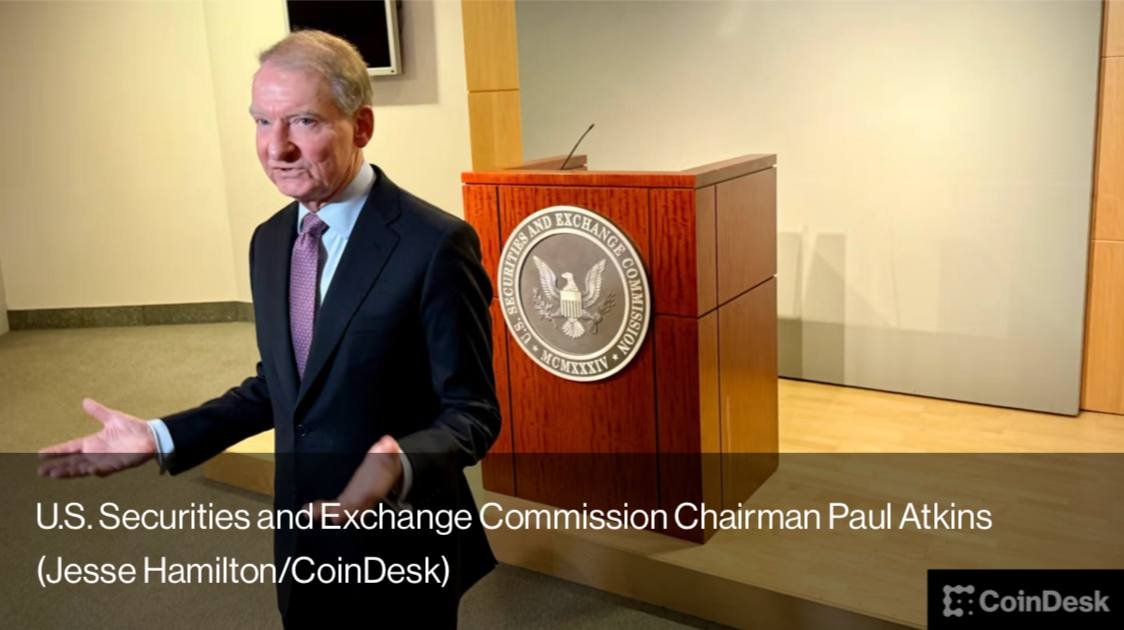
The U.S. Securities and Exchange Commission is preparing one of the most consequential of Chairman Paul Atkins' crypto policies, a new approach that grants some regulatory leeway to those seeking to tokenize securities, such as company stocks. But it's not yet what the crypto sector has asked for: permanent policy it can rely on, which still may be a long way off
The SEC has an option to pursue formal tokenization rulemaking the closest it can get to carving something in stone, with a process that involves multiple rounds of public comment and revisions that incorporate that feedback. But the agency instead signaled it's working on exercising its standing authority to exempt businesses from securities laws, planning to temporarily grant abilities to put assets onto blockchains as a proving ground to test potential financial innovations