‘Slowing down’ or sometimes what we call ‘waiting’ or ‘pausing’ in the educational or clinical setting is one of the toughest but most effective strategy to learn in supporting children’s learning and communicatiom development. #EYeducSLP
This week we are focusing on slowing down.
Check out our thread from yesterday for more and sign up for our newsletter to get tips and insights sent directly to your inbox! Link in bio.
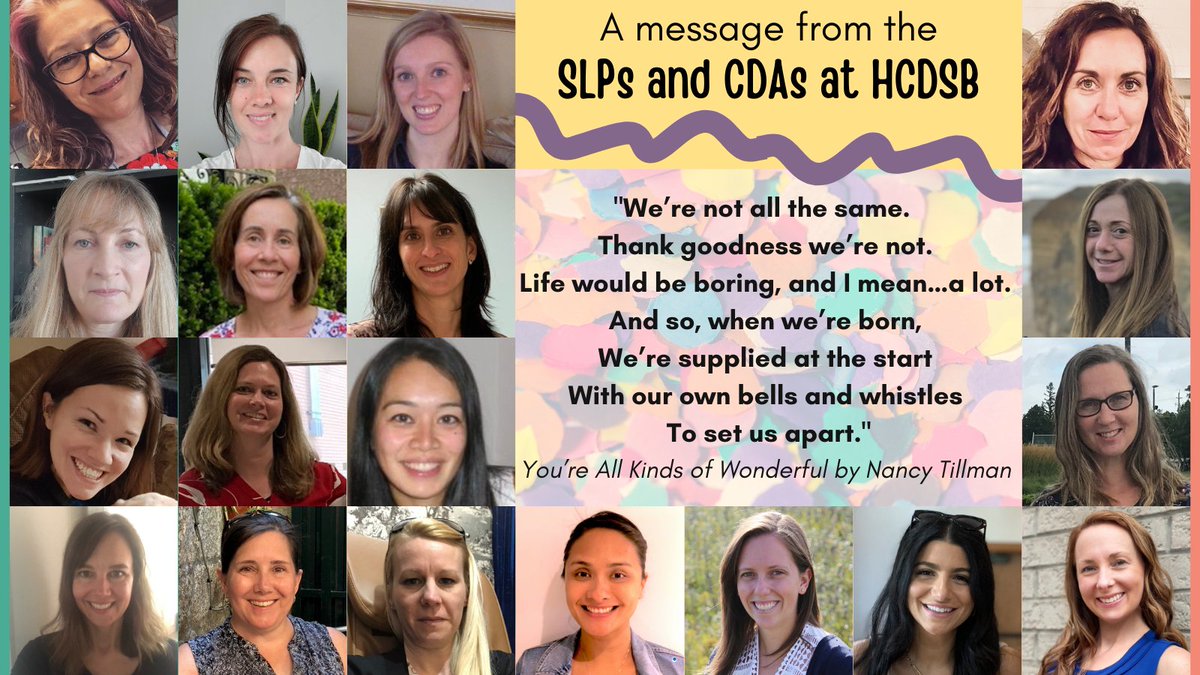
"Who knows the bells that are planted in you? Maybe 19 or 102. Before you were born you were fitted & packed with all kinds of wonderful...that is a fact!"
@HCDSB_SLPs_CDAs are honoured to work with students. You amaze us every day with what you have learned & how you have grown!
Reading aloud with children is known to be the single most important activity for building the knowledge and skills they will eventually require for learning to read. – Marilyn Jager Adams
My godmother, a truly amazing woman, once said to me, “Before you say something, ask yourself: is it honest, is it loving, is it necessary.” What if we all applied this filter to our public comments? We could elevate our public discourse significantly. And we need to.
#CanadianSLPs have you seen the fantastic work of this dynamic trio? They're Ontario school board SLPs working collaboratively with educators to implement a structured literacy program.
https://t.co/2OsFq6AGQZ
“Watch your habits, for they become your posture. Watch your posture, for it creates your boundaries. Watch your boundaries, for they restrict your growth. Watch your restrictions, for they create immobility. Watch your immobility, for it becomes your illness.”―Katy Bowman
Have you heard of Childhood Apraxia of Speech (CAS)? CAS is a speech disorder. Children with Apraxia of Speech have normal speech muscles, but have difficulty moving these muscles in a quick and organized way for speech.
Learn more https://t.co/Tf6863S3Z4
A child’s behaviour is a form of communication. Let’s support our little ones by helping him or her develop the language to communicate his feelings, thoughts, and actions. https://t.co/CwSLlXokZ8
@jlwsmith Thanks for sharing! The use of the word “tolerance” has been a looming issue for me in terms of developing this pyp attitude. Wonder what’s a better word to capture the very essence of what it is abt.
"I calibrate my actions
to align with my vision,
not a dysfunctional organization,
not in response to the behaviors
of individuals, and not in reaction
to a fleeting feeling or thought.
I know who I want to be
and what I want to do in the world."
--@artofcoaching1
When teachers use humor, students feel better about the content, the teacher, and even themselves. Using self-directed humor, funny headlines/quotes, movie clips or other media, and creating a class symbol for humor are all time-tested and dependable sources for humor.