🎙️ This week, FTSG's @amywebb joined host @meghamama on @Marketplace to unpack a growing shift in how ideas circulate online. Amy discusses what private forums mean for democracy, discourse, and the future of digital communication. Listen below👇
https://t.co/rdZUTlYdes
Wow! What an amazing session with @amywebb!
Amy delivered powerful insights on Emerging Tech Trends! Her expertise in strategic foresight and innovation is truly unmatched. ✨
At long last @amazon’s Kuiper finally launched. It’s the long-planned low Earth orbit satellite network that will compete against Starlink to disrupt our current internet infrastructure.
https://t.co/1o6UguaAuY
Big book sale over at @amazon today and my books are deeply discounted.
If you're interested in the future of #AI: https://t.co/HnNgaD7aPG
Future of #Biotechnology and #synbio: https://t.co/pO9IjbmBBX
How to get started with strategic foresight: https://t.co/U5ZkCPL3l8
...but I can imagine this in the future being used to create real-life personas.
To wit: How would @pmarca or @peterthiel actually react to your pitch deck? Run a simulation and predict the probability of either one investing.
Here's the paper: https://t.co/u2IcELN3SU
Would Tony Stark fund your startup?
There's a new AI benchmark that might answer the question. The Turing Test (and others) judge an AI system's conversational ability, but ROLETHINK assesses whether the agent's "internal reasoning" aligns with the character it portrays.
ROLETHINK is a benchmark specifically designed to evaluate the inner thought process consistency of Role-Playing Language Agents (RPLAs).
Meaning: What would Tony Stark think about this particular situation?
This benchmark uses literary character monologues and expert analyses as ground truth to measure how well an agent's generated "inner thoughts" match its motivations and reasoning patterns. Which is fun if you want to gauge Ironman's thoughts on your pitch deck...
This was (and still is) my core argument: AI development is not just a tech issue—it’s a geopolitical and economic one. Tariffs are not the whole story, though it’s the current mode we’re in.
The U.S. and China are engaged in a deepening rivalry in which AI becomes a tool of strategic and economic influence, with massive implications for global order.
I wrote his passage in my book The Big Nine back in 2018. It was a warming about a new form of economic warfare.
“The AI arms race isn’t just about who will build the most advanced systems—it’s about who will control the future of data, governance, and economics. China is already using its centralized authority and national AI plan to build an infrastructure that exports not only its technologies but also its values and influence…
…The United States, meanwhile, continues to let a handful of powerful companies set the tone for innovation, without a coherent national strategy. This is a form of economic warfare, where dominance in AI means dominance in trade, finance, and global politics.”
If you weren't able to join us at SXSW this year, the video of my presentation is now available to stream. This year I focused on what everyone's missing in #AI, as well as why this is the #robotics era (I showed what was announced by #NVIDIA this week), #biocomputing, and critical questions leaders across business and government must ask now.
https://t.co/sY7WvXtq0a
If you're fixated only on AI, you're missing the bigger picture. 2 more technologies are converging with #AI to form something called "Living Intelligence."
Sorry folks, but we aren't preparing correctly for what's ahead. Read my latest in @HarvardBiz
https://t.co/sI3msYJG3T
Traditional strategic planning falls short in today's world. Embrace a futurist mindset to stay ahead: anticipate disruptions, create scenarios, be agile, and collaborate. Learn more from #Thinkers50 Ranked @amywebb via her @HarvardBiz piece: https://t.co/E9AB2bqJW9
Futurist, author, founder and CEO of the @FTI, @amywebb, explains how #AI will help push solutions and creativity in new ways.
Watch her 2024 #SXSW Session on this year's #tech trends. ▶️ https://t.co/GNvehD2frb
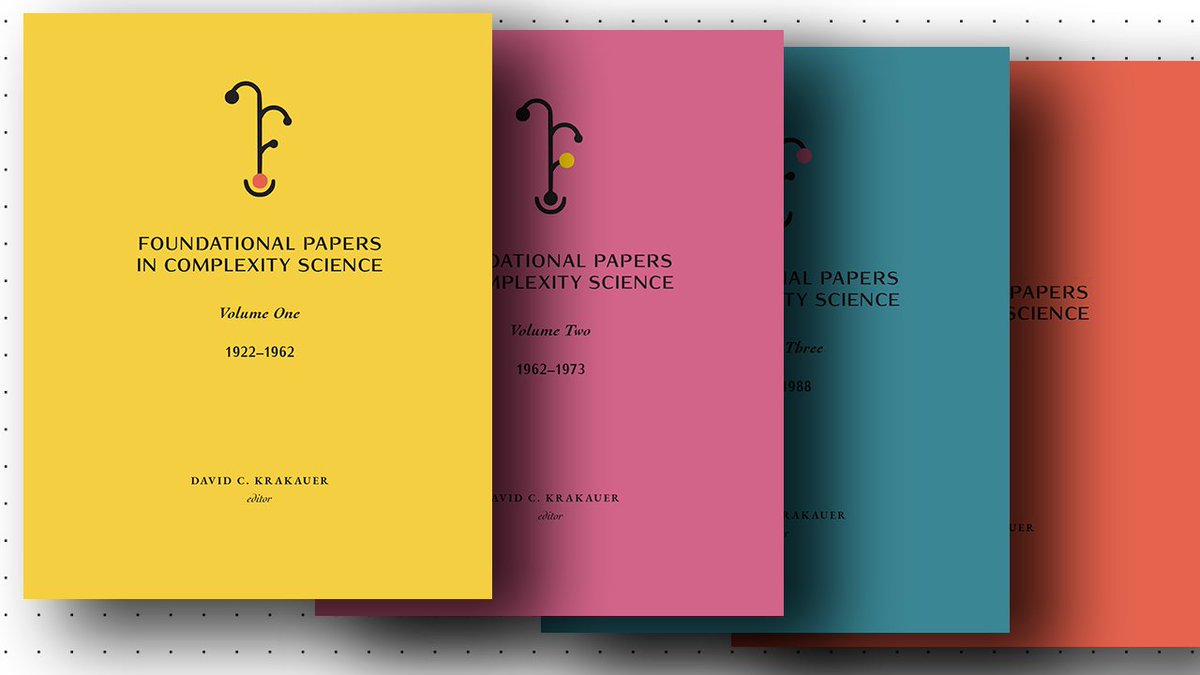
📚 The @SFIPress’s latest project, “Foundational Papers in Complexity Science,” republishes 88 influential papers, providing contemporary insights into the field’s origins and evolution over the past century. From entropy to computation, these papers explore the fundamental pillars shaping our understanding of adaptive systems across biology, computation, and culture.
⚡ The first two volumes are out and available for purchase now, and the third and fourth volumes will be available this summer.
https://t.co/7GmaNnBrqm