A Historic and sacred moment at Kowdiar Palace, Ananthapuri — Her Highness Aswathi Thirunal Gouri Lakshmi Bayi and Prince Avittam Thirunal Aditya Varma reverentially received His Holiness Sri Sri Sri Yogishwara Swami, the 45th Peetadhipathi of the eternal Siddha Guru Parampara since 596 AD.
A divine confluence of royalty, Dharma, and living spiritual wisdom — reminding Bharat that the timeless flame of Guru Parampara still shines through realized masters.
“When wisdom awakens within, the world itself becomes a temple.”
Secure your Copy Now, available in both Amazon and Flipkart
#mustreadbooks
#divine #guru #blessings #exploremore #thewandarerwhoownstheworld #WWOTW #mustread #booklover #newlaunchbooks #keralam #books
“First Get Cured…” — The Doctor Who Touched a Guru’s Heart
At Atta Galatta, Dr. Padmanaban described The Wanderer Who Owns the World as a work revealing the deeper science connecting the mother’s womb, karma, genetics, and the cosmos — before Sri Yogi moved the audience with a deeply personal story about compassion, healing beyond medical systems, and a doctor who chose humanity over money.
As the extraordinary evening at Atta Galatta continued unfolding during the launch of The Wanderer Who Owns the World, the atmosphere had already transformed far beyond a literary gathering.
Scientists had spoken about consciousness.
Doctors had spoken about biology and karma.
Poets had spoken about light hidden within confusion.
Public leaders had spoken about self-understanding and rebirth.
Then another voice emerged — calm, sincere, and deeply moved.
It was the turn of Dr. Padmanaban – Integrative Health Practitioner.
Unlike many speakers who offered long intellectual analyses, his words came directly from astonishment.
He shared that he had gone through the book only a few days earlier, yet what he encountered left him deeply shaken in the most profound way.
“I am amazed,” he said, “by the unparalleled comparison Guruji has made between the mother’s womb, the cosmos, karma, and the genetic system.”
The audience listened in complete silence.
Because throughout the evening, one recurring theme had continued to emerge again and again:
That the human being is not merely biological machinery.
But a living bridge between consciousness, heredity, memory, energy, emotion, and cosmic intelligence.
Dr. Padmanaban admitted openly that it had taken him a long time to even begin understanding the depth of what was written in the book.
Then came a statement that startled many present:
“Whatever science we have studied,” he said emotionally, “feels incomplete. What is written in this book feels like real science.”
The hall became still.
Not because the statement rejected modern science.
But because it pointed toward something many present had been silently experiencing throughout the evening:
That modern knowledge often explains mechanisms — but rarely explains meaning.
The doctor explained that the work did not merely provide information.
It carried transformation.
A new way of looking at life itself.
And with visible sincerity, he prayed that the book would reach millions of people and bring transformation not only to individuals, but to society itself.
The audience applauded warmly.
Then Guruji smiled.
And what followed became one of the most touching moments of the evening.
Turning toward Dr. Padmanaban with affection, Sri Yogi said softly:
“Padmanabha, I know you are feeling emotional.”
The hall smiled gently.
Then Guruji began speaking not about philosophy, karma, or spirituality — but about compassion.
He explained why he respected the doctor so deeply.
Because unlike many practitioners attached rigidly to one medical ideology, Dr. Padmanaban did not imprison himself within labels like allopathy, homeopathy, or Ayurveda.
“He does not think about proving which system is superior,” Guruji said.
“He thinks only about what will truly help the patient.”
That single sentence carried enormous weight.
In a world increasingly divided by systems, identities, egos, and competition, Guruji pointed toward something simple yet revolutionary:
Healing matters more than ideology.
Then Guruji revealed a deeply personal chapter from his own life.
For nearly a month, he explained, he had continuously traveled thousands of kilometers carrying immense responsibilities. Years of relentless travel had severely affected blood circulation around his hip joints. One side had deteriorated significantly.
“This body itself carries heavy responsibilities,” he said quietly.
The audience listened with visible concern.
Guruji then shared how, through Narendra, they came to know about Dr. Padmanaban. Though he normally avoided seeking treatment for himself, those around him insisted because of the pain he was enduring.
The doctor treated him sincerely and tirelessly.
But then came the revelation that deeply moved everyone present:
“He never accepted even a single rupee from us.”
The audience immediately burst into applause.
Yet Guruji stopped them gently.
“I am not praising him merely for that,” he said.
Then he revealed something even more powerful.
Afterward, Guruji began sending other suffering people to the doctor.
And he told him only one thing:
“If people have money, accept it. But if you truly see me as Guru-like, then help those who cannot afford treatment.”
The hall fell silent again.
Because in that one exchange, an entire philosophy of service had quietly revealed itself.
Guruji then shared how several people later returned and said:
“That doctor never asked for money. He only said, ‘First get cured.’”
Many in the audience were visibly emotional by then.
Because suddenly the evening was no longer about intellectual brilliance alone.
It had become about humanity.
About compassion without advertisement.
Service without ego.
Healing without greed.
And perhaps that was why the atmosphere throughout the event felt so different.
Here were scientists discussing spirituality without arrogance.
Doctors speaking about karma without cynicism.
Politicians speaking about self-awareness without performance.
Poets speaking about consciousness without pretension.
And through all of it, Guruji repeatedly turned attention away from himself and toward something greater:
Compassion.
Service.
Awareness.
Transformation.
Finally, Guruji looked toward the audience and said softly:
“People like this are very rare today. That is why there is so much respect for him.”
The applause that followed was not merely appreciation.
It was recognition.
Recognition that true greatness does not always announce itself through fame, power, titles, or wealth.
Sometimes, it quietly exists in a doctor who says:
“First get cured.”
And perhaps that was the deeper mystery of the entire evening at Atta Galatta.
A book launch had slowly transformed into something else entirely:
A living conversation about what it truly means to be human.
Every Sunrise Is Birth… Every Night Is Death” — The Doctor Who Saw Life Differently After Reading One Chapter
At Atta Galatta, Dr. Savitha S. Neeralagi described how The Wanderer Who Owns the World transformed her understanding of birth, sleep, hormones, time, nature, and human existence itself — while Sri Yogi revealed a profound vision where every single day mirrors an entire human lifetime.
As the evening at Atta Galatta continued unfolding into an extraordinary dialogue between science, spirituality, medicine, philosophy, and human consciousness during the launch of The Wanderer Who Owns the World, another deeply moving voice emerged from the audience of distinguished speakers.
This time, it was the turn of Dr. Savitha S. Neeralagi – Pediatric Specialist.
Her words did not come as intellectual analysis alone.
They came as a deeply personal journey of astonishment, humility, and awakening.
She began softly, explaining that the book had reached her only five days earlier.
For a long time, she said, everyone around Guruji had been waiting eagerly for its arrival. Again and again they had heard that once the book was released, it would answer many mysteries of life and reveal deeper truths hidden behind human existence.
So when the book finally arrived on a Saturday, she was genuinely excited.
And like many ordinary readers encountering a profound work for the first time, her first impression was surprisingly simple.
She smiled while recalling it:
“The book looked so beautiful… and honestly, I thought it was small. I felt I could finish reading it quickly.”
The audience laughed warmly.
After all, she was a doctor — a pediatric specialist accustomed to studying massive medical textbooks throughout her life. Compared to those enormous volumes, this book appeared manageable.
But then she opened the first chapter:
“The Womb as a Cosmos.”
And everything changed.
The very first line struck her deeply:
“We arrive in this world as suddenly as we one day depart it.”
For a moment, she thought she understood the idea.
But immediately afterward, Guruji writes:
“It is not that simple.”
Those four words transformed her reading completely.
Because Guruji explains that while death may appear sudden, birth itself is the result of immense preparation — biological, energetic, emotional, karmic, and cosmic.
As she continued reading, her confidence slowly dissolved.
At first, she believed her medical knowledge would help her understand everything.
But gradually she realized:
“This is far beyond what I have studied.”
The audience listened intently.
Because throughout the evening, one theme had repeatedly emerged from scientists, doctors, officers, and intellectuals alike:
This was not a book that could be approached casually.
Dr. Savitha then shared a deeply human moment from her own home.
While she struggled slowly through the text, her husband, Dr. Sanjay Neeralagi, was sitting beside her joyfully immersed in the book, emotionally overwhelmed by what he was reading.
She smiled while recalling how she repeatedly interrupted him with doubts and questions.
But his reply surprised her.
“If I begin explaining this to you now,” he told her, “it may take me one month just to explain one lesson.”
The audience burst into laughter.
Yet beneath the humor was a profound realization.
This was not a book to merely “finish.”
It was a book to live with.
Dr. Savitha admitted openly that she eventually understood she would need to isolate herself in silence, sit with notebooks and reference materials, study slowly, make notes, and perhaps spend months — even years — revisiting the work again and again before truly understanding it.
And then came the turning point of her reflection.
She spoke about how human beings usually question life only during suffering.
When life flows comfortably — childhood, education, marriage, family, career — nobody asks:
“Why have I come here?”
But when pain arrives, when routine becomes exhausting, when suffering begins shaking the foundations of identity, suddenly deeper questions emerge:
“Is this all life is?”“
What is the purpose of existence?”
“Who am I really?”
As she continued reading the book, she said, she slowly began feeling that perhaps through repeatedly studying and practicing what is written there, one day she may truly discover why she has come into this world.
The atmosphere inside the hall had become almost meditative by then.
Then she spoke about one particular chapter that profoundly impacted her:
“To Be With Time.”
Unlike the more intellectually demanding sections, she explained, this chapter carried a simplicity that every ordinary human being could understand and apply.
Its essence was ancient, yet urgently relevant to modern life:
Human beings must live in harmony with nature and time.
She explained how Guruji beautifully describes the rhythm between sunrise, sunset, hormones, sleep cycles, mental health, emotional balance, and physical well-being.
And suddenly, the pediatric specialist began explaining spirituality through neuroscience and biology.
At night, melatonin naturally rises, preparing the body for sleep.
During deep sleep, the brain repairs itself, clears toxins, restores tissues, and strengthens memory through systems such as the glymphatic system.
During Brahma Muhurta, human consciousness enters a deeply restorative state connected to subconscious intelligence and healing.
Then during daytime, hormones like cortisol activate energy, movement, productivity, and engagement with life.
As evening approaches, the nervous system naturally begins calming again.
The audience listened with fascination.
Because what Guruji had written spiritually, she was now explaining medically.
Then came one of the most beautiful reflections of the entire evening.
Guruji, she said, compares one single day to an entire human life.
At dawn, we are like newborn children.
As morning progresses, we enter youth.
Afternoon becomes adulthood and productivity.
Evening becomes old age.
And night becomes death.
Then she paused softly.
"When we sleep,” she said, “we do not know whether we will wake again the next morning… or leave permanently.”
The hall became silent.
Because suddenly time itself no longer felt ordinary.
Every sunrise became birth.
Every night became death.
Every day became a complete human lifetime.
And according to Guruji, she explained, when human beings synchronize themselves with this rhythm of nature, enormous healing begins — mentally, physically, emotionally, and spiritually.
But modern humanity has broken this rhythm completely.
People eat randomly. Sleep randomly. Work endlessly. Chase goals without knowing why they are running. And then anxiety, depression, exhaustion, hormonal imbalance, emotional suffering, and disease slowly begin consuming life.
Yet Guruji’s teaching, she said, was astonishingly simple:
“Be with time.”
That alone can transform life.
Dr. Savitha then turned toward Guruji emotionally and confessed:
“This book should have come much earlier.”
The audience applauded loudly.
Then came Guruji’s humble response.
Smiling gently, Sri Yogi replied:
“I do not know whether all 1.4 billion people will understand this book or not… but at least one person has understood one chapter beautifully.”
The audience burst into warm laughter and applause.
Then Guruji added softly:
“In that chapter, the meanings of dawn, childhood, old age, and the fortune of life itself are becoming clear.”
At that moment, the atmosphere inside Atta Galatta felt transformed completely.
This was no longer merely a gathering around literature.
It had become a living inquiry into time, consciousness, suffering, biology, nature, and the hidden rhythm of existence itself.
Scientists were discussing spirituality.
Doctors were explaining ancient wisdom through neuroscience.
Politicians were questioning karma and rebirth.
Poets were invoking light within darkness.
And at the center of it all sat a wandering monk who continued calling himself simply:
“A Bhikshu.”
Perhaps that humility itself the deepest teaching of the entire evening
#thewandererwhoownstheworld #booklaunch #event #doctor #mustreadbook #newbook #bookrelease #ReadersFavorite #booksame
“Scanning Guruji” — The Actor Who Found Clarity in Ten Seconds
At Atta Galatta, @iamraanna shared an emotional and deeply personal account of how Sri Yogi helped him overcome confusion, purpose, and inner struggle — describing The Wanderer Who Owns the World as a path that could offer clarity, direction, and spiritual awakening to millions searching for meaning in modern life.
As the evening at Atta Galatta continued unfolding into something increasingly profound during the launch of The Wanderer Who Owns the World, the audience had already witnessed scientists speak like philosophers, doctors discuss consciousness, politicians reflect upon karma, and poets describe spirituality through the language of light.
Then came another deeply personal voice — this time from the world of cinema.
It was the turn of Raanna – Kannada Actor.
With humility and warmth, he began:
“Thank you, Guruji. Namaskara.”
There was no dramatic performance in his words.
No attempt to impress the audience.
Instead, what followed became one of the most relatable and emotionally human moments of the entire evening.
Raanna began by saying how privileged and happy he felt to simply be present there among so many distinguished intellectuals, doctors, scholars, officers, writers, and spiritual seekers.
Then, smiling playfully, he reflected on something everyone before him had repeatedly mentioned throughout the evening:
That reading this book was not easy.
“One person said you need one dictionary,” he laughed.
Another person said you need another dictionary…
The audience laughed immediately.
Then he turned toward Dr. Savitha S. Neeralagi, whose speech had deeply impacted the gathering moments earlier.
“When Madam spoke,” he said, “I finally felt relieved.”
The audience smiled.
He thought perhaps the book could still be understood by ordinary people if approached sincerely.
But then, with comic timing, he added:
“And in the end, she said she understood only one chapter properly — even she had doubts about the rest!”
The hall burst into laughter.
“So I thought… what exactly is this book!”
Yet beneath the humor was genuine curiosity.
Raanna openly admitted that he still had not fully read the book and believed only after sitting down seriously with it would he truly understand its depth.
But then his reflections shifted into something deeply personal.
He explained that he first came to know Sri Yogi through Narendra Sir, who was close to his family.
The first time he met Guruji, he recalled, Guruji was casually sitting among people and speaking informally.
Yet something about the experience deeply unsettled him. Because while watching Guruji interact with everyone, Raana felt as though Guruji possessed some invisible “scanning device.”
The audience laughed softly again.
But this time, there was curiosity in the silence that followed.
“I genuinely felt,” he said honestly, “that he was scanning people.”
He described how strange and unfamiliar the experience felt to him at first.
He sat there silently observing, wondering:
“What exactly is happening here?”
That moment, he said, became unforgettable.
Later, he got another opportunity to meet Guruji along with his family.
And then, once again, Guruji turned that “scanning device” toward him.
This time, however, it was no longer amusing.
It became transformative.
Raanna admitted openly that during that period of his life, he had entered a phase of deep confusion.
Like many people in modern society — regardless of profession, success, fame, or achievement — he had reached a point where he genuinely felt lost.
The audience listened carefully.
Because suddenly the actor was no longer speaking as a celebrity.
He was speaking as a human being.
He explained how confusion had entered his mind regarding his profession, direction, purpose, and life itself.
And through all that confusion, one strange thought kept returning repeatedly:
“I need to go meet Scanning Guruji.”
The audience smiled warmly.
Because what began humorously had slowly become deeply emotional.
He shared how he would repeatedly call Narendra Sir asking whether Guruji would be available for darshan. Sometimes it would not happen because Guruji was busy traveling or meeting others.
But eventually, he met him again.
And when he stood before Guruji, something happened.
“Within a single second,” he said quietly, “you gave me clarity.”
The hall became silent.
Because the sincerity in his voice carried no performance.
No exaggeration.
Only gratitude.
Raana then made perhaps the most powerful confession of his speech:
“The path I am walking even today,” he said, “is the path you showed me that day.”
The audience applauded deeply.
But what moved people most was why he chose to reveal such personal experiences publicly.
He explained that when he first saw the title of the book — The Wanderer Who Owns the World
— only one thought arose within him.
Just as Guruji had given him clarity during a period of inner confusion, he believed this book too would give clarity and direction to countless people searching for meaning in life.
“That is what I understood from the title itself,” he said.
The audience listened in complete stillness.
Because by then, the evening had revealed a remarkable pattern:
Scientists saw consciousness in the book.
Doctors saw healing.
Poets saw light.
Politicians saw inquiry.
And now an actor saw clarity.
Raana then spoke directly to those silently struggling in life.
“People searching for something,” he said softly, “will definitely find some clarity through this.”
And perhaps that was why the atmosphere throughout the evening felt so different.
No one spoke merely about literary brilliance.
Everyone spoke about transformation.
Finally, Raana smiled and concluded with a line that left the audience deeply moved:
“For me, standing before Guruji for just ten seconds while he used that ‘scanning device’ created such change within me…”
He paused.
“Then imagine how much clarity one can gain by truly spending time with this book.”
The hall erupted into applause.
And somewhere within the silence of Atta Galatta, one thing had become unmistakably clear:
People had arrived expecting a book launch.
Instead, they encountered something that felt deeply personal — a living dialogue about confusion, purpose, healing, consciousness, and the search for meaning in modern life.
And at the center of it all sat a wandering monk who continued referring to himself simply as:
“A Bhikshu.”
Perhaps that simplicity itself was the most powerful “scanning device” of all.
#thewandererwhoownstheworld #booklaunch #event #kannadaactor #raanna #movies #kannada #mustreadbook #newbook #bookrelease #ReadersFavorite #books
“India Once Guided the World Through Wisdom — Can It Awaken Again?”
At Atta Galatta, Vishweshwar Hegde Kageri spoke of karma, rebirth, Sanatana Dharma, and India’s forgotten spiritual identity, while Sri Yogi delivered a powerful final message on ego, surrender, Guru, consciousness, divine grace, and the awakening of the inner light — transforming the launch of 'The Wanderer Who Owns The World' into a profound call for humanity to rediscover truth, devotion, and the deeper purpose of life.
At Atta Galatta, the atmosphere during the launch of The Wanderer Who Owns the World gradually transformed from a literary gathering into something far deeper — a profound dialogue on human existence, karma, consciousness, and the forgotten spiritual identity of civilization itself.
As scientists, doctors, actors, professors, officers, poets, and seekers continued sharing their reflections, another respected voice stepped forward — Vishweshwar Hegde Kageri, Member of Parliament for Uttara Kannada and former Speaker of the Karnataka Legislative Assembly.
His words carried neither political ambition nor public rhetoric.
They carried remembrance.
He began with folded hands and a truth deeply rooted within Indian civilization itself:
“As Indians, there are two eternal truths we deeply believe in — rebirth and the law of karma.”
The hall fell silent.
Because these were not merely philosophical concepts. They were truths that had shaped Indian civilization for thousands of years.
Kageri spoke about the sacredness of human birth itself — how scriptures describe human life as the result of merits accumulated across countless lifetimes. But beyond even that, he said, being born in India was considered an even greater blessing.
Not because of wealth.
Not because of power.
But because this land carried awakened spiritual consciousness.
Referring to the earlier discussion about sunlight and cosmic energy, he reflected on how ancient India understood life not merely through material existence but through deeper spiritual perception.
“To be born in this land,” he said, “and to receive the opportunity to witness such spiritual power is itself the fruit of immense merit.”
Then his voice became even more emotional.
“And beyond that,” he added, “to come into the presence and association of Guruji means the fruits of our karma are even greater. Otherwise, how many people truly receive such an opportunity?”
The audience listened with complete stillness.
Because by then, the evening had already crossed beyond the boundaries of a normal book launch.
This had become a collective search for meaning itself.
Kageri then reflected upon India’s forgotten civilizational identity.
“In history,” he said, “India became the Guru of the world.”
But immediately he clarified:
“Not because of wealth.
Not because of diamonds.
Not because of military power.
Not because of worldly dominance.”
India became the teacher of humanity because of knowledge.
Because of the wisdom of the Vedas.
The Upanishads.
The Bhagavad Gita.
The Smritis.
The spiritual sciences preserved through Sanatana Dharma.
For centuries, India illuminated humanity not through conquest, but through consciousness.
Yet after generations of foreign invasions, slavery, exploitation, and growing human greed, he said, India slowly drifted away from its true identity.
But now, after independence, a new opportunity stands before the nation.
An opportunity to once again become a light of wisdom for the world.
And according to him, works like The Wanderer Who Owns the World were part of that awakening.
“Guruji is not trying to share this knowledge only with India,” he said. “He is trying to share it with the entire world.”
He explained that many truths revealed through the book did not arise merely from intellectual learning or ordinary life experiences, but from deep spiritual sadhana.
“Guruji often says, ‘Mother made me write this,’” Kageri reminded the audience.
He compared this phenomenon to the ancient mantra-drashtas — the great seers who perceived subtle truths beyond ordinary human perception through intense spiritual realization.
“In the same way,” he said, “through Guruji’s sadhana, this knowledge has now become available to humanity in the form of books.”
And then came the prayer that concluded his speech:
“May all of us receive Guruji’s blessings and inspiration.”
But what followed next transformed the atmosphere of the entire evening.
Because when Sri Yogi began responding, his words did not sound like the conclusion of a book launch.
They sounded like a call toward inner awakening itself.
With humility and simplicity, Guruji began:
“A human being’s true dharma and self-realization begin the moment one realizes:‘I know nothing.’”
The audience remained motionless.
Because in that single sentence, he shattered the illusion of intellectual certainty.
He explained that the real journey of spirituality begins only when ego dissolves.
As long as human beings remain trapped in “I,” “me,” and “mine,” understanding remains limited to the body and intellect.
“If you become a great doctor, judge, actor, scientist, or leader,” he said, “it is not merely because of you. Something beyond you is functioning.”
The moment a human being claims total ownership over achievement, he explained, consciousness becomes confined.
But saints, realized souls, and great beings remain alive in humanity’s memory for centuries because they transcended that limited identity.
Again and again, Guruji returned to one core message:
Surrender.
Not weakness.
Not blind belief.
But surrender to the Divine intelligence moving through existence itself.
“The One who speaks through you,
guides through you,
plans through you,
and fulfills through you —
that Divine force alone truly exists.”
The atmosphere inside Atta Galatta had become deeply emotional.
Then Guruji simplified spirituality in a way that stunned even intellectuals present there.
“Children understand divinity naturally,” he said, “even before they know names or identities.”
He gave the example of a crying baby.
Before the child even asks, the mother’s breast fills with milk.
“That connection,” he said, “cannot be fully explained through science or intellect alone.”
Divinity, according to him, was not something to be debated endlessly through logic.
It was something to be experienced.
He then explained the true meaning of Guru.
“A Guru does not walk for you,” he said.
“You must walk with the Guru.”
The Guru, he explained, is like shade, cool breeze, food, and water offered to a tired traveler resting beneath a tree.
The Guru supports.
But the journey must still be walked by the seeker.
Then his words became even more intense.
“You cannot simply declare someone as ‘my Guru.
’The Guru decides who becomes a disciple.”
The audience listened in complete silence.
He warned people not to approach spirituality through arrogance, display, wealth, or ego.
Before approaching saints or temples, he said, one must first purify the inner vessel.
���If a beggar comes asking for food,” he explained, “you first clean the vessel before serving. In the same way, your inner being must become pure before approaching spirituality.”
Then Guruji touched upon ancient wisdom, mantras, cosmic energy, and Sanatana Dharma itself.
“Temples and idols may be destroyed,” he said, “but Sanatana Dharma cannot be destroyed because its essence lives within consciousness itself.”
He urged people never to attack another person’s faith and emphasized that every path protecting humanity deserves respect.
Throughout the evening, many people had spoken about extraordinary experiences around him.
But Guruji repeatedly rejected personal glorification.
“If someone thinks I can read minds or know everything,” he said with humility, “that does not make me God or Guru.”
Spirituality, according to him, was never about displaying powers.
It was about understanding the cosmic intelligence behind existence itself.
Then came one of the most astonishing moments of the evening.
Guruji described how a child who supposedly could not even read sat silently with the book for nearly 45 minutes in deep concentration.
Later, the child asked questions that stunned everyone present:
“Why does a baby keep its eyes closed inside the mother’s womb?”
“Why is a newborn covered in blood?”
“Why is sacred fire necessary in rituals and marriage ceremonies?”
The audience sat speechless.
Because those questions did not emerge from memorization.
Guruji smiled gently and explained:
“The child did not read with intellect.
He read with devotion.”
That one sentence seemed to summarize the entire spirit of the evening.
Not intellectual superiority.
Not blind faith.
But inner openness.
Finally, Guruji revealed another extraordinary detail.
This was not his first book.
The Wanderer Who Owns the World was his 76th work
He explained that the earlier books were part of a long process of refining deeper spiritual frequencies into a form understandable through human language.
“The original experience,” he said, “does not come in Kannada, Tamil, Malayalam, Sanskrit, or English. It comes in another kind of frequency.”
Even the international publisher, he said, reportedly spent seven months editing the manuscript — yet did not alter a single word.
As the evening finally approached its end, Guruji blessed everyone gathered there:
“May all of you receive complete health, prosperity, growth, and the grace of the Divine Mother.
May you become like Prahlada and Ekalavya —
seekers filled with devotion, sincerity, and truth.”
And at that moment, Atta Galatta no longer felt like a literary venue.
It felt like a space where science, spirituality, philosophy, suffering, devotion, knowledge, and human longing had all briefly merged into one living conversation about existence itself.
@kageri250
#thewandererwhoownstheworld #booklaunch #event #kagerihegde #mustreadbook #newbook #bookrelease #ReadersFavorite #books
The Evening That Bridged Science and Spirituality || Sriyogi with Sri A.S. Kiran Kumar – Former ISRO Chairman
How a single book launch at Atta Galatta sparked a profound conversation on human consciousness, inner awakening, Artificial Intelligence, and the hidden possibilities within the human mind through The Wanderer Who Owns the World by Sri Yogi.
Within the quiet literary atmosphere of Atta Galatta, on the evening of May 7th, 2026, something unfolded that many present would remember not as an event — but as an awakening.
At 5:10 PM, scholars, doctors, lawyers, judges, political leaders, actors, poets, professors, software engineers, auditors, media professionals, and seekers from different walks of life gathered under one roof. They had not come merely for a book launch. They had come searching, knowingly or unknowingly, for something modern life has slowly taken away from humanity — inner clarity.
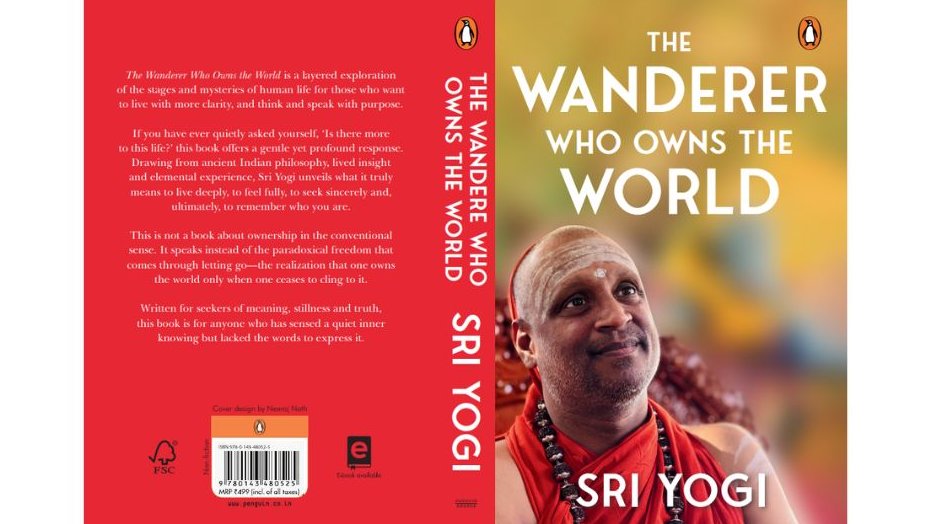
The occasion was the launch of The Wanderer Who Owns the World by Sri Yogi, published by Penguin Random House India — a profound exploration into human consciousness, identity, suffering, success, self-realization, and the hidden dimensions of human potential.
At exactly 6:36 PM, the book was unveiled.
Yet what emerged that evening was far greater than paper and ink.
“One owns the world only when one ceases to cling to it.”
Those words moved through the hall not as a quote, but as a mirror held before the restless modern mind.
Among the distinguished voices present was A. S. Kiran Kumar– Former ISRO Chairman, whose reflections transformed the gathering into a rare meeting point between advanced science and ancient spirituality.
Speaking with the precision of a scientist and the curiosity of a seeker, he described the human being as a highly evolved living intelligence system — one functioning through sensors, memory, controllers, and action mechanisms, much like the robotics and AI systems modern science strives to create today.
He explained how machines operate through sensors, actuators, operational memory, and protective intelligence. Then he turned toward humanity itself.
Human beings too receive information through the senses. They process reality through memory. They act through organs of action. They carry hereditary information, environmental conditioning, and invisible programming shaped even before birth.
But unlike machines, human beings possess something extraordinary:
The possibility of awakening.
He spoke about how humanity continuously invents technologies by imitating hidden powers already existing in nature. Infrared cameras imitate nocturnal vision. Radar imitates the navigation systems of bats. Artificial Intelligence imitates aspects of human intelligence itself.
Then came the deeper question that silenced the hall:
If technology can extend the limits of human capability, what hidden dimensions remain dormant within human consciousness itself?
Could yogis and realized beings be individuals who have activated capacities lying asleep within every human being?
The discussion moved beyond blind belief and entered a rare territory where spirituality was expressed through scientific language, logic, observation, and lived experience.
For many present, it was not merely a speech.
It was a shift in perception.
Then, in a deeply humble and sincere moment, A. S. Kiran Kumar turned toward Guruji and said:
“I want your guidance and help to truly read, understand, and implement what is written in this book.”
The hall fell silent.
And then came a response no one expected.
Guruji smiled gently at the audience and said with humor:
“See… he is trying to book me.”
The hall burst into laughter.
But what followed carried a depth that moved far beyond humor.
Sri Yogi explained that even at that very moment, someone was helping him speak Kannada. “I told them I would help spiritually,” he said playfully, before leading the audience into a profound reflection about light, consciousness, energy, and human evolution.
He spoke about the Sun.
How sunlight takes eight minutes and twenty seconds to reach the Earth.
How plants grow because of sunlight.
How even modern science still depends upon sunlight for the growth of the human body, for Vitamin D, and even for healing conditions like jaundice.
“Whether you call it Sun God,” he said, “or call it cosmic energy in the language of atheists, human life still depends on light.”
Then came the deeper metaphor.
Even if a person possesses eyes, they cannot see without light.
In the same way, human beings may possess intelligence, education, wealth, and achievement — yet without inner light, they continue to live in confusion.
That evening, Guruji did not speak as someone trying to create followers.
He spoke like a wandering monk trying to remind humanity of something it had forgotten.
Using the example of cosmic distance, he explained how physically reaching the Sun would take thousands of years. Yet through consciousness, discipline, yogic practices, and inner transformation, human beings can experience subtle dimensions of existence far beyond ordinary perception.
He spoke about practices like Agnihotra, about the forgotten sciences hidden within Sanatana Dharma, and about the immense challenge modern humanity faces:
Discipline.
Everyone desires peace.
Everyone desires higher awareness.
But very few are willing to practice consistently enough to transform themselves.
And perhaps that was the true essence of the evening.
The event was not about miracles.
It was not about blind faith.
It was not about religion.
It was about awakening responsibility toward one’s own consciousness.
The book became more than literature.
It became an invitation.
An invitation to observe the architecture of the human mind.
An invitation to understand suffering.
An invitation to question identity.
An invitation to discover whether human beings are truly living to their highest possibility — or merely surviving inside conditioning.
As the evening concluded, something extraordinary could be felt among the audience.
Science had not opposed spirituality.
Technology had not stood against inner wisdom.
Instead, both stood together before the same eternal mystery.
At Atta Galatta that evening, a profound realization echoed silently through the hearts of those present:
The greatest universe waiting to be explored may not exist somewhere beyond the stars.
It may exist within the human being itself.
You don’t own the world by holding it.
You own it when you stop needing it.
“One owns the world only when one ceases to cling to it.”
The Wanderer Who Owns the World by Sri Yogi (published by Penguin India) is a spiritual book exploring the art of living with clarity, purpose, and inner freedom, drawing on Indian philosophy to explain how letting go leads to true ownership of the world.
#SriYogi #InnerFreedom #LetGo #Philosophy #Mindfulness
A New Era Begins at Shri Kshethra Bangaramakki
Under the divine blessings of Avadhootha Srimath Paramahamsa Parivrajakacharya Sri Sri Sri Yogishwara Swami, a historic movement has taken shape — blending spirituality, culture, and vision for the future.
Led by the visionary Shri Maruthi Guruji
Inaugurated by renowned Padma Shri Dr. A.S. Kiran Kumar.
Samskritika Kumbha & Malanadu Uthsava mark not just a celebration — but the dawn of a scientific and divine revolution.
This is more than an event.
This is a union of ancient wisdom & modern science.
This is a movement for generations to come.
From sacred traditions to futuristic vision —
Shri Kshethra Bangaramakki is now a global spiritual landmark.
A Message of Peace and Responsibility to the Leaders of the World
By His Holiness Srimath Paramahamsa Parivrajakacharya Sri Sri Sri Yogishwara Swami
In this critical period of human history, the world stands at a delicate crossroads. Across continents we are witnessing rising tensions, conflicts, ideological divisions, and increasing mistrust between nations. Humanity has reached a moment that demands deep reflection, wisdom, and responsible leadership.
Many spiritual observers and astrologers note that the planetary alignments of the coming period—particularly the influence of Saturn and Neptune during 2025–2026, the long-term transformation associated with Pluto in Aquarius, and the powerful cycles of Mars during 2026—symbolically reflect a time when confusion, ideological divisions, struggles for authority, and geopolitical shifts may intensify. These cosmic patterns, while not determining our fate, mirror the emotional and psychological climate of our world.
Such influences may manifest among nations as:
· Conflicts driven by ideology and belief systems
· Struggles for power, authority, and control
· Misunderstandings, misinformation, and distrust
· Rising military tensions and aggressive posturing
Particular attention is being drawn to periods such as June 28 – August 12, 2026, when Mars is traditionally considered strong in Aries, and November 2026 – January 2027, when Mars reaches its exalted position in Capricorn. Symbolically, such periods can represent heightened global energy, decisive actions, and intensified geopolitical movements.
However, it is essential to remember that the future of humanity is not determined by the stars alone, but by the wisdom and choices of human leaders.
At this time, the world does not need more confrontation, retaliation, or competition for dominance. What the world urgently needs is dialogue, understanding, and a sincere commitment to peace and harmony.
To the leaders of nations, governments, and international institutions, this message is offered with humility and concern:
Let wisdom guide decisions rather than fear.
Let dialogue replace hostility.
Let cooperation overcome division.
Every conflict avoided, every negotiation initiated, and every step toward reconciliation protects millions of innocent lives. The responsibility carried by world leaders today is immense���not only for their own nations, but for the entire human family.
History will remember those who chose peace when conflict seemed easier.
Let the coming months be a time when leaders rise above political interests and ideological divisions to safeguard the future of humanity. Let diplomacy, compassion, and mutual respect prevail over aggression and war.
May the wisdom of humanity overcome the forces of division.
May peace prevail among nations.
May harmony guide the destiny of our world.
With prayers for global peace and unity,
His Holiness
Srimath Paramahamsa Parivrajakacharya Sri Sri Sri Yogishwara Swami
Share this widely and join the movement to spread peace, kindness, and humanity across the world.
Compulsion chains the mind from within, driven by anxiety and the urgent need for relief. Advice, however, stands outside as a gentle guide, never a tyrant. True wisdom lies in recognizing the difference: compulsion demands obedience, but advice invites reflection—reminding us that freedom begins the moment we consciously choose our response.
Every living being in nature is interconnected and part of a balanced ecosystem. If anyone harms life or the environment for selfish purposes, it ultimately leads to consequences. Nature restores its balance, and those who damage it often experience the impact.
True freedom begins with awareness. When a person understands the constitution of the land, they gain external freedom as a conscious citizen. When they understand their own mind, they gain internal freedom as a conscious human. Study your rights, observe your thoughts, and discipline your mind—because real maturity comes from mastering both the system and the self.
True peace begins within. A restless mind spreads anger, fear, and conflict into the world around it. When we learn to observe our thoughts, practice patience, and respond with awareness instead of impulse, harmony grows naturally. Mastering the mind is not escape—it is the foundation for building a wiser, calmer humanity.
True change begins with understanding pain, not destroying life. Violence often grows from ignorance, anger, and unresolved suffering. When we choose awareness, teaching, and compassion, minds awaken and hearts transform. Listen before judging, understand before reacting, and guide before condemning. Educated consciousness builds a peaceful society where wisdom replaces violence and humanity evolves together.
No one transforms through force; compulsion breeds resistance while love and faith awaken willingness. Real change begins when hearts feel safe, valued, and believed in. Replace pressure with patience, authority with example, and judgment with encouragement. Nurture growth through compassion and conviction—because lasting transformation rises from belief, not fear.