The Mag 7 is extremely undervalued right now and this chart is exactly why (Save this).
From 2006 to 2024, Alphabet, Meta, Microsoft, and Amazon steadily grew their free cash flow in a relatively orderly line, modest capex, expanding margins, compounding cash generation year after year.
Then something breaks around 2025–2026.
Free cash flow drops sharply as all four companies simultaneously committed a combined ~$725 billion in capital expenditure for 2026 alone, a 60%+ increase from already-record 2025 levels to build the AI infrastructure layer of the next decade.
Amazon's Free cash flow fell 95% in Q1 2026 as it spent $44 billion in a single quarter.
Meta's FCF compressed against $19 billion in quarterly capex, with projections turning negative by 2027.
Alphabet guided Capex as high as $185 billion for the year and this is the reason most investors are scared right now.
But then look at what Bloomberg consensus estimates show happening from 2028 to 2030.
Free cash flow explodes, the stacked bar chart nearly triples from current levels and approaches $650 billion combined by 2030.
This is the math of how infrastructure investment works, you spend the money first, you depreciate the assets over 10–20 years, and once the buildout is complete, incremental revenue becomes almost pure free cash flow because the fixed costs are already sunk.
Amazon CEO Andy Jassy described this perfectly, "we're investing to be the meaningful leader, and our future business, operating income, and FCF will be much larger because of it.
The evidence that monetization is already beginning is visible right now.
Microsoft's AI business is running at a $37 billion annual revenue run rate, up 123% year over year, with 20 million paid Copilot seats growing at 250% annually.
Google Cloud revenue surged 63% year over year to $20 billion in Q1 2026, with Alphabet's cloud backlog nearly doubling to $460 billion in one quarter.
AWS saw its strongest growth since 2022, and Amazon's AI services crossed a $15 billion annualized run rate just three years after launch.
The Capex fear is being priced as if this spending has no return,when in reality the contracted backlog tells you the demand is already locked in and signed.
The FCF trough you see in this chart from 2025–2027 is not a sign of broken businesses but rather the price of owning the infrastructure layer of the AI economy for the next 20 years.
The window to buy that at a discount closes the moment the market starts pricing the 2028–2030 FCF explosion, and that repricing could happen faster than most expect.
Bullish on Mag7 and if you want to see exactly what Mag7 we are buying, come join Milk Road Pro for just a dollar using the link below to get our daily updates.
a former PM at Citadel and D.E. Shaw, now trains institutional analysts, on where alpha actually exists:
"my general prior is that alpha lives in the tails."
"80% of stocks are mostly fairly priced. but there's a 10% tail on the right, 10% tail on the left where there's meaningful mispricing."
"so the decomposition of generating alpha is finding a differentiated perspective and investing behind that differentiated perspective with conviction."
80% of the market is efficiently priced. the edge isn't in the middle, it's in the extremes that most people avoid because they're uncomfortable.
same distribution in trading. most strategy ideas are noise. most parameter combinations are curve fit. few strategies that survive every validation test you throw at them.
He left after 27 years at Goldman Sachs - started there as a broker and rose to Vice Chairman - now he is the only investment banker Warren Buffett trusts
Buffett mentioned him by name in his annual letter - "it hurts me to say this - but he earns his fee "
in this interview he reveals how billionaire families invested during every crash from 1987 to COVID - and won every single time, for free
in 2008 he saved Goldman Sachs with one phone call to Buffett - $5 billion - brokered $23B Mars-Wrigley - $6.1B record Celtics sale
now manages $70 billion for America's wealthiest families
he was considered as Buffett's own successor at Berkshire Hathaway
bookmark & watch today!
Narrative violation: A new study of 21,559 firms in the U.S. finds that “companies that adopt AI tend to grow faster following adoption”.
“Firms making the largest AI investments grow employment by roughly 10% following adoption, while low-intensity adopters see no statistically significant change.”
“Entry-level headcount rises 12% for high-intensity adopters.”
“Gains emerge gradually and are broad across roles, including engineering, sales, administration, and customer service.”
“The results counter predictions that AI adoption will lead to broad job loss.”
The study is based on observed AI spending from Ramp card and bill pay data linked to Revelio Labs workforce records.
Hey everyone, I have received permission from my employer to publish this research.
It is a lengthy investment thesis on what I believe will be the next chapter of AI. After months of research, we are turning bullish on the hyperscalers and explain why we believe the market is underestimating where the economics of AI are ultimately heading.
The rest is covered in the X article below. I hope you enjoy reading it, and I look forward to hearing your thoughts and challenges.
The Mathematics of Losing
One of the biggest misconceptions in investing is that gains and losses are symmetrical. They aren’t because if you loose 20%, and you don’t need to make 20% to recover. You need 25%. The deeper the hole becomes, the steeper the climb back out.
Most people understand this when they see the math. Very few change the way they invest because of it. That is surprising because this simple chart explains why so many investors spend years working hard without actually moving forward. They aren’t just trying to grow wealth. They’re constantly trying to recover wealth that never should have been lost in the first place.
Imagine you have $1 million and your portfolio falls by 50%. You now have $500,000. Many investors instinctively think they simply need another 50% return to get back to even, but a 50% gain on $500,000 is only $250,000. You would still be sitting at $750,000 and would need your portfolio to double just to break even.
This is where investing becomes less about mathematics and more about psychology. Human beings naturally focus on upside because upside is exciting. We dream about doubling our money, finding the next great company, or discovering an investment nobody else has noticed. Very few people spend equal time thinking about what happens if they’re wrong.
That may be the biggest mistake of all. The stock market has an invisible tax that almost nobody talks about. It isn’t inflation, management fees, or capital gains taxes. It is large drawdowns. You lose money immediately, then you lose something even more valuable while trying to recover it.
You lose time. Time is the one resource that can never be replaced. Warren Buffett cannot buy more of it, and neither can you. A large drawdown doesn’t simply reduce your portfolio. It steals years of future compounding that quietly disappear forever.
Imagine two mountain climbers trying to reach the summit. The first climbs incredibly fast but slips every few hundred feet and falls halfway back down. The second climbs more slowly, but never loses ground. Most people assume the faster climber wins, yet over time it is often the steady climber who reaches the top first.
Investing works exactly the same way. The goal is not to climb the fastest. The goal is to avoid falling off the mountain.
Think about someone who breaks their pelvis (ie me, lol). The accident itself happens in seconds, but recovery can take months. They need surgery, physical therapy, and time before they can even begin making progress again.
Large investment losses work the same way. The decline may happen in weeks, but recovering from it can consume years of your financial life. A single bad decision can erase half a decade of disciplined investing (something I recently experienced with $TTD). That should completely change how you think about taking risks.
Compounding is often described as an engine. I think a snowball is a better analogy. Every year it grows a little larger, and because it is larger, it gathers even more snow the following year. Eventually the process becomes almost magical.
Now imagine picking up that snowball and throwing it off a cliff. You haven’t just made it smaller. You’ve forced yourself to begin building another one from scratch. That is exactly what catastrophic losses do to a portfolio.
There is another trap hidden inside large losses that is even more dangerous than the mathematics. Once people lose enough money, they stop thinking clearly. They begin anchoring to the price they paid instead of the value of the business they own.
The market doesn’t know what price you paid. The market doesn’t care what price you paid. Only you do.
1/👇
Morgan Stanley: Semiconductors
> Total datacenter capex across major hyperscalers is projected to reach $892.6 billion in CY26, driven by an 87% YoY growth rate (up from 62% in CY25).
> Datacenter capex as a percentage of sales is expected to jump significantly to 30.0% in CY26 and 35.7% in CY27, up from just 18.6% in CY25. Major executives have noted that capacity remains heavily constrained by compute power and electricity limitations.
> Servers: Cloud capex spending intensity will remain at historical highs, tracking at roughly 30% of revenue.
> Consumer Slowdown: Cautious outlooks dominate for personal devices in CY26. Due to demand pull-forward, rising input costs, and memory cost inflation, shipments are forecast to decline by 13% YoY for PCs and 13% YoY for Smartphones (impacting Android vendors particularly hard).
> Automotive & Consoles: Automotive semiconductor demand faces headwinds from weaker demand in China and macroeconomic issues. Meanwhile, gaming consoles like the Switch 2 and PS5 are seeing higher pricing due to memory inflation, leading to a forecast shipment decline in CY26.
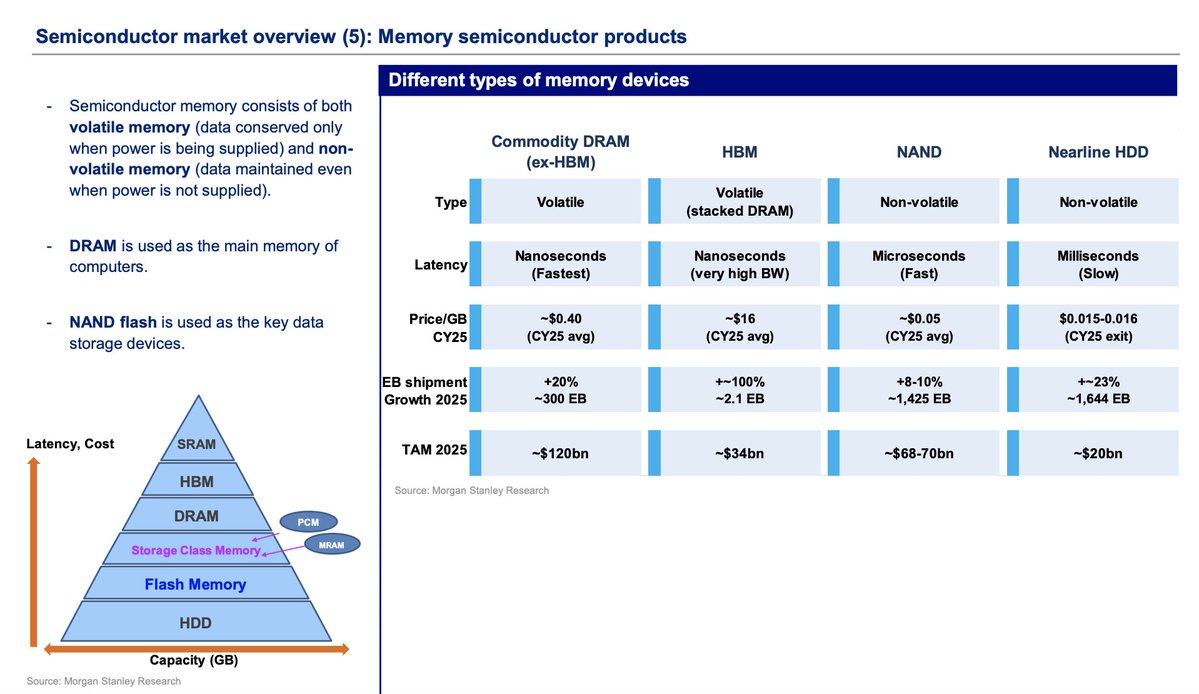
> High Bandwidth Memory (HBM) is growing at an astronomical pace with an exabyte (EB) shipment growth of ~100% expected for 2025. It commands a massive price premium at ~$16 per GB (compared to just ~$0.40/GB for standard Commodity DRAM) due to its ultra-fast, stacked-DRAM latency.
> Standard DRAM remains the largest financial market segment with a 2025 TAM of ~$120 billion, followed by NAND Flash at ~$68–70 billion.
> NAND Flash: Positioned as a non-volatile, relatively fast storage solution (microseconds latency). It holds a massive volume share with an expected 1,425 Exabytes (EB) shipped in 2025, operating on a low average cost of ~$0.05 per GB.
> Nearline HDD: Remains the slowest (milliseconds latency) but lowest-cost medium at $0.015–$0.016 per GB. It boasts the largest shipment volume in 2025 at ~1,644 EB.
> Revenue, Unit shipments, and Average Selling Prices (ASP) for the Memory sector show significantly higher volatility and more aggressive growth spikes in the 2025/2026 timeframe compared to the steadier Non-memory sector.
> Global DRAM and Flash memory sales graphs reveal a dramatic revenue surge heading into 2026, mirroring the intense demand spikes seen in previous peak cycle years (such as 2010 and 2017–2018).
BREAKING: Hedge funds sold the most US information technology equities in the week ending June 25th since data began in 2016, according to Goldman Sachs.
This even exceeds August 2024, when the Nasdaq 100 fell over -10%, entering correction territory.
In total, hedge funds sold the most US equities since the April 2025 "Liberation Day" selloff.
Meanwhile, Magnificent 7 stocks' exposure as a % of total US hedge fund exposure is down to 14.5%, near the lowest in 3 years.
This percentage has declined -7 percentage points since the start of 2026, marking the biggest 6-month decline since the 2022 bear market.
Hedge funds are cutting US tech exposure.
Even Chinese companies are signing LTAs now lol
RTRS:
- China’s CXMT has signed a $3 billion LTA with Tencent.
- CXMT is also in talks with other Chinese internet companies, including Alibaba Cloud, ByteDance, and Xiaomi.
- As of Q1, CXMT’s DDR5 yields still lagged behind Western peers.
- CXMT currently operates two 12-inch DRAM fabs in Hefei and one fab in Beijing, with total wafer capacity of around 300k wafers per month.
*AMAZON HAS RENEGOTIATED IT’S DEAL WITH ANTHROPIC
*ANTHROPIC RENEGOTIATED DEAL WITH AMAZON TO ONE BASED ON TOKENS RATHER THAN COMPUTE HOUR’S
*AMAZON IS EVALUATING OTHER AI MODELS TO MITIGATE RISING ANTHROPIC COSTS
$AMZN
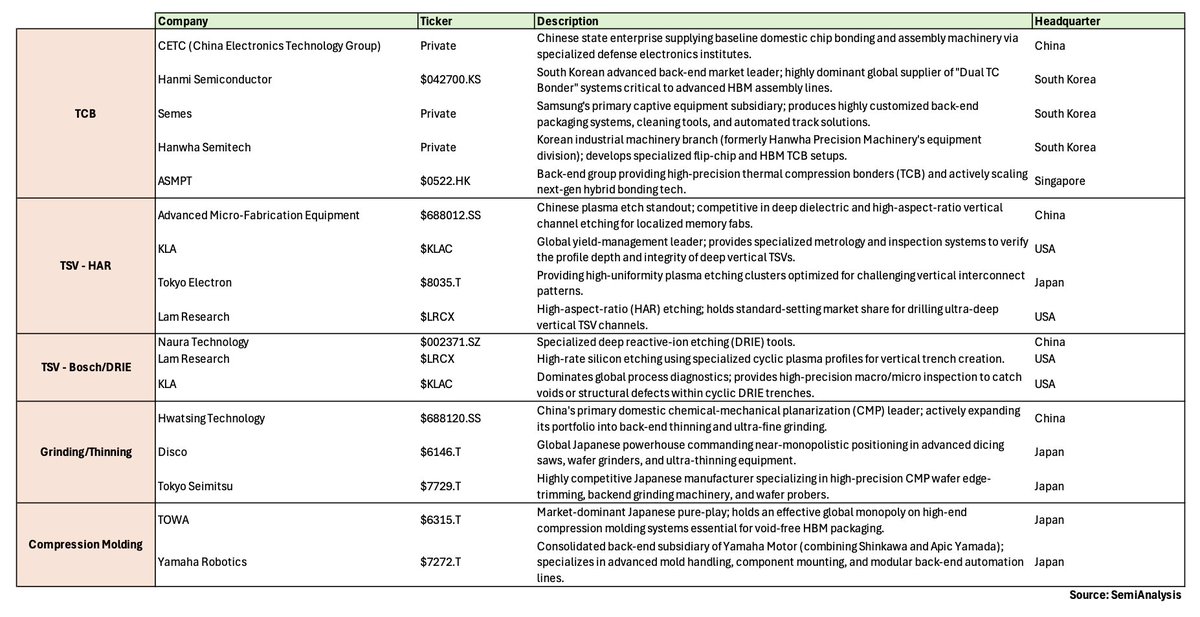
One of the most underappreciated ways to play the AI semiconductor buildout may be through materials rather than chips themselves.
As the industry races to produce more advanced semiconductors, demand isn’t just rising for GPUs and wafer fab equipment, it’s rising for the critical materials that make modern chips possible. (1/6)🧵
J.P. Morgan: Memory Update
> DRAM Supply Deficit (2026E–2027E): DRAM bit demand is projected to significantly outpace bit shipments in 2026E (32.5% vs 22.9%) and 2027E (34.4% vs 21.7%), pointing to a tight market before flipping to an oversupply in 2028E (21.1% vs 23.8%).
> NAND Consistently Demand-Driven: Across almost the entire forecast period (2025A–2027E), NAND bit demand percentages consistently outpace shipments. By 2028E, the gap narrows drastically to a near-balance of 22.3% demand vs 20.9% shipment.
> Both markets show consistent year-over-year growth in absolute terms, with DRAM demand scaling toward 80,000+ M (8Gb Eq.) and NAND scaling toward 60,000 Mn (256Gb Equi) by 2028E.
DRAM Market Trends:
2026E: Demand peaks sharply at 32.5% while shipment growth sits at 22.9%.
2027E: Demand growth remains high at 34.4% vs. 21.7% shipment growth.
2028E: The trend reverses; demand drops to 21.1% while shipment growth edges higher to 23.8%.
Bit demand steadily pulls ahead of both actual bit consumption and bit supply in 2026E and 2027E, leading to a noticeable supply gap before tightening up in 2028E.
NAND Market Trends:
2025A: Showed 19.3% demand vs. 14.5% shipment.
2026E: Spikes to 23.0% demand vs. 19.8% shipment.
2027E: Reaches a demand growth peak of 29.4% vs. 21.2% shipment.
2028E: Settles to 22.3% demand vs. 20.9% shipment.
In 2026E, bit consumption is expected to temporarily overshoot bit demand, but by 2027E and 2028E, absolute bit demand clearly leads the metric totals.
China’s is seeing unprecedented money supply growth:
China's M2 money supply is up to a record ~240% of GDP, the highest among any major economy in the world.
This metric has surged +100 percentage points since the 2008 Financial Crisis.
Over this period, China’s M2 money supply has surged +500% in Dollar terms.
By comparison, the country's gold reserves and total FX reserves have risen +100% and +60%, respectively.
To put this into perspective, Japan's M2-to-GDP ratio, the next highest, stands at ~185%, while the US sits at ~70%.
China's monetary expansion is unlike anything seen among major economies.
AWS raising GPU prices 20% is a positive indicator for hyperscale ROICs and as a general AI demand signal.
It also highlights an advantage $AMZN has, with (by far) the largest installed base of 3P cloud infrastructure, now re-pricing to market rates. Returns on legacy infrastructure will improve with no incremental capital, as contracts come up for renewal. These old A100s will soon be fully depreciated!
FWIW, a GW of B300 (Blackwell) GPUs at the pricing below and 100% utilization would monetize at ~$57B per GW per year. In practice, spot instances are never 100% utilized, and most capacity is sold as reserved instances at big discounts.
But even at hypothetical 60% discount for reserved instance pricing, B300s would monetize at ~$19B per GW at that old pricing levels, and ~$23B per GW at the new price levels. This pricing would drive >20% unlevered IRRs on DC capex as I’ll show below, and makes me very optimistic on earnings growth for hyperscalers as they bring more AI DC capacity online this year and beyond.