Dogs are slow to ketosis and their levels never get as high as because blood glucose is maintained by gluconeogenesis. Humans are singularly adapted to ketosis and their infants rely on it for their uniquely rapid brain development (Dr. Stephen C. Cunnane, Université de Sherbrooke in Canada and others). Healthy human infants are normally in a state of mild ketosis independent of recent feeding. Ketones produced from fatty breast milk and their own fat stores not only fuel brain growth but provide most of the carbon backbones used to build lipids needed for neuronal membranes. The brains of children are vastly more efficient at importing ketones than adult humans, for whom ketosis is more of a backup plan.
Makes me wonder about those female ancestors I'm researching (genealogy) who had 14 children during their life. Did they receive rejuvenating cell transplants every couple of years from their late teens to mid forties? Still takes a toll! Not to mention housework, farm work, and home spun in the old days.
President Trump has dismantled Iran’s military capabilities, destroyed nearly 100 percent of its military factories, and buried its nuclear program.
We are now entering the endgame. At dawn begins an economic D-Day — the single greatest financial offensive ever marshaled against an adversary.
The Islamic Republic has subsisted by dressing extortion as security guarantees. It has drawn strength from a calculus that regards Iranian retaliation as certain and American enforcement as negotiable. Under President Trump, that era is over. And those who fear the danger of defying Tehran ought not to discount the cost of testing Washington.
The President has created the conditions to leverage every agency, every authority and action many assumed we would never summon. Our objective is to sever every economic lifeline that sustains the tyrannical regime until Tehran stands alone.
@giveashitnature We put galvy on the roof stood off 1/4” to reflect sunlight. They are picky though, producing 2+ broods in one and never touching an identical one in a similar location. It’s like the barred owl nest boxes we built based on researchers specs - rejected.
That’s good news, I have tons of goldenrod. Monarchs ignore my native milkweeds and only produced pupae when I planted tropical milkweeds. You need a lot of plants as one caterpillar will denude a plant before it’s done growing. Too much work.
4 generations of monarch butterflies lived and died this summer. The one on your flowers right now is the 5th, and it's built completely differently from every one that you've seen so far.
The previous 4 generations lived 2-6 weeks, mated, laid eggs, and died. The fifth generation is born in reproductive diapause, meaning it won't mate until spring.
Instead of spending energy on reproduction, it converts every calorie from nectar directly into fat for a 3,000-mile journey to mountain forests in Mexico it has never seen.
It will live eight times longer than its parents. Fly ten times farther. Navigate using a sun compass in its antennae that corrects for the sun's position across the sky and switches to magnetic sensing on cloudy days. The destination is encoded in its genome across generations that have never made the trip.
That butterfly is in your yard visiting your flowers right now, fueling up.
What it needs: goldenrod, native asters, ironweed, and boneset are the premium fuel sources for the crossing. No pesticides on those plants or anything near them. A yard that's still blooming in August is a way station the super generation desperately needs.
August is peak wasp season and almost everything you think you know about them is based on five species out of 18,000.
The wasps people fear all come from one family. Less than one percent of wasp species on the continent. The other 99 percent are solitary, and right now in August they are doing some of the most important pest control work of the year.
The mud dauber finishing her nest on your porch eave has been stocking each clay cell with paralyzed spiders, sometimes including black widows, for a single larva.
The egg hatches within days, the larva eats the spiders, and the developing wasp may remain protected inside the nest until the following season. She built the whole structure alone and is extraordinarily unlikely to sting you because she has no colony to defend.
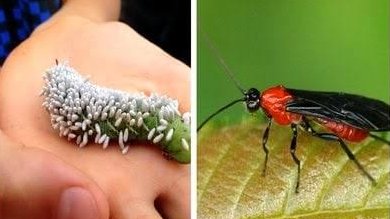
The braconid wasp, elusive and rarely seen, is laying eggs inside the tomato hornworms on your plants right now. The larvae feed from the inside, emerge through the skin, and spin the white cocoons you might mistake for eggs.
Those cocoons hatch in under a week into a new generation of wasps that immediately go looking for more hornworms. The caterpillar you kill when you find it covered in white growths takes out the next wave of pest control with it.
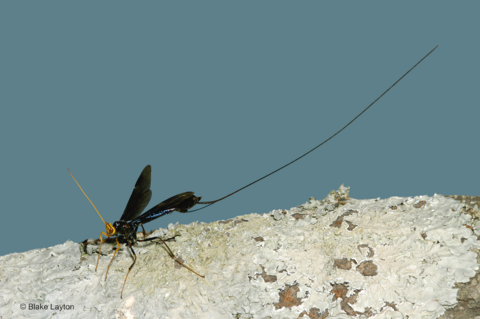
Ichneumon wasps, a worldwide group containing more than 25,000 described species, including roughly 5,000 in North America, are parasitizing caterpillars, beetle larvae, and other insects in your trees and garden.
The wasp that stocked your eave, parasitized your hornworm, and hunted your garden pests all summer never introduced itself. It didn't need to.
I have all those minus beautyberry plus chokecherry, wild cherry, and piles of fruiting brambles. Nobody seems to eat them. I was hoping to get away from feeders but the birds empty them and the suets within a week.
The best bird feeders aren't actually bird feeders. They're native shrubs. If your yard doesn't have any, you're missing out.
As migration approaches, many songbirds shift heavily toward fruit. Berries provide fast carbohydrates that can be converted into the fat required for long flights.
Native dogwoods, viburnums, serviceberries, spicebush, elderberries, beautyberries, hollies, Virginia creeper, and pokeweed all produce food timed to different parts of the season.
Some fruits disappear in late summer. Others ripen during peak migration. Some remain into winter, when birds have fewer alternatives.
A living fruiting plant also does things a tube of sunflower seeds cannot. It shelters birds from predators. It hosts insects during spring and summer. Its flowers feed pollinators. Its branches provide nesting sites. The birds eat the fruit and deposit the seeds somewhere else.
Not every berry is equally useful, and native plants are generally better integrated into the local food web than an ornamental shrub imported from another continent.