This is true as I have heard this from contacts in the Valley. Goes with my pinned post.
The AI race is shifting from bigger models to cheaper, smarter systems https://t.co/lS1YKxkjl0
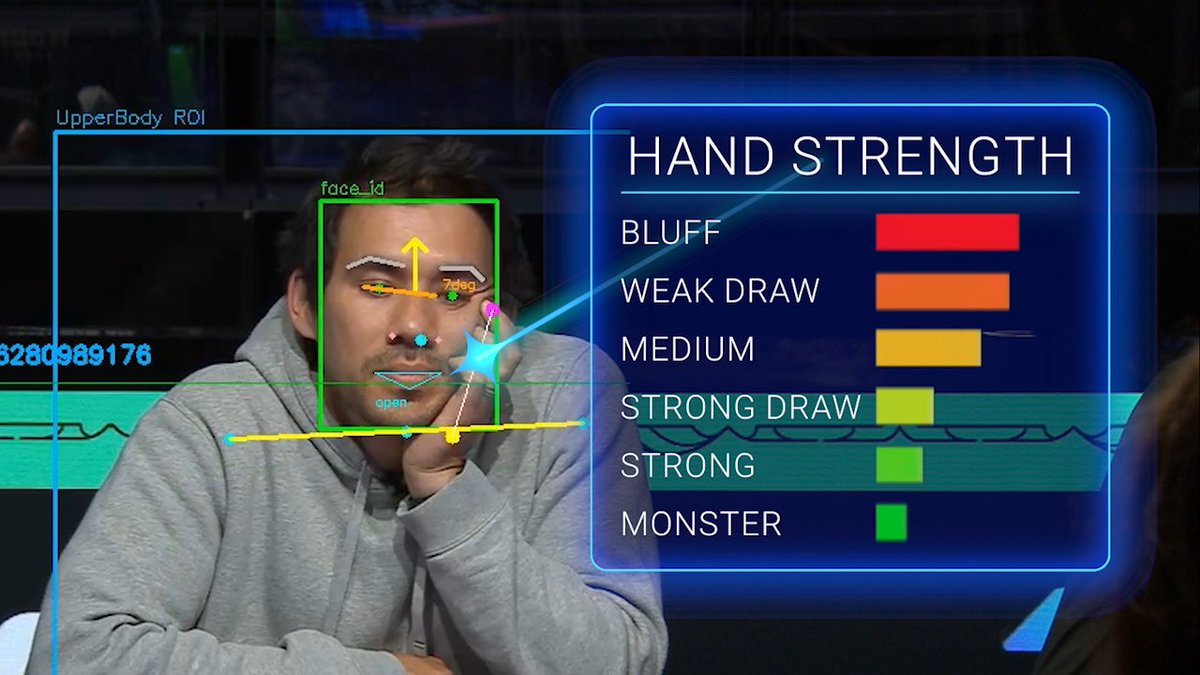
ESPN's World Series of Poker coverage this year includes a computer vision AI model that identifies when players are likely bluffing based on how they move their face.
So much chatter about index rebalance this week. In the words of an old colleague, “many [candidate] portfolio managers can talk a great game about index rebal, but very few can do it well” (I know you are reading this). A short 🧵
1/
Hi, it’s me. I’m the guy at Citrini whose job it is to go to the software store every once in a while.
It’s actually amazing I still have a job. What a freaking joke, right?
My Trading Manifesto:
Embrace risk.
Accomplishment and fulfillment in any endeavor requires facing the unknown head on, placing your bet, and accepting the consequence.
You can't control what cards life deals, but you can control when to shove your chips in the middle. Focus on that part.
Bet size matters too. Balance your aggression. Size relative to the opportunity.
Study each situation with as little ego as possible. Prioritize truth over preconceived notions. Many an "expert" has been taken out to the woodshed because they couldn't let go of their grand theory.
Don't hesitate to build your understanding of things from the ground up again and again. That keeps you closer to the truth and further from outdated or tainted knowledge.
Hold feedback in high value. Use feedback as a compass to adjust strategy and make a better bet on the next try. There's nothing more valuable than ex-post information. It's the primary tool of improvement. It's how you move from a poor risk-taker to an exceptional risk-taker. It's how you develop killer instinct.
Again, keep ego out of the process. If contradictory evidence comes back, don't dismiss it. Update your views and approach. The desire to "be right" must never overpower the objective search for truth and results.
Finally, keep self-preservation top of mind. Earn the right to bet big as your knowledge progresses, but only to a limit. Never put yourself in a situation where a negative outcome means complete destruction. Preserve your seat in the game. Without a seat at the table, killer instinct will decay.
You will experience exhilarating wins and bone crushing defeats regardless. No amount of preparation or strategy can eliminate uncertainty, so hold your head high in the tough times and remain humble in victory.
Luck's a fickle beast after all…
there's always edge in markets. it just changes.
had this conversation with a quant i've known for 15 years. same conclusion.
indicators that worked 10 years ago don't work now. strategies that work this year won't work next year. the market adapts. the edge dies. a new one is born.
but here's what doesn't change: finding edge is a skill. you get good at it by doing it. by losing money. by iterating. by staying in the game.
the people who make it aren't the ones who found the perfect strategy. they're the ones who kept looking after their last one stopped working.
edge doesn't disappear. it moves.
i write about where i'm looking for edge next.
the early signal: https://t.co/x967RWziCd
Over the last few weeks I have noticed feeling more feelings of despair, like I’m falling behind, or there’s not enough time in the day to escape what’s coming.
Prayer has given me some solace. Sharing this from a prayer channel I’m in that helped me feel better today.
The Big Rug
Gooning is well covered in the Doom thesis. Elon's "Imagine" is digital crack cocaine being given out for free. So that's in progress. But, GPT5 shows us that enterprise / tool calls is where companies are converging
This mirrors the rest of the economy. Consumer apps have to use ads or extractive loops (gambling/ porn/ DLC video games) to monetize at scale. Or you do Enterprise. Anthropic's CEO has indicated that companies pay up to 10x as much for better reasoning. And that training a model is positive unit economics t+12 months
Which is the first time anyone is talking about unit economics. Which means the GPU costs of ppl just chatting away were getting gnarly.
So today I'll write a bit about the Enterprise part of the Doom Thesis - which I call "The Big Rug"
The core idea of the Big Rug is that everything you do in Claude Code, all the Vibe Coding you do, and even the work you do with AI that is covered by Terms of Service will end up getting completely stolen and monetized by AI research labs in order to justify their enormous valuations.
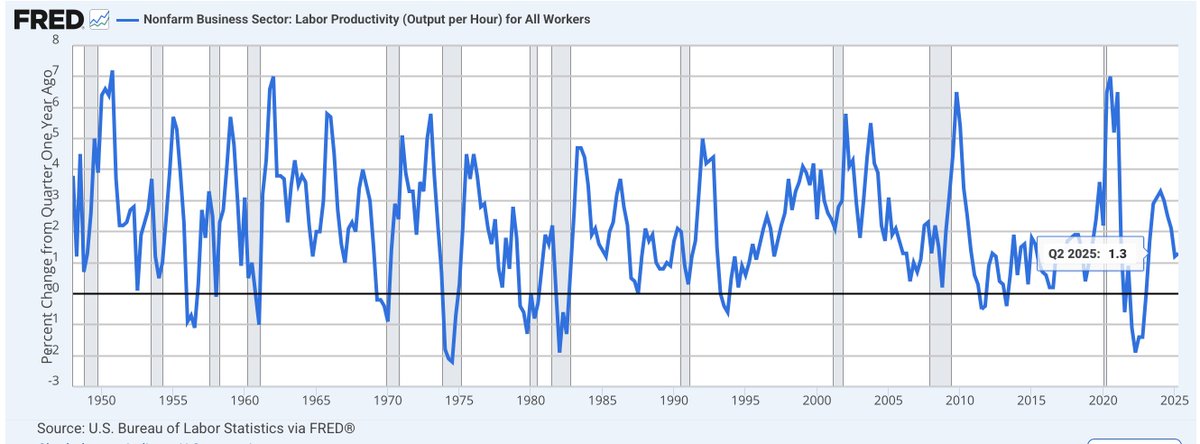
The US economic system is not sustainable. There is a single chart below that shows this. US labor productivity is growing at 1.2% while Microsoft and other AI companies are reporting token consumption growth above 400%.
Salesforce indicated that 30-40% of its code is written by AI but its cash flow from operations is up single digits along with its headcount. So -- if 100% of code was written by AI ... what would everyone do again?
At the same time, AI very clearly is a thing. And there's huge demand. But the vast majority of companies are not using AI correctly.
We can - in part, deduce this from basic common sense. VSCode and Copilot are terrible / borderline unusable if you use Claude Code/ Cursor. but they are in hyper growth nonetheless
People are likely drastically increasing their technical debt. Because AI isn't good enough on default settings to really use to automate huge amounts of work. At least right now.
Managers are saying "use AI". And employees are doing it. And doing it poorly.
Because AI valuations are so high it's vibe coding and vaporware across corporate America. "We need an AI strategy"
The most cynical VC I know just joined Cognition, selling 10s of thousands of seats to financial institutions.
GPT5 isn't the Death Star. Productivity is growing at 1.5%. In boom times that can be 5-7%. We are definitively not in a productivity boom despite the hype.
But then -- certainly this is not sustainable? If aggregate productivity is going 1.5% -- how is enterprise usage going to go sustainably at triple digits? Like -- the ROI is not going to be there. And then demand will go off an absolute cliff unless there is a fundamental non linear change in the cost of inference
Indeed. Everyone knows this.
Let's spell it out more specifically.
1. You are an enterprise agent company (whether that's openAI or Claude Code)
2. You see the slop generated by Vibe Coding
3. You see the same aggregate productivity statistics as everyone else namely that
A. Margins are not expanding a ton
B. Aggregate productivity is also not expanding
4. You know at some point an economic downturn results in massive cuts to token usage
5. Which makes your momo Q2 2025 into a hard comp and people start talking about a tech crash
6. But you just raised billions of dollars at a nosebleed valuation
7. You need to justify this valuation somehow or you're cooked
Enter The Big Rug
AI usage is a bit magical because you can't point to any single person or workflow that is responsible for training data. The training process, of compression, is a big jumble. We've already seen the implications of this in IP theft.
Copyrighted material is fully known by ChatGPT. We don't know exactly how it ended up in the training dat,a bc the model weights aren't really intelligible. So it's hard to prove anyone did anything wrong. Even though the copyrights are there
So if copyrights arent' enforceable. Trade secrets, methodologies, and non copyrighted user interfaces are *really not enforceable"
This is an important point because many of the actions of closed source models explicitly break copyright and other laws, but they have such enormous financial legal firepower -- and the technical details are so hard to prove - that if you ask for Grok to render images from movies, it will. Or if you ask Chatgpt for the full plots of books - it will happily provide it.
So there's already precedent for large scale non compliance with rules in the name of growth.
And this non-enforceability is the nature of the big rug.
Your employees don't really care about your enterprise IP and are more than happy to use closed source AI tools to help them be more efficient cogs. And then all this information and know how finds its way into the training data of AI research labs
And then - when agents come out. It won't be enterprises tailoring agents to their use cases. It will be agents, essentially assembling apps that are FAR BETTER than anything those enterprises could do. With proprietary models that aren't for sale
And because AI is completely portable, these agents could be spun off in offshore compliant jurisdictions likely with even less transparency. Or run through subsidiaries. Or even through crypto rails which are now getting supercharged by stablecoins
So not only did you *not get an efficiency boost* because the Vibe coded apps were slop. But you also lost all your trade secrets, IP, and know how. And will be competing with an AI equivalent that will destroy your margins
Welcome to the New Economy.
It's essentially the largest vampire attack in corporate history. Everyone using closed sourced API models thinks they're going to be safe due to enterprise SLAs, or simply don't care (bc they're employees told to use Cursor or get fired). But they won't be safe.
Once it's in the model. It's gone.
So that's the Big Rug.
And here's the funny thing. The Big Rug is actually necessary for this productivity chart to start going up. So before you get a massive acceleration in agentic workflows, the entirety of the people who formed the basis for those agentic workflows being created. Will be made completely obsolete / financially ruined.
After the Big Rug - is when unemployment starts ticking up. Token growth will indeed go off a cliff but it won't matter bc we will be past the facade that for some reason AGI was going to be made accessible via API
And if I were wrong, then these AI research labs wouldn't be worth what they are. And there wouldn't be animal spirits secondary demand for SPVs getting access to them at insane valuations. The writing is on the wall.
You think you're vibe coding, but really you're contributing to the Agent that will drink your milkshake.
The reason I haven't written about the Big Rug is that it's fairly far away. It will be a bit (maybe 12 months) before the research labs go mask off and launch agents directly instead of providing their models through APIs. Because as soon as this starts happening suddenly every company is going to lock down the usage of its coding tools. And presumably by then the ROI calculations won't make any sense
Smart companies will adapt early on by using self-hosted API layers, and open source models even though they are worse. China will likely keep funding heavy open source development because it's a way to subtly promote the Chinese worldview -- so I guess the downside will be getting brainwashed by the CCP if you want to avoid the Big Rug.
Once the Big Rug really kicks off, the enterprise software sector and any cloud player that hasn't hedged with their own AI research equity exposure will get completely shrekt. I've been a long time hater of Accenture and AI consulting plays, as they're basically in a 1-2 year white space of hope before the hammer drops pricing long term growth. Of course, the majority of cloud players have piled into the Labs for exactly this reason.
If GPT5 were incredible -- I think we'd have a bit more time before this narrative kicks into gear. But now that the disappointment is there, the enterprise focus is there, the abrupt 'focus on unit economics' is appearing - the 2nd part of the doom thesis - the de-rating of everything non AI - should begin percolating.
In crypto I am long Ambient to express this view - but it's a private holding with a minable test-net coming soon. My own network we're working to design to be more robust to the Big Rug (I think Google Docs, and Microsoft Word, and Github Gists are all basically going in the training data - so we are migrating to Proton Docs and using more encryption).
In stonks it's genuinely terrible for the whole IT service sector (or anything in a software index that isn't heavily long OpenAI, Anthropic, or Deepmind).
The white collar unemployment kick from the Big Rug should result in lower interest rates due to higher unemployment. The breach of trust/ economic shock should result in lower equity multiples. Other financial implications I'm still thinking through but just wanted to put this out here
LLM's are trained on trading blog slop, not on production code of people who actually make money trading.
If you want CC to produce interesting pricing models or trading evaluations you have to gaslight it constantly
Microsoft just changed the game 🤯
They've open-sourced bitnet.cpp, a 1-bit LLM inference framework.
It let's you run 100B parameter models on your local CPU without GPUs.
- 6.17x faster inference
- 82.2% less energy on CPUs
100% Open Source.
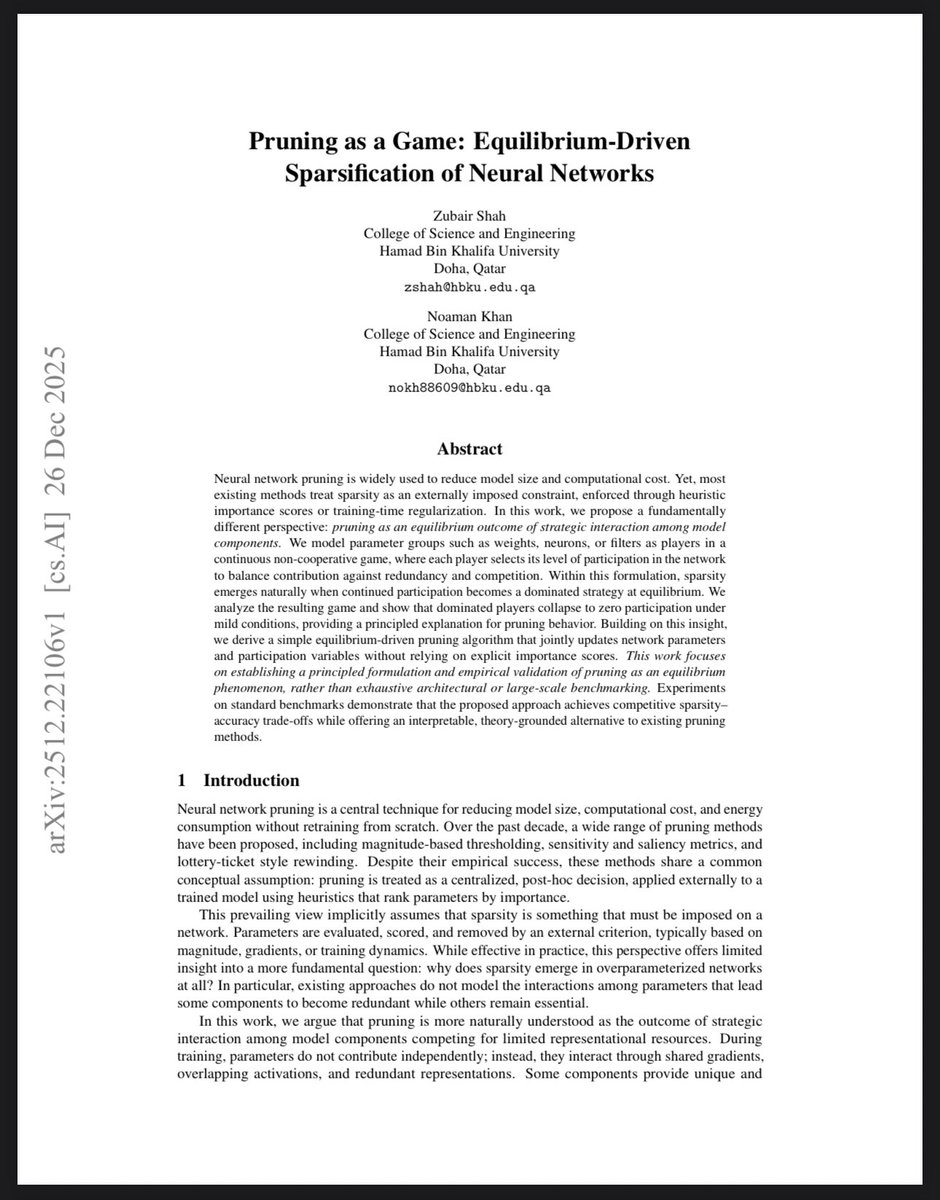
Breakthrough: Game-Theoretic Pruning Slashes Neural Network Size by Up to 90% with Near-Zero Accuracy Loss: Unlocking Edge AI Revolution!
I am testing this now on local AI and it is astonishing!
introduced Pruning as a Game.
Equilibrium-Driven Sparsification of Neural Networks, a novel approach that treats parameter pruning as a strategic competition among weights. This method dynamically identifies and removes redundant connections through game-theoretic equilibrium, achieving massive compression while preserving – and sometimes even improving – model performance.
Published on arXiv just days ago (December 2025), the paper demonstrates staggering results: sparsity levels exceeding 90% in large-scale models with accuracy drops of less than 1% on benchmarks like ImageNet and CIFAR-10. For billion-parameter behemoths, this translates to drastic reductions in memory footprint (up to 10x smaller), inference speed (2-5x faster on standard hardware), and energy consumption – all without the retraining headaches of traditional methods.
Why This Changes Everything
Traditional pruning techniques – like magnitude-based or gradient-based removal – often struggle with “pruning regret,” where aggressive compression tanks performance, forcing costly fine-tuning cycles. But this new equilibrium-driven framework flips the script: parameters “compete” in a cooperative or non-cooperative game, where the Nash-like equilibrium reveals truly unimportant weights.
The result?
Cleaner, more stable sparsification that outperforms state-of-the-art baselines across vision transformers, convolutional nets, and even emerging multimodal architectures.
Key highlights from the experiments:
•90-95% sparsity on ResNet-50 with top-1 accuracy loss <0.5% (vs. 2-5% in prior SOTA).
•Up to 4x faster inference on mobile GPUs, making billion-parameter models viable for smartphones and IoT devices.
•Superior robustness: Sparse models maintain performance under distribution shifts and adversarial attacks better than dense counterparts.
This isn’t just incremental – it’s a paradigm shift. Imagine running GPT-scale reasoning on your phone, real-time video analysis on drones, or edge-based healthcare diagnostics without cloud dependency.
By reducing the environmental footprint of massive training and inference, it also tackles AI’s growing energy crisis head-on.
The implications ripple across industries:
•Mobile & Edge AI: Affordable on-device intelligence explodes.
•Green Computing: Lower power draw for data centers and devices.
•Democratized AI: Smaller models mean broader access for startups and developing regions.
As AI scales toward trillion-parameter frontiers, techniques like this are essential to keep progress practical and inclusive.
Pruning as a Game: Equilibrium-Driven Sparsification of Neural Networks (PDF: https://t.co/OxRgcEqOue)
I will continue my testing but thus far results are robust!
devs are making $10k-200k monthly on polymarket
no they're not lol
here's what those threads don't tell you
zero fees = zero friction for HFT shops to eat your lunch.
In an efficient market, these simple arbitrage opportunities are fleeting at best. High-frequency trading bots and sophisticated arbitrage algorithms continuously scan for such discrepancies, capturing profits within milliseconds.
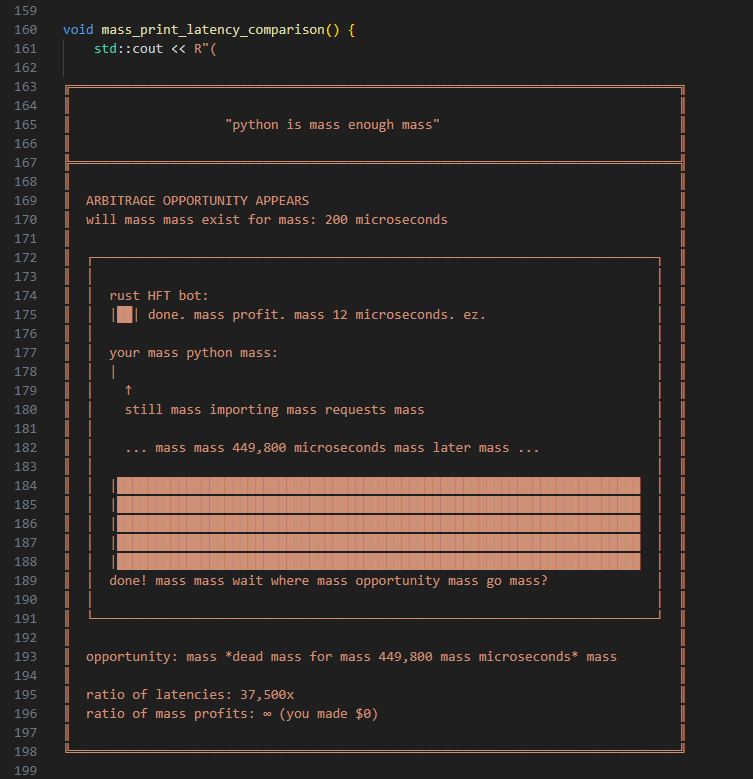
You're not competing with other python hobbyists
You're competing with rust bots running on dedicated polygon nodes with sub-millisecond execution.
That "simple python script" from twitter?
For Python systems, these numbers were more in the 250-500 microsecond range per message, meanwhile actual HFT systems in rust/c++?
Processing time per quote message is about 12 microseconds.
that's 20-40x slower before you even place an order.
what you actually need:
- dedicated polygon RPC nodes (public ones rate-limit you into irrelevance). 99.99% uptime, 100% healthy nodes in production, and average latency max 86.5 ms for premium infrastructure
- VPS colocated near polymarket servers. Ultra-low latency and physically close to Polymarket's servers
- Code written in rust. There's literally a polymarket-hft crate optimized for trading scenarios requiring fast execution
- Proper quant algorithms you can't vibecode because garbage collection is extremely useful during development but often sub-optimal for certain high frequency trading strategies
so those "$200k/month" traders?
They exist.
They're the top 0.5% and they're running infrastructure that costs more than your yearly salary.