@sabinedoering@JuergenZimmerer Herr Grethe bietet kaum unabhängige Expertise zu Denkfabriken. Und die Borchert Kommission ist das beste Beispiel dafür, wie Wissenschaft jede Unabhängigkeit verliert, indem sie selbst Teil des gesellschaftlichen Diskurses wird um bevorzugt organisierte Interessen zu vertreten.
@alz_zyd_ Start building a new ship. Obviouly you will be living less than uncomfortably on some planks in rough waters for quite some time, however, always under the risk of drowning.
@joefrancis505 Honestly I think the issue is the whole causal inference framework.
Trying to extrapolate tools used for extremely high quality data on labor economics to this messy stuff is just asking for trouble
@buhler_doris Schutzschild Herkunft und Habitus, Nagel auf den Kopf! Habitus, Habitus. Ohne diesen Schutzschild ist es kaum zu schaffen. Und kaum zu überleben. So ist es.
@alz_zyd_ That's exactly my criticism. You throw humanistic ideals together with historical materialism into one pot and say one falsifies the other. That's sloppy. Generally, I would be carefull with claims on the end of history. It's probable that your status quo bias will be dismantled.
@alz_zyd_ Listen, Marx was marerialist. His scientific hypothesis was that capitalism would break due to the (socially effective) contradictions it produces. Not, that capitalism SHOULD be overcome for the sake of justice. Taking social philosophy a little more serious would do you good.
@alz_zyd_ You serious? Capitalism is an institutionally coined system without clear system borders. As a real scientist, who constantly reflects critically assumptions and potential flaws and blind spots of its theories and analyses, how should you not reflect about capitalism dayly?
@IsabellaMWeber In Germany, there is an old saying still very alife among real anti-fascists: "Wer hat uns verraten? Sozialdemokraten!" (Who has betrayed us? Social democrats!"). It's a party that always sides with the interests of capital. It's no more but wishful thinking to put hope into them
@AtifRMian Mathematics has a well defined theory-, problem-, & solution-space, economics doesn't. Other than in mathematics is there a disjunct between the model and the object of scientific inquiry. The major problem still is, how to create a better fit. AI is not of much help there (yet).
immigration debate will go nowhere until we all come to terms it is deeply inhumane to have such massive differences in living standards across the globe and expect people to just accept that
Sagen, was ist
Dieser Auszug aus der Rede von Navid Kermani beim feierlichen Rekrutengelöbnis im Bendlerblock lohnt nicht nur wegen des dummen Gesichts, das Verteidigungsminister Pistolius dabei macht... Smiley!
"Zu sagen, was ist, bleibt die revolutionärste Tat."
R. L.
@IsabellaMWeber I propose to include capital cost (deprivation) into the calculation of margins. Net margins are nice, scalable indicators. Observe them at the industry-level, scale them down to product-level, and find out that the main driver of prices in the last years have been input costs.
The King Who Turned Ten Million Screaming People Into Belgian Marble
Imagine the worst thing you’ve ever read about any genocide, then double it, remove every camera, and stretch it across twenty-three quiet years that Europe applauded as charity.
That was Leopold’s Congo.
From 1885 to 1908, under the guise of the “Congo Free State”—a personal fiefdom granted to Belgium’s King Leopold II at the 1884–85 Berlin Conference, where European powers casually carved Africa like a holiday roast—the rubber trade became a death machine.
Leopold, who never set foot there, styled himself a humanitarian philanthropist, founding the International African Association to “civilize” the continent.
In reality, it was plunder: the Congo Basin’s vast rubber vines (discovered in the 1890s amid the bicycle boom) fueled Europe’s industrial age, turning wild lianas into tires, hoses, and insulation.
Every month, villages had to deliver tonnes of rubber hacked from vines deep in the rainforest. Miss the quota by a kilo and the punishment was immediate: soldiers—often Force Publique mercenaries from Zanzibar or Haiti—marched in, rounded up every woman and child, locked them in pens to rot or be raped until the men delivered more.
Still short? Hands. Right hands, severed while the victims were still alive, smoked over slow fires so they wouldn’t rot on the journey to the district officer.
Children’s hands counted toward the tally; tiny, shrivelled things tossed into baskets like dried fruit.
One officer was reprimanded not for the killings, but for using bullets too freely; from then on, a severed hand had to accompany every spent cartridge as proof it had been used on a human.
Ten million people (half the entire population) vanished between 1885 and 1908, per estimates from historians like Adam Hochschild in King Leopold’s Ghost (1998) and the 1904 Casement Report, a British consular exposé that finally pierced the silence.
Some shot, some starved because they couldn’t farm under guard, some worked until their hearts burst, some simply died of grief when their children were taken.
Whole regions turned into howling wilderness. The birth rate collapsed; survivors spoke of villages where only old people and crippled remained, sitting silently because there was no one left to talk to.
And the money? Rivers of it.
Hundreds of billions in modern terms. Leopold spent it like a psychopath winning the lottery:
• He tripled the size of his palace at Laeken.
• He erected the gigantic Cinquantenaire arch in Brussels (still the postcard view).
• He built an entire seaside resort in Ostend so perfect that Belgians still stroll there on Sunday, ice cream in hand, walking on pavement paid for with smoked children’s wrists.
• He gifted his sixteen-year-old mistress a villa that looked like a wedding cake made of Congolese blood.
When the truth finally leaked out (missionaries smuggling photos of stump-armed children, baskets of hands, crucified men), Leopold just burned the state archives for five straight days.
Belgium took the colony off his hands in 1908, called it “reform,” and carried on looting for another half-century under the Belgian Congo until independence in 1960—sparking further chaos, including the CIA-backed assassination of Prime Minister Patrice Lumumba in 1961, which sowed seeds for today’s conflicts.
The king died in 1909 bedecked with medals, hailed as the great builder. His statues stood untouched until 2020.
Ten million people. More than the Holocaust and Stalin’s purges combined, in a fraction of the time.
And most of the world still thinks “Congo” means poverty, not the largest forgotten slaughter in human history.
Brussels is literally built on their bones.
Next time you see those pretty arches, listen closely.
Some cities echo with trams.
This one still echoes with screams no one bothered to record.
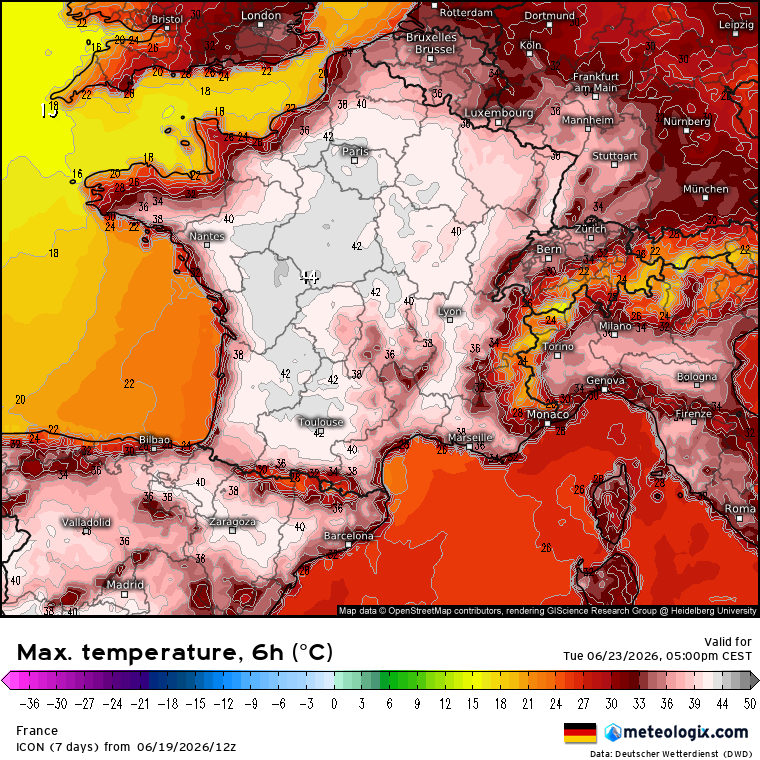
J’ai très sincèrement encore du mal à réaliser ce que la France pourrait subir dès dimanche. Le pic de chaleur s’allonge et s’intensifie : c'est désormais mardi qui apparaît comme la journée la plus chaude de l’épisode.
➡️Plus de 20 millions de Français pourraient être confrontés à des températures dépassant les 42°C.
➡️Dans certaines régions, notamment en Poitou-Charentes, la barre des 42°C pourrait être franchie pendant près d’une semaine.
➡️Certains scénarios envisagent même des températures supérieures à 44°C de lundi à mercredi.
Plus les modèles persistent dans cette voie, plus la situation me paraît irréelle. Ce soir, je ne sais plus si je ressens de la peur, du déni, de la résignation ou de la tristesse. J'ai du mal à mettre des mots sur ce que j'éprouve.
@McFaul It's not about consumption, it's about the power to create a world according to your own wishes. Musk is a paradigmatic example. Can never have too much money towards that end.
URGENT: Germany’s collective punishment of my family continues. They’ve now frozen my pensioner mother’s bank account, claiming I somehow “control” it too. Her savings are inaccessible — yet she has received no official notice from any German authority. No charges no due process
#OTD 20 May 1944, David and Perla Urbach and their two daughters, Rosa and Regine, were deported on transport no. 74 from Drancy transit camp, France to Auschwitz-Birkenau.
Perla and Rosa survived
Regine’s fate is unknown
David was murdered on a death march
This is their story: https://t.co/ZVSw1ZOasI