Passionate Railwayman, Compelling Storyteller; Compulsive traveller; Cultural Explorer. Watch out for Food posts and Lunchtime humour. Views strictly personal.
Friends, finally, after some delay, my podcast with @kunalvijayakar on the History of the Bor Ghat railway line on @IVMPodcasts is live! It has come out well though the editing could have been a little better. I regret if there are any errors in the podcast. I would request you to watch it on YouTube in leisure (as it is 47 minutes long 🙂) and let me know how it came out! Thanks! 🙏 #podcast #IndianRailways #History
https://t.co/GGuBTXmmjW
Lunchtime humour - An old man asks an astrologer - Please tell me my future.
.
.
.
Astrologer - A young girl will touch your body everywhere.
.
.
.
Old man (excited) - When and where?
.
.
.
Astrologer - Next month, in the ANATOMY lab! 😃😛😂
Lunchtime humour - An old man asks an astrologer - Please tell me my future.
.
.
.
Astrologer - A young girl will touch your body everywhere.
.
.
.
Old man (excited) - When and where?
.
.
.
Astrologer - Next month, in the ANATOMY lab! 😃😛😂
#Sunday#humour - Ek TV reporter ne ek bomb blast se zakhmi huey aadmi se pucha - Kya bomb badey zor se phata tha kya?
.
.
.
.
.
.
Zakhmi aadmi (obviously livid at the question) - Nahi re, woh regta hua mere paas aaya, aur sharmaa ke bola - DHOOM! 😃😛😂 #SundayFunday
This day that year - At 8 a.m. on October 25, 1951, the first votes in independent India’s first general election were cast in the remote tehsils of Chini and Pangi in Himachal Pradesh. It was the beginning of an unprecedented democratic exercise that would unfold over several months, until February 1952, as millions of Indians went to the polls for the first time.
The story of India’s first election is also the story of the people who took part in it. Among them was Shyam Saran Negi, a schoolteacher from Kalpa in Himachal Pradesh, who cast his vote in October 1951. Decades later, he would be remembered as independent India’s first voter.
Making that participation possible across a country of continental scale required extraordinary planning. Millions of voters had to be identified and registered, polling stations established in far-flung locations, and a system devised to let people cast their votes regardless of literacy. At the centre of this unprecedented undertaking was Sukumar Sen, India’s first Chief Election Commissioner, tasked with turning the promise of universal adult suffrage into a functioning electoral process.
Sukumar Sen oversaw the preparation of electoral rolls, the setting up of polling stations, and the logistics of reaching voters across mountains, forests, deserts, and remote villages. From ballot boxes marked with party symbols to the use of indelible ink, the election demanded ingenuity at every turn. #elections #history
@ArunKrishnan_ Tilak - You didn't call
Nitesh - You just come, I'll come too, alright?
Tilak - Hey, will you say two, will you go
The rough translation of the conversation.
Probably one of the rare occasions when two Telugu-speaking batsmen are at the crease and this serious conversation is fun, even though it came during the final nail-biting moments of the match before we won yesterday. #TilakVarma#NitishKumarReddy#CricketTwitter#INDvsNZ
తిలక్ - నువ్వు కాల్ ఇవ్వలేదు
నితీష్ - నువ్వు వచ్చేసేయ్ నేను వచ్చేస్తా ఆరాంసే
తిలక్ - రేయ్ రెండు అని చెప్పురా పోనీ
ఎంత బాగుందో
ఇంటర్నేషనల్ మ్యాచ్ లో తెలుగులో మాట్లాడుకుంటుంటే 😍
Max Born with the family of Dr B.S.Madhava Rao, the famous mathematician and theoretical physicist. From 1935 to 1938, Dr Madhava Rao worked with Max Born on Born's nonlinear electromagnetic field theory, producing eight published papers and a doctoral thesis on the subject.
The second photo features Max Born and his wife, Hedi Born, with the former wearing the Mysore Peta turban and his wife elegantly draping a sari. #MaxBorn #NobelLaureate #India
From the IISC (Indian Institute of Science) Archives -
Letter by Sir Chandrasekhara Venkata Raman (Sir C.V.Raman) to Physicist Max Born, inviting him to IISC Bangalore as Reader In Theoretical Physics at an honorarium of ₹15000, dated 17th Jan, 1935.
Max Born, who had fled Nazi Germany, accepted the invitation from C.V. Raman to come to the Indian Institute of Science (IISc) in Bangalore. He arrived in Bangalore in 1935, where he taught, gave lectures (such as his famous lecture on the fine structure constant), and directed theoretical physics research for six months.
Although Raman hoped Born would stay permanently, Born did not secure a permanent position at IISc due to local institutional politics and governance conflicts surrounding Raman at the time.
Max Born was awarded the 1954 Nobel Prize in Physics for his fundamental research in the field, most notably for providing the statistical interpretation of the wavefunction (known as the Born Rule). #research #history
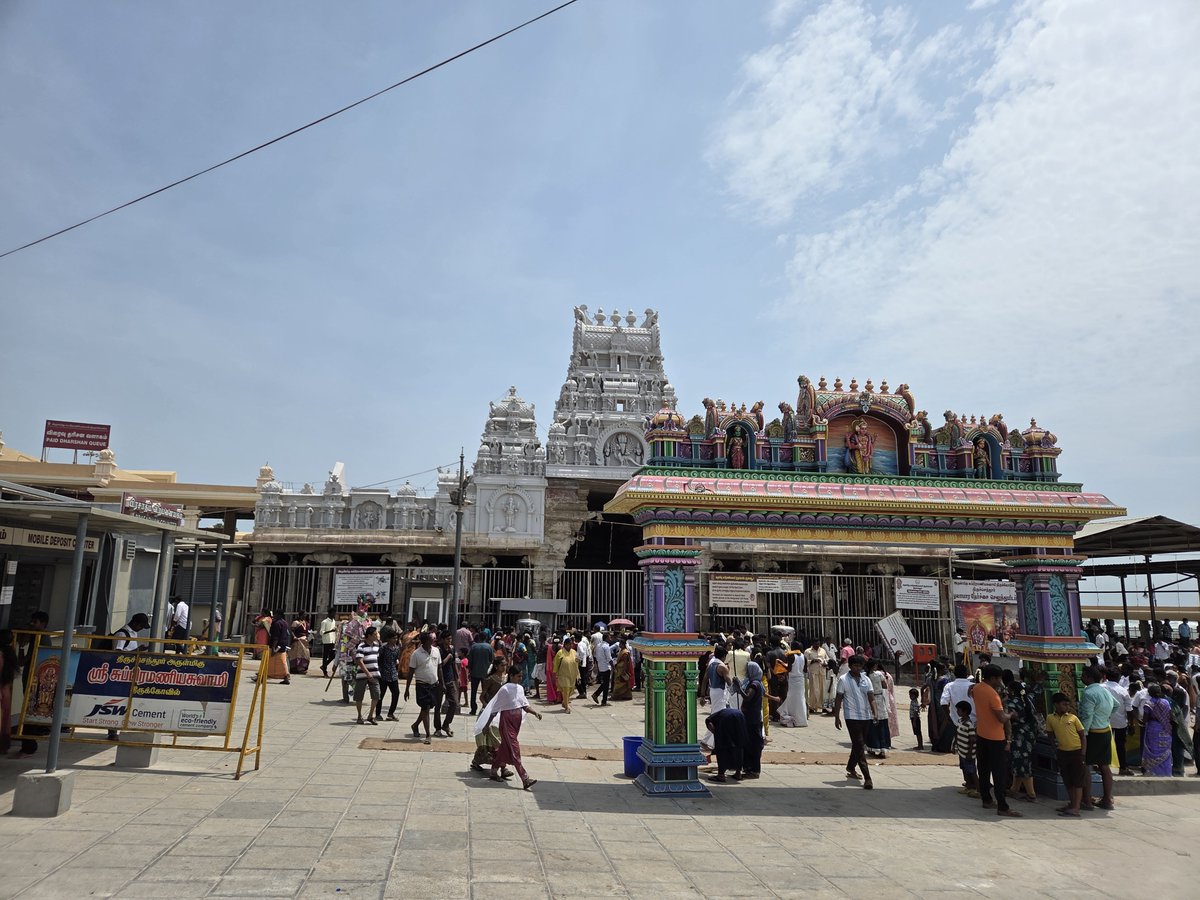
Divine darshan of Subrahmanya Swamy, Tiruchendur! 🙏
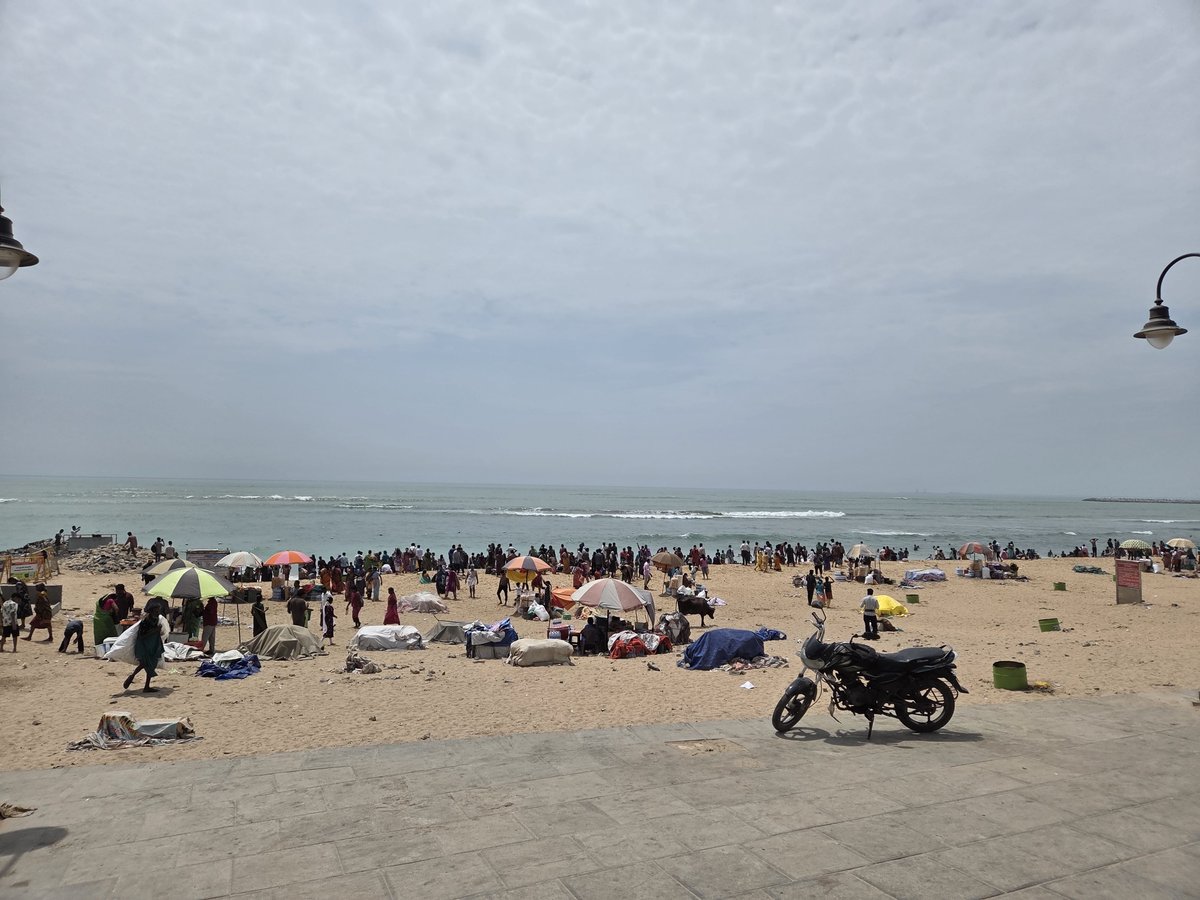
The Thiruchendur Murugan Temple is the second of the six sacred abodes (Arupadai Veedu) of Lord Murugan, uniquely situated directly on the seashore of the Bay of Bengal in Tamil Nadu. Legend says that this seaside location was the battleground where Lord Murugan vanquished the demon king Surapadman. After defeating the demon, Lord Murugan worshipped Lord Shiva at this very spot to express gratitude for the strength granted during the war.
The temple is referenced extensively in ancient Tamil literature, including the Thirumurugatrupadai composed by the Sangam poet Nakkirar in the 2nd century CE, confirming its multi-millennial antiquity.
While the other five Arupadai Veedu shrines sit atop hills or mountains, Thiruchendur stands majestically on the active shoreline, fusing the rhythm of ocean waves with continuous devotional chants (Arogara). #TamilNadu #temple #legend #history @Gopalee67
#DidYouKnow In 1881, there were approximately 9,900 miles of railway line; in 1891, 17,300 miles, in 1901, 25,300 miles, and about 42,000 miles of line in 1935! Such was the rapid pace of construction of railway lines at the onset of the 20th century! #IndianRailways#History
This was my first inspection of a New Line railway project - the Tindivanam-Nagari line in Southern Railway. These photos were taken just 2 km from Nagari. This is how the work site looks before the track is laid. The blanketing has just been completed.
What is blanketing material - it is a coarse, granular, well-graded aggregate (like crushed stone, quarry dust, or gravel) placed between the ballast and the subgrade to distribute train loads, prevent ballast from sinking, stop fine soil from mixing in (mud pumping), and improve drainage, ensuring track stability and longevity by meeting strict particle size distribution and low fines content requirements.
The third photo is the construction of a road underbridge in progress. And the fourth one is the platform for what we call a trolley refuge - a spot for parking push trolleys while inspecting the track. With the laying of the ballast, sleepers, and rails, the height will be raised upto the level of this platform. #IndianRailways #projects
A. B. KERKAR (Born 1932) - In 1962, JRD Tata brought in a young hotelier to fix one badly-run hotel in Bombay. 35 years later, he had built the Taj Hotels into one of India's most powerful hotel companies.
That hotelier was Ajit Baburao Kerkar. His path into hospitality started by accident. He moved to Bombay wanting to be a cricketer. Cricket took him to England, where he drifted into the restaurant trade & eventually rose to manage a well-known London catering institution.
That's where the Tatas found him. When he joined the Taj Mahal Hotel, Bombay, the property was struggling badly. The hotel was so poorly managed that JRD Tata had once joked that he didn't even know where to begin fixing it.
But Kerkar figured it out. He joined in 1962, and by 1970, he was running IHCL as MD. He gutted parts of the Taj while it remained operational, installed a lift, expanded the property and found ways to fund improvements through the hotel's own savings instead of constantly going back to the Tatas for capital.
Over the next few years, he took that single hotel and built it into India's largest hospitality company. He structured separate companies with outside investors to fund each new property.
He helped build Fort Aguada in Goa, turning it into one of the properties that helped put Goa on the global tourism map.
Then two maharajas approached him separately, one from Udaipur, one from Jaipur, asking if the Taj would run their palaces. Kerkar said yes to both & in doing so invented an entirely new category in Indian tourism: “Palace Tourism.” Rajasthan as a global destination exists largely because of that decision.
The same approach took Kerkar to Delhi, Kolkata, Kerala and several other destinations. By the mid-1990s, the company had grown from a single flagship hotel into a portfolio of 40–50+ hotels, with FY1996-97 sales of over ₹618 crore & net profit above ₹146 Cr.
He didn't just build hotels. He built the reasons people started visiting India in the first place. #hotels #legends
A narrow, winding street in old Amritsar, India — 1907. 🇮🇳 This stereoview card by the H.C. White Company in 1907, shows a typical scene in the "Native Quarter" (the walled inner city) of Amritsar, specifically near the bustling Dholi Bazar and Katra areas.
The old city was structurally organized into specialized commercial sub-quarters called Katras, which were established during the 17th and 18th centuries. These served as secure residential and commercial hubs tailored to specific artisan trades or merchant guilds.
These narrow, winding streets radiated directly outward from the city's spiritual and physical center, the Sri Harmandir Sahib (Golden Temple). The architecture seen here—tall brick townhouses (havelis) with overhanging balconies (jharokhas) lining narrow alleys—was incredibly functional. It provided defensive advantages against invaders, protected pedestrians from the harsh Punjabi summer sun, and created wind tunnels that naturally channelled cooler air through the dense urban maze.
The economy of the city around that time relied heavily on its positioning along trans-regional trade routes. Goods from Kashmir, Tibet, and Central Asia were funneled through these very markets. The city was world-renowned for its textile manufacturing, specifically the refinement and trade of high-grade wool, Pashmina shawls, and silk weaving.
The introduction of the British railway network and the extensive expansion of regional canal irrigation transformed the surrounding area into an agrarian powerhouse. Raw materials like wheat, cotton, and pulses flooded the urban markets, introducing a new wave of wealthy merchant brokers and legal professionals into the city.
Prior to Partition, the walled city boasted a diverse, closely integrated demographic mix consisting of a slight Muslim majority alongside massive Sikh and Hindu populations. Communities lived tightly packed within respective mohallas (neighborhoods), sharing local marketplaces.
The early 1900s were marked by deep religious and educational revitalization. The local population heavily funded projects like the iconic Khalsa College (completed around 1911–1912) to promote modern education alongside cultural heritage.
While daily life appeared calm on the surface, this period was the calm before the storm. Agrarian friction against colonial laws (like the Land Alienation Act of 1901) was brewing intense nationalist resistance. Just over a decade later in 1919, this exact dense urban ecosystem would become the epicentre of global anti-colonial resistance following the tragic Jallianwala Bagh massacre.
#Amritsar #society #economy #history
The Barton Library and Museum, Bhavnagar, photographed circa, 1889. Established on December 30, 1882, the library was inaugurated by Maharaja Takhtsinhji Gohil and named in honour of Colonel L. C. Barton, the English Political Agent at the time.
It originally housed a vast collection of books and regional antiquities. Over time, the antique and artifact collections were shifted to the lower level of the nearby Gandhi Smruti building, forming the Barton Museum, while the library remains active on Diwanpara Road.
It was built in the late 19th century, reflecting colonial-era institutional design blended with local craftsmanship. The layout features classic two-storeyed colonial elements, arched windows, traditional high-roof or tiled detailing, and naturally ventilated reading halls designed for quiet public scholarship.
It is recognized as one of the oldest public libraries in Gujarat and Saurashtra's premier literary spaces. The library holds over 60,000 to 70,000 books, historical literature, 1,800-year-old Bhavnagar Gazettes, and multi-language texts in Gujarati, English, Hindi, and Sanskrit. The attached museum preserves regional history, local archaeological remains, and historical artifacts that anchor the identity of the former princely state. #Bhavnagar #library #history @GujaratHistory@DeshGujarat
Early 20th Century - view of Princess Street, Bombay (Mumbai).
Princess Street near Crawford Market, was opened by the Prince of Wales. The Prince and Princess of Wales (later King George V and Queen Mary) visited Bombay in 1905.
Created as part of the Bombay Improvement Trust's post-plague urban planning schemes, it was designed as Mumbai's first major cut-through street to let fresh sea breezes flow into the dense inner-city neighbourhoods.
It was later renamed Samaldas Gandhi Marg in honor of the freedom fighter Shamaldas Gandhi, who led the Arzi Hukumat (temporary government) of the princely state of Junagadh in 1947.
It is now a major wholesale and retail marketplace renowned across India for selling chemicals, pharmaceutical products, medicines, and medical equipment. The street sits near the busy Marine Lines Railway Station and connects core South Mumbai localities including Thakurdwar, Bhuleshwar, Lohar Chawl, and Dhobitalao.
Publisher - B. Rigold & Bergmann, Bombay. B. Rigold & Bergmann was a prominent historical trading firm established in London (1876) that maintained prominent operations, offices, and publishing activities in Bombay (Mumbai) and Calcutta during the late 19th and early 20th centuries (c. 1895–1916).
Originally a British trading house based out of Bishopsgate, London, the firm expanded into India. They traded in diverse imported commodities—ranging from luxury German-made porcelain dolls to playing cards and branded betel nuts. Between 1895 and 1916, they became famous for producing high-quality, monochromatic collotype and lithograph postcards. These cards meticulously documented colonial Bombay’s streetscapes, landmarks, and daily scenes. #Mumbai #streetphotography #history @mumbaiheritage@dhavalkulkarni
A correct decision can double the confidence while a wrong decision can double the experience. One needn't worry in both cases. Good morning, friends, and have a great #Sunday! 🙏 #SundayMotivation
A correct decision can double the confidence while a wrong decision can double the experience. One needn't worry in both cases. Good morning, friends, and have a great #Sunday! 🙏 #SundayMotivation
#DidYouKnow For 25 years since 1854, East Indian Railway Company didn't have a regular home. It functioned from a building in 29, Theatre Road since the time MacDonald Stephenson was the Agent. It shifted to its present location called Fairlie Place in 1879.
The earliest reference of Fairlie Place dates back to a map of 1794. It's named after William Fairlie, a distinguished Calcutta merchant of the firm, Fairlie, Gilmone & Co., who had bagged the contract for feeding elephants and camels of the British Army under Lord Wellesley. It initially set up a booking office after acquiring it and completed refurbishing it in 1884. The same building continues to headquarters of Eastern Railway till date. #IndianRailways #History
#DidYouKnow The development of Calcutta port necessitated direct rail connectivity to the port and this was provided by the East Bengal Railway, which was formed in 1857 and first opened a single line from Calcutta to Ranaghat in September 1862.
Between 1882-84, the company opened a line from Dum Dum to Khulna (now in Bangladesh) and another from Ranaghat to Bongaon. The linking of EBR with EIR was achieved with the construction of the Jubilee Bridge connecting Hooghly (Bandel) and Naihati on 21st February, 1887. #IndianRailways #History
From the IISC (Indian Institute of Science) Archives -
Letter by Sir Chandrasekhara Venkata Raman (Sir C.V.Raman) to Physicist Max Born, inviting him to IISC Bangalore as Reader In Theoretical Physics at an honorarium of ₹15000, dated 17th Jan, 1935.
Max Born, who had fled Nazi Germany, accepted the invitation from C.V. Raman to come to the Indian Institute of Science (IISc) in Bangalore. He arrived in Bangalore in 1935, where he taught, gave lectures (such as his famous lecture on the fine structure constant), and directed theoretical physics research for six months.
Although Raman hoped Born would stay permanently, Born did not secure a permanent position at IISc due to local institutional politics and governance conflicts surrounding Raman at the time.
Max Born was awarded the 1954 Nobel Prize in Physics for his fundamental research in the field, most notably for providing the statistical interpretation of the wavefunction (known as the Born Rule). #research #history