A project of the @JamesWilsonInst. Teaching anew the grounding axioms of the American regime, and seeking to restore the wisdom of the Founding Generation.
NEW: @MTMehan of @HillsdaleInDC joins @AnchoringTruths podcast to explore how to pass down the goodness of America through fables during America 250. Mehan is the author of "The American Book of Fables" discusses his new heirloom volume, both a collection of original and reworked fables set across the U.S.
https://t.co/xZltXL3eKm
The Supreme Court has now denied Louisiana’s application for a stay in the Danco Labs case. The shipment of mifepristone will not be blocked. Only Justices Alito and Thomas dissented—with force and clarity. 🧵on its importance. 1/
"While the rest of us worry about rogue superintelligent machines rising up to take over, [Glenn Harlan Reynolds] argues the real danger is far more subtle—and far more tempting."
@instapundit discusses Seductive AI on @AnchoringTruths.
https://t.co/zCPScIUEzs
What is freedom for?
Is freedom of speech for the purpose of being able to say whatever one wants? Is the First Amendment there to shield us from ANY government effort to enforce an orthodoxy?
Or is it for the purpose of making sure truth is not suppressed?
And does it have limits?
Check out my latest essay, graciously published by my friends at the @JamesWilsonInst, analyzing some of the language in the recently decided Chiles v. Salazar case and what the precedent means going forward!
https://t.co/BWgoXeKPMM
NEW EPISODE!🗣️
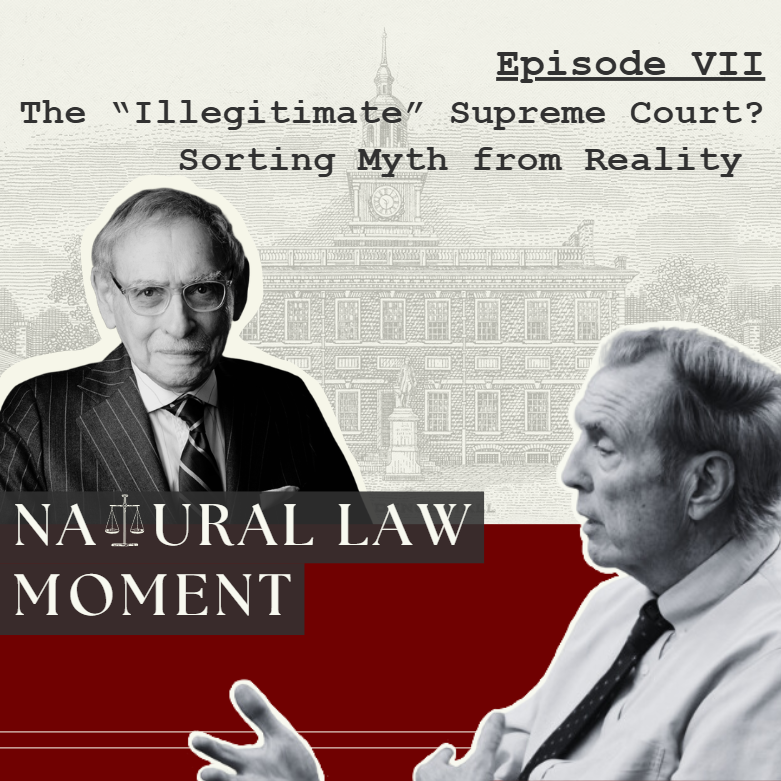
Join co-hosts @HPArkes_ and @Prof_GBradley for a pointed discussion of the Supreme Court and the federal judiciary in American life in the latest episode of Natural Law Moment - "The 'Illegitimate' Supreme Court? Sorting Myth from Reality."
Tune in below!!
Legal conservatism can't be rebuilt on procedure alone.
In his latest, Garrett Snedeker argues that Merriam’s critique stops short of the deeper truths the Founders took for granted that expose the racial determinism at the heart of our current constitutional.
NEW EPISODE! 🚨
Professor @JoshMBlackman of @STCL_Houston joins us to discuss his article "Bilateral Judicial Reform" recently published in the Texas A&M Journal of Law and Civil Governance.
Click the link below to listen to "Reforming the Judiciary with Josh Blackman" now! 👇
As we gather to celebrate Thanksgiving, we honor the vision of two great leaders who enshrined this sacred tradition. George Washington, at the behest of Congress, proclaimed October 3, 1789, a day of public thanksgiving and prayer. He urged Americans to unite in acknowledging “the providence of Almighty God,” which had sustained the nation through its trials and secured its independence.
Seventy-four years later, Abraham Lincoln, amid the anguish of civil war, proclaimed the last Thursday in November as a national Thanksgiving. He called upon the people to repair “the breaches of the Almighty” and restore “the full enjoyment of peace, harmony, tranquillity, and union.”
Today, we give thanks for the legacy of our founding, the story of our success, and the promise of our future.
From all of us here at JWI, Happy Thanksgiving!
An old message from yours truly:
Over seven centuries ago, Thomas Aquinas summed up what western civilization understood to be the natural debt of gratitude all human beings owe to God, family, and country.
“Man becomes a debtor to other men in various ways, according to their various excellence and the various benefits received from them . . . the principles of our being and government are our parents and our country, that have given us birth and nourishment. Consequently man is debtor chiefly to his parents and his country, after God. Wherefore just as it belongs to religion to give worship to God, so does it belong to piety, in the second place, to give worship to one’s parents and one’s country.”
As is abundantly clear from the rest of the articles in this week’s feature, the American founding generation understood what these words meant. Immersed in a culture of distractive decay, and systematically miseducated to reflexively deconstruct purpose and deny principle, we find their meaning much harder to understand.
The premise is that we all owe debts based on what we have freely received. The “principles of our being and government,” or that from and out of which our very lives and way of life arise and exist, are our parents and our country. The form of government in which we are born, no less than our parents, give us our existence and allow us to maintain it, all while shaping our character, or who we are and can become.
Thus the extent to which we are all debtors to the Founders is hard to fathom. Nearly every earthly good we possess—and thanks to their notion of religious freedom, nearly every spiritual good as well—is in some way ours by means of and within the regime the Founders wrought.
All the ironic and increasingly vitriolic sentiments one reads on national holidays ridiculing our nation’s (often very real) flaws are very much like ridiculing or pointing out your Mother’s faults on Mother’s Day, or saying you can’t quite celebrate Valentine’s day with your significant other on account of her imperfections, which you proceed to list. And then telling everyone else that they are making idols of their Mother or beloved because they celebrate these days without such childish impudence.
We are not usually able to directly repay, nor even fully understand, the breadth nor depth of what we have received from those who have nourished and taught us, never mind those who in some real way have sacrificed for us, sometimes to the point of death. We are often left with the attempt to give what we received from those who cared for us to those under our own care. This form of giving is often the only way open to us to pay our debts in this life. It also why gratitude entails giving and receiving properly. We learn and can actually grow in generosity by receiving it.
As Aquinas also says, citing Aristotle, “The Philosopher says (Ethic. v, 5): ‘We should repay those who are gracious to us, by being gracious to them in return,’ and this is done by repaying more than we have received. Therefore gratitude should incline to do something greater.”
With sincerity and without irony, let us give gratitude today to what and whom it is due in our lives without apology or qualification. May we “incline to do something greater.”
Happy Thanksgiving!