I study the Loops of Meaning — how our biological drives, symbolic imagination and cultural systems interact to shape our views on our past, present and future.
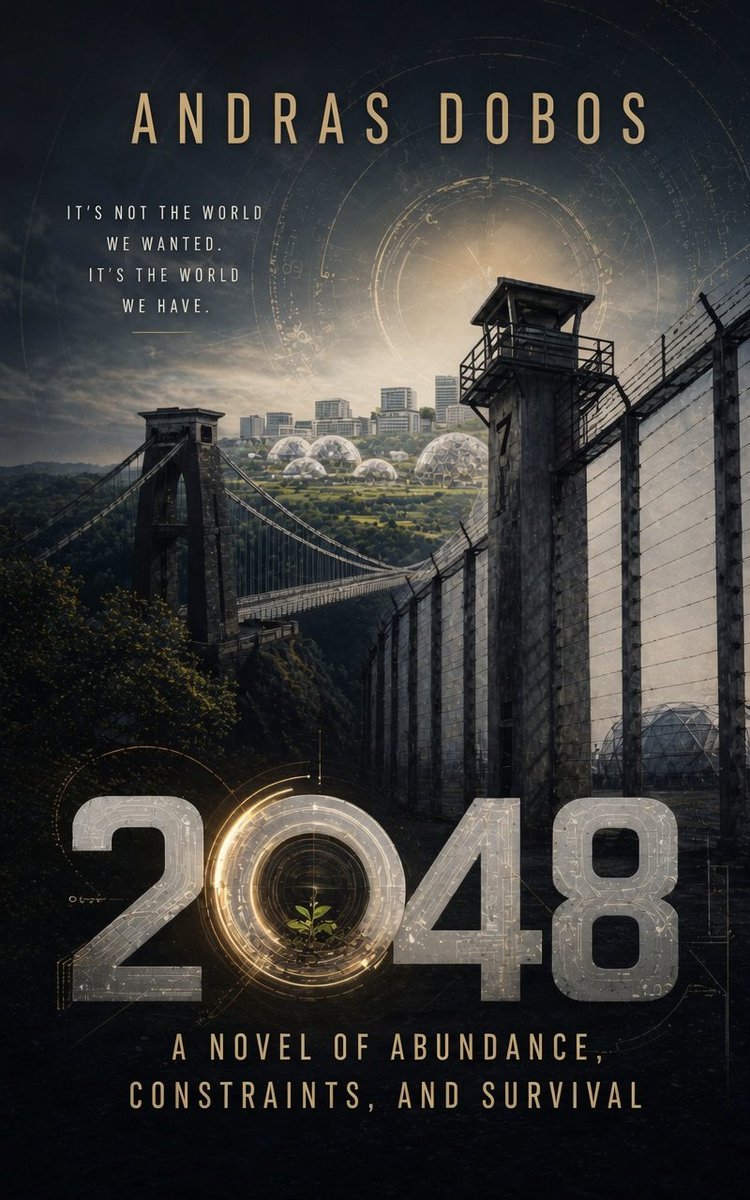
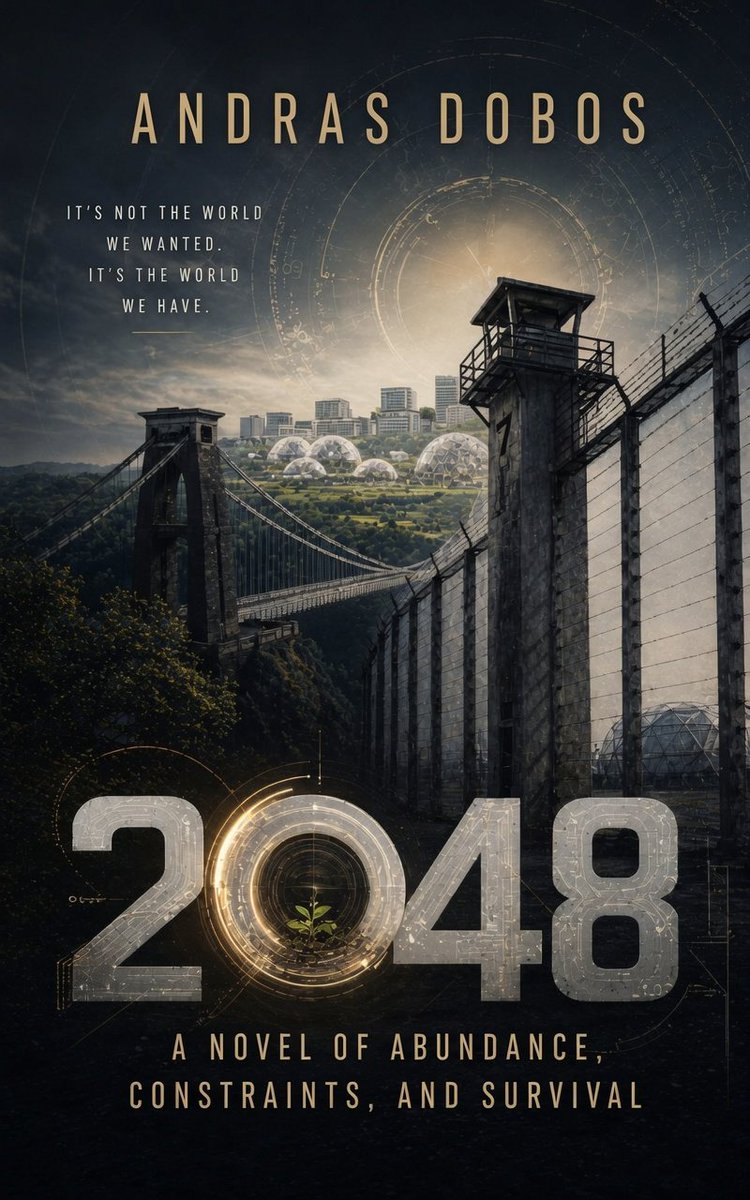
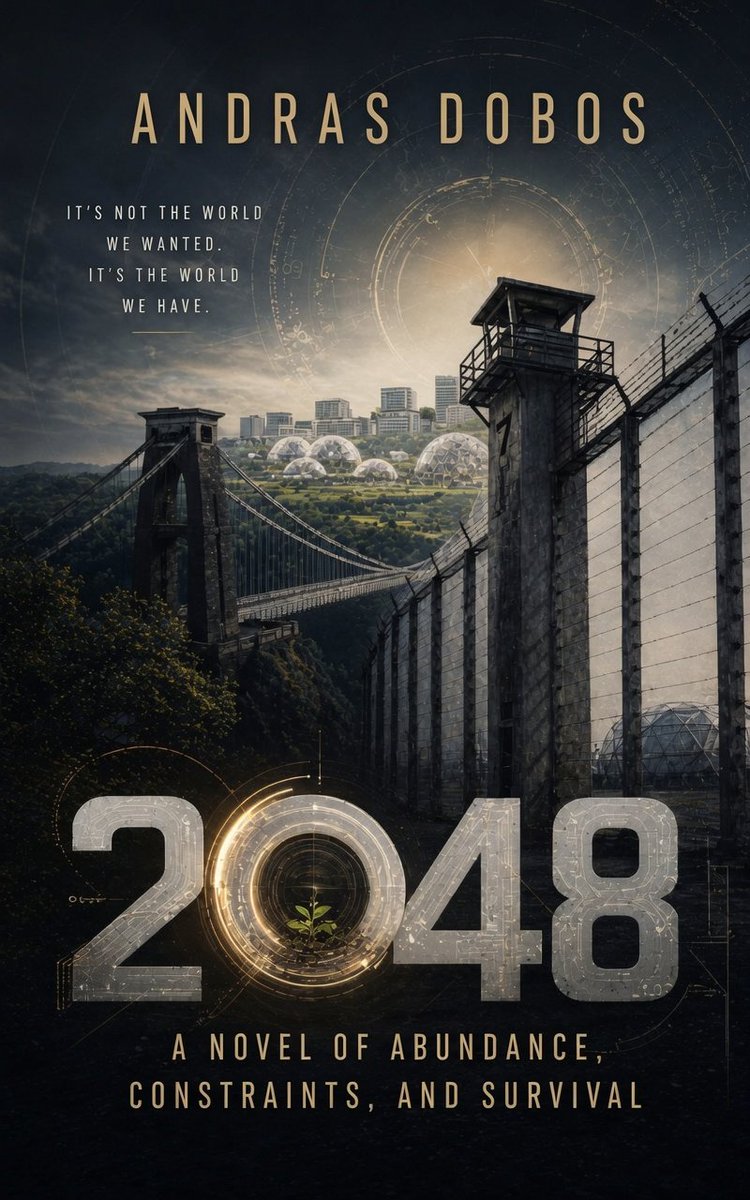
@athenaeumbc You could read 2048, a speculative fiction about a family leaving a breaking Bristol (UK) for a city where food, energy and shelter work again, then finding out what that kind of abundance actually requires.
The Amazon sample is live now:
https://t.co/0EqUX2W74a
The future probably isn’t the clean utopia they promise, or the total collapse people fear. A miracle might get us to abundance. Collapse is more likely. But the space in between is what 2048 is about. Where systems still work for some, people are kept alive, fed and managed while the rest falls away. The likely future for those who don’t die.
https://t.co/mcHyRKWmIX
Blaming Lloyd George or Disraeli is a convenient way to avoid the obvious question: wasn’t neoliberalism supposed to be the ideology that finally knew how to solve these problems?
After four decades of privatisation, deregulation, financialisation, and market-first policy, we have weak growth, fragile public services, unaffordable housing, high inequality, and an economy increasingly sustained by debt rather than productive investment. Research on the Thatcher era finds that the promised prosperity did not broadly trickle down; household debt rose sharply, while post-1979 growth did not improve on earlier postwar performance.
That is the point. Neoliberalism presented itself not as one political choice among others, but as economic realism. Now its failures are blamed on everyone except the model itself.
@kusikDVM@LisaBritton@pensandpoison Yes, a paperback edition is planned for the end of the month. At over 130,000 words, the printing cost means it will be considerably more expensive than the ebook, but I know the reading experience is different on paper. I’ll share the link when it’s available.
The decline of the West is less a story of ideological surrender than of neoliberalism reaching the end of its cycle.
Like communism before it, neoliberalism promised a universal model, treated its own failures as temporary distortions, and gradually lost the ability to explain reality. It hollowed out institutions, weakened the state, transferred power upward, and reduced public life to market logic. What remains is not confidence but ritual: leaders repeating formulas they no longer believe while the system continues to deteriorate.
That is hypernormalisation, a term coined by Alexei Yurchak and popularised by Adam Curtis. The structures still function, but increasingly as stage sets. Everyone knows the official story is failing, yet no alternative has acquired enough legitimacy to replace it.
The West is not simply destroying itself in the name of ideology. It is trapped inside a dying ideology, performing belief in institutions that no longer correspond to reality.
The 15 billion claim is questionable. But the underlying mechanism is real, and AI makes it worse.
Credit isn't wealth. It's a claim on future labor. When $15 billion in credit is created, $15 billion + interest must be extracted from workers, consumers, and businesses over time. Every loan is a promise that someone will work, produce, or pay.
AI accelerates this extraction in three ways:
Faster credit creation. Algorithms design complex financial products in minutes. Risk models justify higher leverage. Deals that took weeks now close in days.
Intensified productivity demands. AI-powered monitoring, automation, and optimization extract more output per worker. "Efficiency" means doing more with less, until there's nothing left to give.
Widening the gap. AI speeds up paper claims faster than real value can be produced. Obligations multiply. The pressure cascades: layoffs, wage suppression, price hikes, burnout.
The escape economy blooms because the crush is real. Desperate people buy courses, schemes, retreats or anything that promises an exit. The more crushing the system, the more lucrative selling hope becomes.
AI isn't the escape. It's the acceleration of the crush.
You are the person who has to decide what happens when your father is ill, the lights go out, the child needs feeding, the road floods, and no one else is coming.
Fight Club understood the urge to tear it all down.
https://t.co/Aj6pVQnLcG
or
https://t.co/fPMhAl5kVm
@Serf_InTheCity@_The_Prophet__ Fair point, if compute stays widespread and optional, it’s harder to control. But if it becomes essential to identity, payments, work, logistics and defence, it becomes a chokepoint. Private ownership doesn’t prevent state control when continuity or security is at stake.
@garrytan We need ambition again, but “add feedback loops” is not a harmless technical fix. In a society built on AI abundance, feedback means continuous measurement, coordination and correction, including of people. 2048 is about what that future might demand.
https://t.co/eTuYdh2BS7
@Dr_Singularity Many imagine abundance as the moment constraints disappear. That gets it backwards.
Abundance at scale means deeper dependency on infrastructure and systems that have to keep working and that brings new constraints and more control.
2048 about that future.
https://t.co/eTuYdh2BS7
@_The_Prophet__ The question is whether it happens transparently or just gets folded into the machinery of 'continuity and resilience' the way most critical infrastructure quietly does.
@_The_Prophet__ The natural endpoint is state absorption, not just soft regulation. Once intelligence production behaves like a utility with national security weight, no government leaves that fully in private hands for long.
@MattWalshBlog Agreed. Add climate change and the AI/automation jobocalypse to the pile too. A nation and its political class failing to secure their own future is just gross neglect of duty. So let's discuss.
@MichaelLew33229 2048
Near-future speculative/climate/social science fiction. Also Critical dystopia.
2048 shows the abundance we can actually build, not the one we've been promised. It's a realistic account of what getting there costs, and what living inside it demands.
https://t.co/D0bC8mTLIM
@GoodwinMJ "Fortress" wasn't even a phrase when I started writing 2048. Now it's becoming a mainstream shorthand in real time. That's the part that should worry you more than the border debate itself, how fast the language shifts once people feel the ground move.
https://t.co/D0bC8mTLIM