There are over 300 publicly listed companies that could be classified as serial acquirers.
But how do you separate the great ones from the rest?
Charlie Munger had a simple approach: "Invert, always invert."
Instead of asking what makes a great serial acquirer, start by identifying the red flags.
Here are 5 key things to look for when evaluating serial acquirers 👇
What is your biggest takeaway from Li Lu's talk at Columbia Business School on October 5th?
I'll share mine over the next few days
https://t.co/YD0BMyPv0h
50 Sites That Show What Billionaires Buy and Read for Free🤯
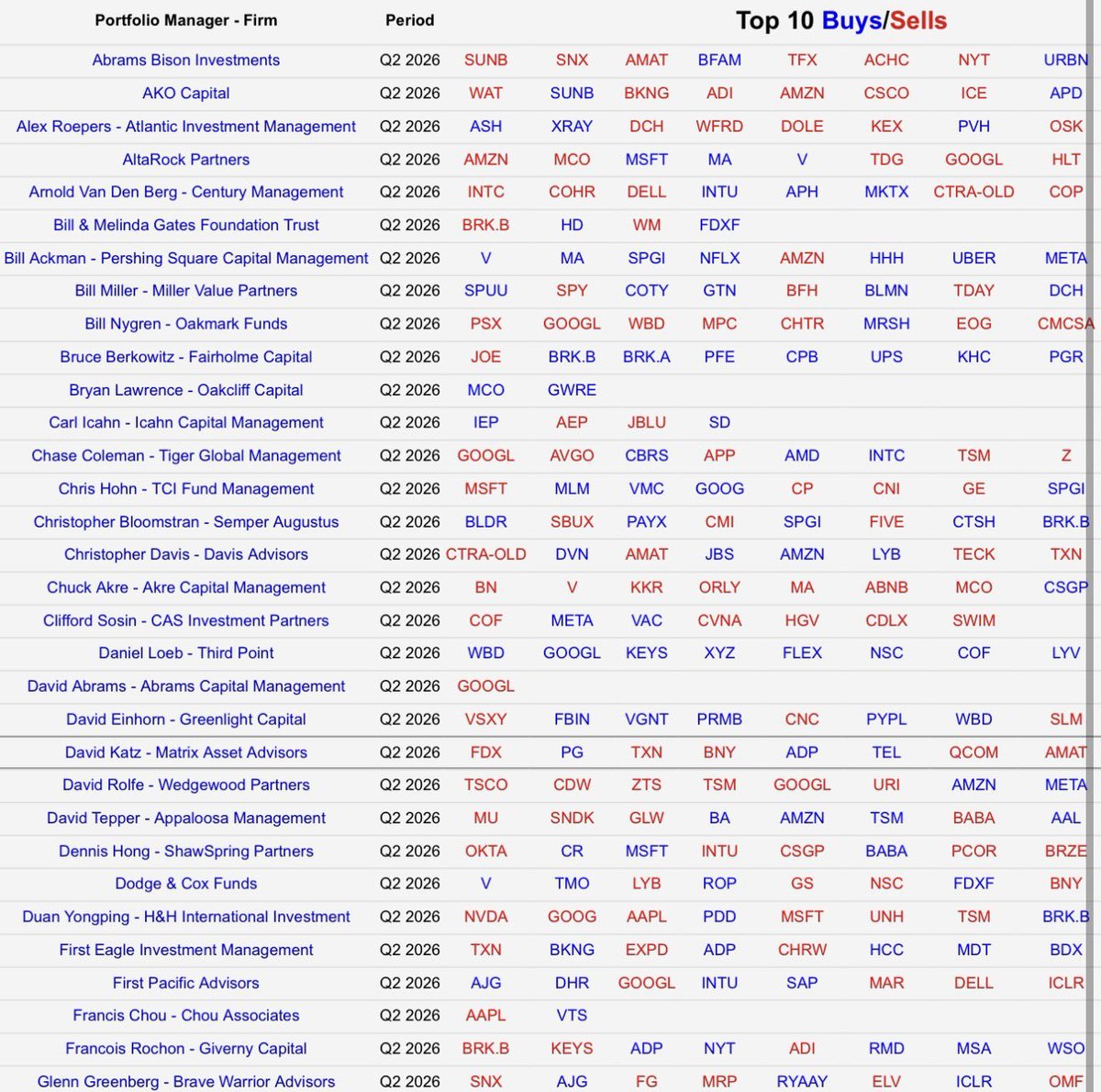
1.) https://t.co/mvAFha3UcY → Current portfolios of famous investors
2.) https://t.co/VjOIL5Kj7A → Quarterly fund trades
3.) https://t.co/pyHuR5ONhD → Stock transactions of US politicians
4.) https://t.co/2L2KSsXhOR → Executives' own company stocks
5.) https://t.co/U0eklGHXcn → Making fund filings readable
6.) https://t.co/lrMexKysa4 → Companies' official reports
7.) https://t.co/w1Em8oLpKl → Buffett's letters since 1977
8.) https://t.co/ext9919w8f → Video archive of Buffett meetings
9.) https://t.co/f2BkyzJiGf → Howard Marks' investor memos
10.) https://t.co/Pp3n1W0if7 → Research from Ray Dalio's firm
11.) https://t.co/8L1ngcmpun → Dalio's principles for free
12.) https://t.co/dno7ADFdiF → Jeremy Grantham's market notes
13.) https://t.co/a8rXDzONYd → Quantitative fund research
14.) https://t.co/mAUpmSgjEX → Damodaran's valuation data
15.) https://t.co/KBUGehAISK → Valuation professor's blog
16.) https://t.co/6SMvHvJlsr → Morgan Housel's money writings
17.) https://t.co/NMqdV93mXJ → Mental models for decision-making
18.) https://t.co/px8LaAqr6D → JPMorgan's free market guide
19.) https://t.co/ek9boIMk0V → Innovation-focused fund research
20.) https://t.co/Z0uXDnZMSk → Venture capital essays
21.) https://t.co/GX9jOaFzG6 → Value investing lecture notes
22.) https://t.co/hxvNeFPJ8M → Columbia's value investing archive
23.) https://t.co/BafbVYJP4x → Fed's economic data archive
24.) https://t.co/hKNAg2TfFf → Fed decisions and statements
25.) https://t.co/bNBsCvLcZh → European Central Bank data
26.) https://t.co/DOfFtQZpGy → Reports from the central bank of central banks
27.) https://t.co/BNCg0sGiUT → Countries' economic indicators
28.) https://t.co/pXQ2FkAO7f → Companies' long-term charts
29.) https://t.co/dEgHv3yC3E → Company financials for free
30.) https://t.co/9ixwpGlIHT → Companies' market cap rankings
31.) https://t.co/7MqH62ojVK → Stock screener and heat map
32.) https://t.co/6IdMnRTpi7 → Portfolio backtesting
33.) https://t.co/3CZcOYGdXT → Charts and market analysis
34.) https://t.co/WbRaajTSo7 → Professional market screener
35.) https://t.co/yYXBrk2AHB → Company activity reports archive
36.) https://t.co/NtKuBPtENy → SEC's investor education site
37.) https://t.co/OkbIKghb5c → Passive investing encyclopedia
38.) https://t.co/KOdlzRNGH8 → Financial terms dictionary
39.) https://t.co/t6ETCJ4rWm → Free finance guides
40.) https://t.co/kDj8uBsVIR → CFA research publications
41.) https://t.co/npCqge3hok → Fund and stock evaluations
42.) https://t.co/sJfn3Flo4t → Companies' visual analysis
43.) https://t.co/c1INhDEcGY → Archive of selected investment theses
44.) https://t.co/6usagzjipB → Seeing what's inside funds
45.) https://t.co/WG6x4PmYuA → European fund backtests
46.) https://t.co/tMK10BK7xU → Investment writings with data
47.) https://t.co/dlhu9JPkmM → Market history notes
48.) https://t.co/fmp9hAQK64 → Investor psychology writings
49.) https://t.co/DMaTpZMCB3 → Explaining the economy with charts
50.) ourfiniteworld? → (see note)
The rich don't hoard information. They just don't tell you where it is.
Save it, follow @monicaa_AI you'll need it.
Not investment advice.
A dollar invested with Mohnish Pabrai in 1999 would have grown to about $15.
The S&P 500 would have turned it into roughly $7.
In this 51-minute Columbia Business School lecture, he presents 28 models for allocating capital.
In one of them, Pabrai argues that after decades of investing, the two or three largest holdings should account for 70% of a portfolio's value. A lower figure indicates repeated sales of the companies responsible for most of the wealth.
He cites a study of U.S. stocks from 1926 through 2016 to explain why those rare holdings matter.
The best-performing 4% accounted for the market's entire net gain over one-month Treasury bills. The remaining 96% collectively matched those government securities.
If a few businesses generate most of your returns, they will naturally occupy more of the portfolio. Continually trimming them limits how much those exceptional investments can contribute.
His example is fund manager Nick Sleep, whose personal holdings were divided equally among Berkshire Hathaway, Costco, and Amazon.
The online retailer eventually grew to around 80% of the total. Sleep sold half that position and moved the proceeds into ASOS, a British fashion business Pabrai calls "useless, garbage."
He illustrates that switch with the Distracted Boyfriend meme.
"The mistress always looks hotter than the wife."
Pabrai is comparing the shares already in your account with the stock competing for their place. You know the problems of the first business. The second can look flawless while it is still only a pitch.
Before making that switch, compare their future prospects. Reducing concentration can be sensible.
The new stock must give you a reason to stop owning the old one.
The clearest 11 minutes I have heard on why the AI capex boom may not pay off. @ChrisBloomstran at the Zurich Project on the depreciation wall, ~$650B of off-balance-sheet SPV debt, and the circular financing between Nvidia, OpenAI, and the hyperscalers.
@IrrationalMrkts, Congrats joining the intrinsic value podcast. We briefly met at small cap discoveries. I look forward hearing your takes on businesses and hoping you share some of your small cap ideas.
Learning has never been so easy.
Today, you can learn more buy watching a documentary than a book.
Here are 7 Documentaries that teaches you about money.
@QCompounding One thing missing is the financing structure that Buffett used borrowing the Japanese yen to fund these purchases. @QCompounding could you elaborate on this trade and the arbitrage? And also the impacts, as recently the Japanese government was implying/raising rates?