@Ariadne_Bido@agbrolo Curious, how complicated would it be to make a test for different viruses?
What would you need to do to detect multiple different viruses/antigens at the same time?
@JoshuaPhotonics @BenB_UBC@SBQMI_UBC@ECEUBC@lukasc_ubc The absolute intensity can be measured only indirectly. One way would be as @JoshuaPhotonics described, and it includes the Q-factor, too.
Alternatively, it could be calculated from a nonlinear optical response.
@JoshuaPhotonics @BenB_UBC@SBQMI_UBC@ECEUBC@lukasc_ubc Hi Ben,
The field distribution can actually be mapped by sSNOM, which is a technique that employs an AFM with a metallic tip.
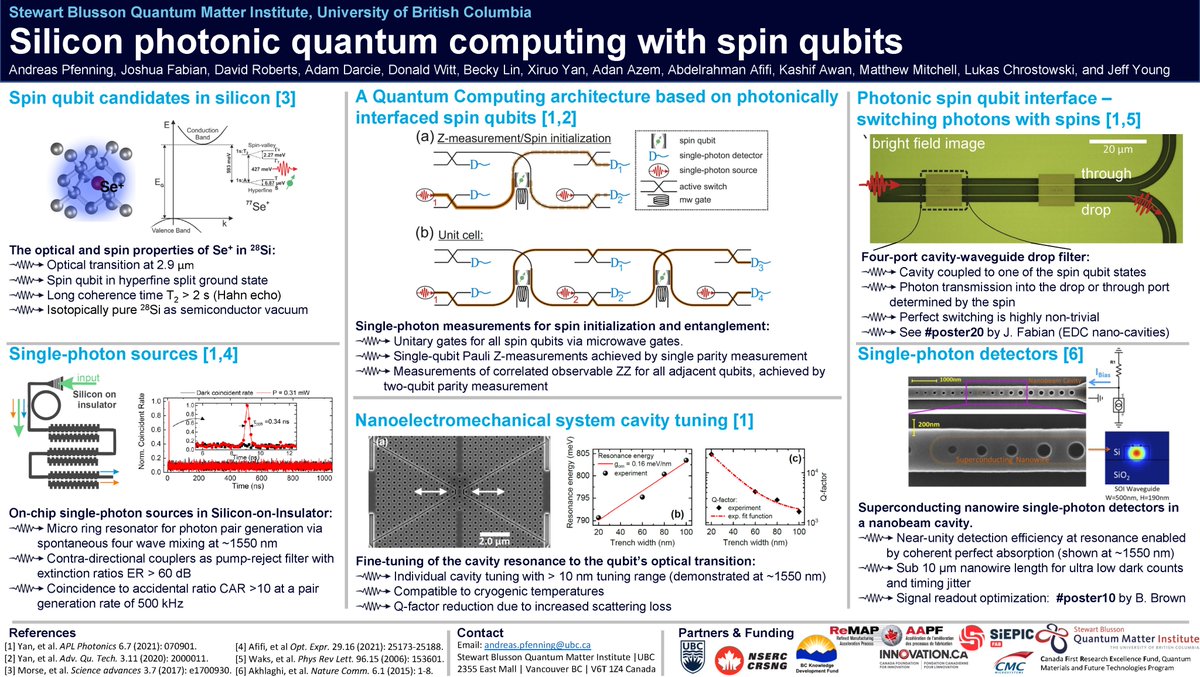
Quantum computing with spins and photons - all on a silicon chip? From theory to device physics and nanofabrication – see how our team at @SBQMI_UBC is turning a research idea into reality. #poster22#PCAMM2021
To see how light can be confined to tiny spatial modes far below the classical Abbe limit, take a look at @JoshuaPhotonics poster https://t.co/xWYluhWNE7
Quantum computing with spins and photons - all on a silicon chip? From theory to device physics and nanofabrication – see how our team at @SBQMI_UBC is turning a research idea into reality. #poster22#PCAMM2021
Quantum computing with spins and photons - all on a silicon chip? From theory to device physics and nanofabrication – see how our team at @SBQMI_UBC
is turning a research idea into reality. #poster22#PCAMM2021
Check out @BenB_UBC's #poster10 to see how to build a readout circuit for integrated superconducting nanowire single-photon detectors with off-the-shelf electronic components.
https://t.co/l0Tj9KHMq9
In Quantum Optics, you need to detect light at the single-photon level. As important as the performance of the detector is its readout. Here, we show how this can be realized by using off-the-shelf components. #poster10#PCAMM2021