I have seen at least five different people reposting Popper’s letter about Habermas to Raymond Aron, the first image in Daniel’s tweet. The letter is so harsh that it is easy to see why it keeps attracting attention. So some context and commentary:
1) In 1960, Popper was invited to open a discussion on the logic of the social sciences at a congress in Tübingen. In his opening address (1961), he presented 27 theses. Adorno was invited to reply.
2) Ralf Dahrendorf was at the Tübingen session and later wrote a report on it. He says the organizers wanted a real confrontation between Popper and Adorno, but it never really happened. It disappointed everyone.
3) Habermas wrote a long paper criticizing Popper as a “positivist,” and Hans Albert, a Popperian, wrote replies to Habermas.
4) All of this was collected in a 1969 volume titled Der Positivismusstreit in der deutschen Soziologie, translated into English as The Positivist Dispute in German Sociology (1976).
In 1970, the TLS published a review of the Positivismusstreit volume. Popper disliked it and wrote a letter to the editor titled “Dialectical Methodology” (the third image in Daniel’s tweet). This was the first time Popper wrote about Habermas. After reading Popper’s TLS letter about the volume, Raymond Aron wrote to Popper (the second image in Daniel’s tweet), and then the famous letter dunking on Habermas came out (the first image in Daniel’s tweet).
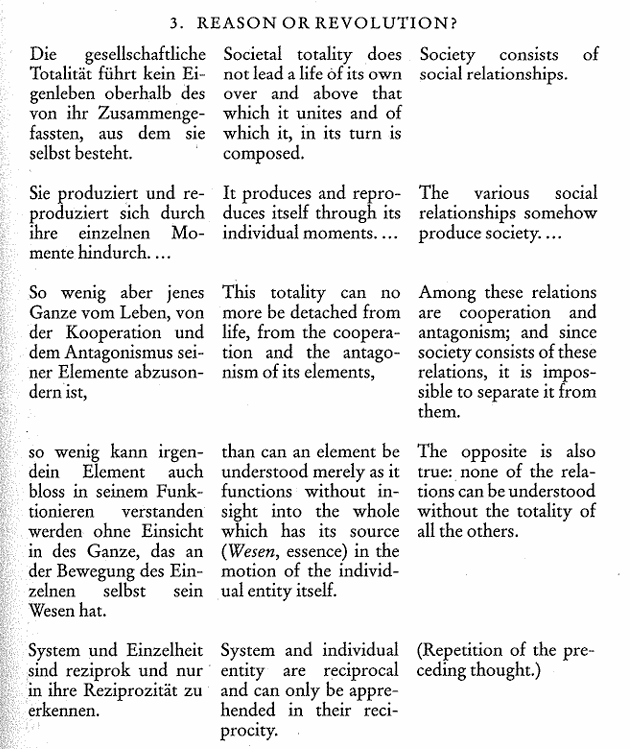
Popper says that Raymond Aron suggested he expand this letter into a fuller critique, which he did. The result was the essay “Reason or Revolution?”, later included in the English translation of the Positivismusstreit volume (1976) and reprinted in Popper’s The Myth of the Framework. It contains the famous passage in which Popper takes a quotation from Adorno, selected by Habermas, and translates it into simpler language (first image below).
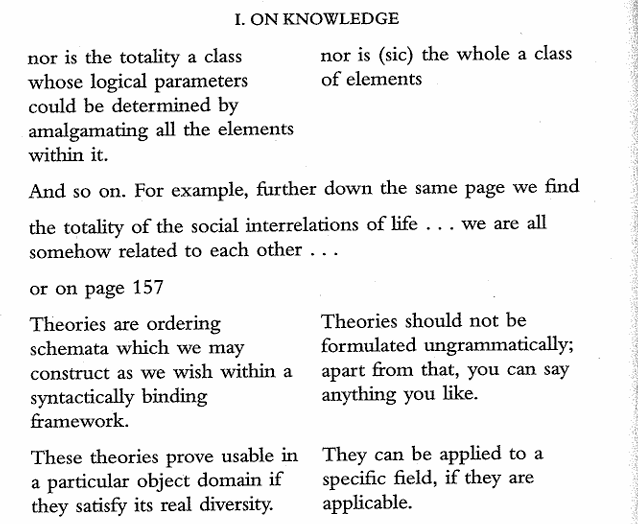
There is also an overlapping text titled “Against Big Words,” published in Popper’s book In Search of a Better World. It was originally a confidential letter that Popper wrote to Klaus Grossner. In this letter/chapter, Popper does the same 'translation', now also with Habermas (second and third image below!).
People sympathetic to critical theory usually read Popper’s letter to Aron and call him names. People unsympathetic to the Frankfurt School read it and say Popper is spot on. Geoffrey Stokes perhaps did better in his piece on the similarities between Popper and Habermas published as a chapter in The Cambridge Companion to Popper. He argues that, despite the hostility, their philosophies converged over time, and not only politically.
What counts as a violation of the Rule of Law?
In my new article in Law and Philosophy, I develop a typology of Rule of Law violations to clarify a question that is often misunderstood.
🔗 https://t.co/CUGJsMDTuM
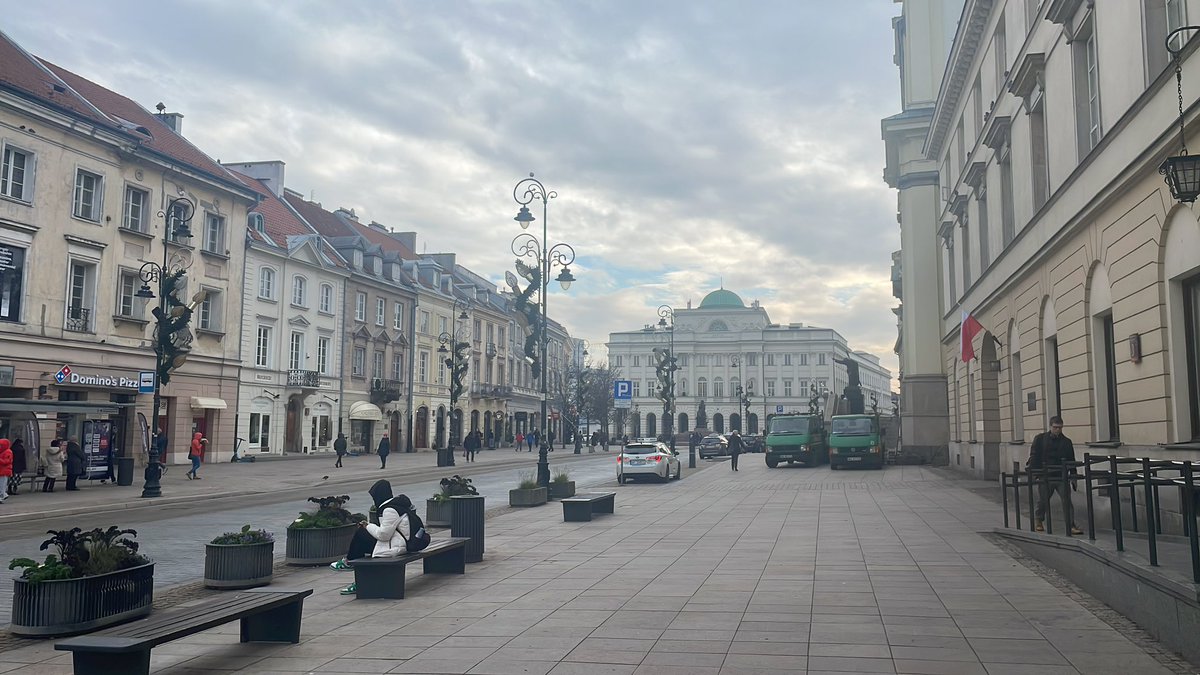
Exciting news for legal theory: a new hub of excellence is emerging at the University of Warsaw! Make sure to visit soon—you'll be truly impressed. Many thanks to my host, Paweł Banaś, for the wonderful time and discussions!
https://t.co/CiWQ0a7mqB
CONVOCATORIA para hacer la TESIS DOCTORAL a tiempo completo en el marco de nuestro proyecto "Sesgos en la producción y en la aplicación del derecho. Racionalidad legislativa, razonamiento probatorio e inteligencia artificial": https://t.co/IaNtbYPVnb
This is a truly impressive article on a matter so important and - to many - troubling. I have been struggling with this issue, re Poland, for quite some time now. Victoria’s is a new and original voice in this debate. @MVicKristan
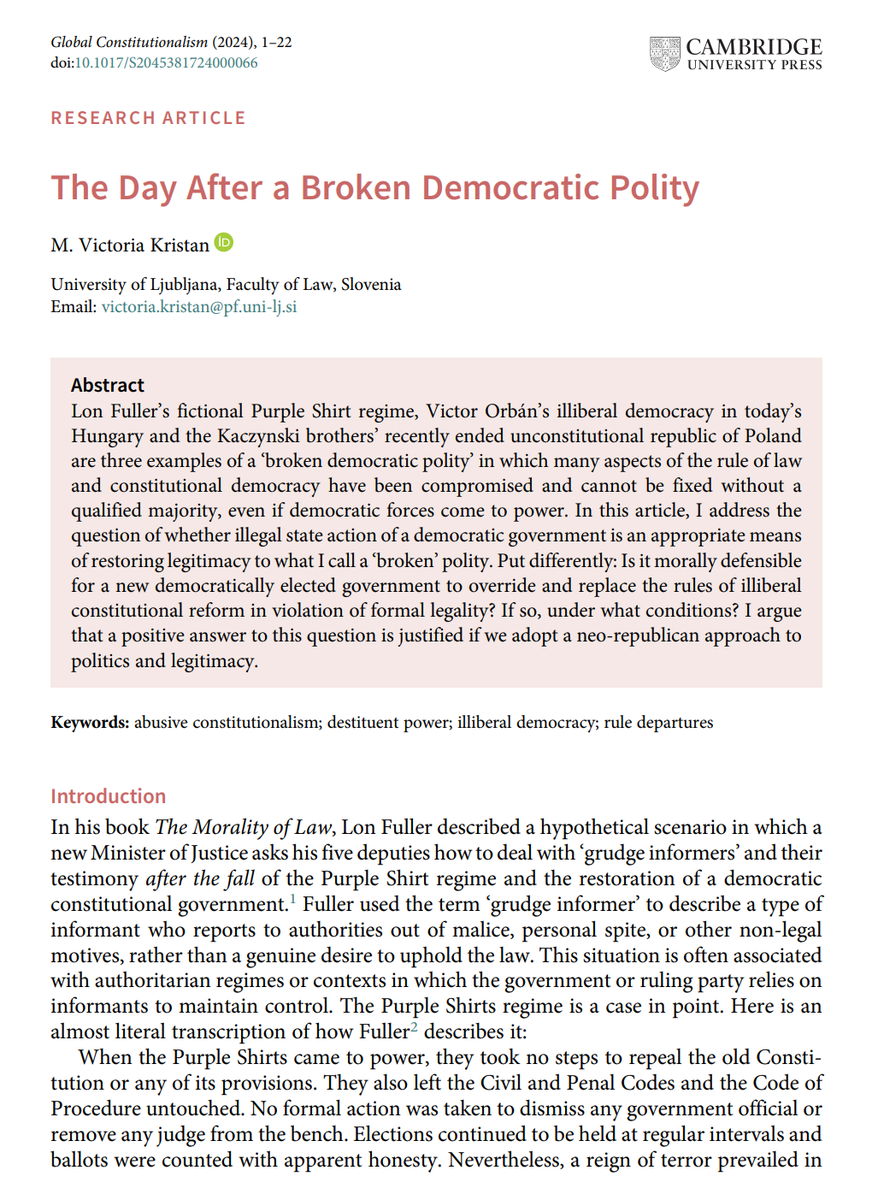
@MVicKristan explores the moral justifications for restoring democracy, even at the cost of breaking formal legality. "Replacing a dominating rule with a nondominating rule is more important than meeting all the procedural requirements of formal legality." https://t.co/FvxbOvKhhJ
🤩 📝 This is one of the most important papers published in the last 10 years. It asks whether it is morally justifiable for a democratically elected government to act illegally in order to repeal the illiberal rules of the former regime.
Open access: https://t.co/6UNrTNtfVH
El Master en Derecho de Daños de la Universidad de Girona es útil en cualquier sistema jurídico porque nos orientamos al estudio de los fundamentos del derecho privado y al derecho comparado. Si te interesa puedes escribirme a [email protected]
If you have read the latest book by Philip Pettit and are wondering: why the state? I invite you to read the book review that we wrote with Donald Bello Hutt for @ResPublicaJrnl
https://t.co/JlTAVPkFMz
¿Te interesa incorporarte como investigador posdoc en el Grupo de filosofía del derecho de la U. de Girona? Preséntate a esta preconvocatoria: https://t.co/onMigkvPAJ
Temas relevantes:
Razonamiento probatorio
Filosofía del derecho privado
Seg. jurídica o teoría de la legislación
New paper in @PsychScience! 🚨 Here's the one-minute version. ⏱️ There are two cities in Iran. One has water, so it has gardens, grapes, and the famous Shiraz wine.
#postdoc @IstitutoTarello is hiring! Are you, or someone you know, interested in contributing to two projects funded by the European Commission under my leadership? #LegalTheory, #RuleofLaw https://t.co/IjidOfMBkN