The contrast between Reagan’s speech at Point-Du-Hoc and Pete Hegseth today are like two different galaxies. Listen to how much reverence he gives to the same allies that Hegseth attacks.
This is really stupid, and it’s not getting enough attention.
The Trump administration is pulling a working $368 million ocean monitoring system out of the water, equipment taxpayers already bought, built, and sank into the deep ocean.
And they are doing it right when the oceans are behaving in ways that alarm the scientists who study them.
Record-breaking temperatures.
A system of Atlantic currents that may be lurching toward collapse.
The response?
Yank out the instruments and walk away.
That is not budgeting. That is smashing the gauges while the engine is on fire and calling it efficiency.
For what? The Trump administration dressed it up as a “nimbler approach” and “smart lifecycle management,” which is fancy nonsense for “we shut it off and hoped nobody would ask why.” There is no return-on-investment analysis. They cannot show taxpayers save a dime, because the gear is already paid for and the science it produces protects real money and real lives.
The kicker: the same people killing the monitors want to mine the deep sea for minerals. So they are destroying the only tools that could measure what that mining does. That is not an accident.
That is the point. You cannot see the damage if you break the instruments first.
https://t.co/MzE4AW1QBv
James Valentine & myself put all the Go-Go moves together for 100 seconds of unique ABC TV from November 1987. Thanks James, what a pro. More clips on my YouTube or https://t.co/cyE09bwWM9
Betelgeuse: The Red Giant on the Brink of Cosmic Glory Located just 640 light years away, Betelgeuse is one of the most spectacular stars in our night sky — a swollen red supergiant roughly 700 times larger than our Sun. If it replaced the Sun at the center of our solar system, it would stretch all the way to Jupiter’s orbit.This colossal star is now in the final chapter of its life. Deep inside its core, nuclear fusion is running out of fuel, and one day the core will collapse — triggering a spectacular Type II supernova explosion that will briefly outshine entire galaxies.Astronomers have been watching Betelgeuse with intense focus, especially after its mysterious “Great Dimming” between 2019 and 2020, when the star suddenly lost nearly 60% of its brightness — the biggest drop ever recorded for this star. At first, some wondered if it was about to explode. But detailed observations from the Hubble Space Telescope and powerful ground-based observatories revealed the real culprits: enormous convection cells the size of continents, massive dust ejections, and powerful pulsations in its outer atmosphere.The Reality CheckDespite the drama, scientists stress there is no imminent explosion. Betelgeuse could go supernova anytime in the next 100,000 years… or it could remain relatively stable for much longer. These wild brightness swings are part of its normal, turbulent death throes — not a final countdown.When it finally does explode, the show will be unforgettable. Simulations suggest the supernova could shine brighter than the full Moon and remain visible even during the daytime for several weeks. At 640 light years away, Earth will be perfectly safe — but astronomers will get front-row seats to one of the greatest scientific events in history.The blast will forge and scatter heavy elements like carbon, oxygen, and iron across space — the very building blocks of planets and life itself.Betelgeuse isn’t a doomsday clock. It’s a slow-burning cosmic masterpiece, reminding us that even the most violent endings in the universe unfold with patience, power, and breathtaking beauty across vast timescales.Keep looking up — one of the sky’s most famous stars is writing its final, brilliant chapter right now.
"The Iranian regime has emerged strengthened. The U.S. has emerged weakened...Trump’s defeat is also America’s. This defeat will be very difficult to reverse. But there was never going to be a painless way out of the disaster of Trump’s second term."
https://t.co/MuC6ZBV031
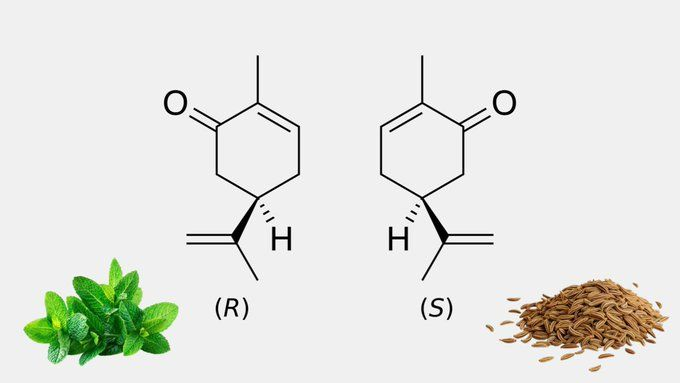
Spearmint and caraway seeds smell completely different. Fresh. Sweet. Minty vs warm, spicy, earthy.
Yet the difference comes down to mirror images of the same molecule: Carvone. Same atoms. Same bonds. Same formula.
Only one thing changes: 3D orientation.
• (R)-carvone → spearmint
• (S)-carvone → caraway
Our noses can tell them apart because olfactory receptors are chiral too they “feel” molecular handedness, just like a left hand doesn’t fit a right glove.
This is a beautiful reminder that in chemistry (and biology), shape matters as much as composition. Something you can literally smell. Chemistry is everywhere - even in your spice rack.
FT Exclusive: Four months after its establishment, the organisation’s financial fund set up by the World Bank has received no money from donors, according to four people familiar with the matter. https://t.co/yzANaf2mVN
We’re calling it: The war in Ukraine has entered a new phase.
@KatStepanenko and I have authored a new special report studying how Ukraine is actively challenging the positional character of the war that has dominated the battlefield since 2023.
Data on Russia’s battlefield performance indicates that the character of the war is shifting in favor of Ukrainian forces – at least for now. Russian forces rates of advances are stagnating while Ukrainian forces are employing novel tactics and operational concepts in efforts to break out of positional warfare. Neither Russia nor Ukraine can conduct operational maneuvers yet, however.
The bottom line is that the war in Ukraine is competitive and far from stalemated. Ukrainian forces are out-innovating Russian forces in both military technologies and in applying these new technologies in effective operational concepts that can help Ukrainian forces break out of positional warfare. Ukraine is employing mechanized equipment in tactical maneuvers in ways that were impossible 12 months ago. Russia’s ability to conduct infiltration missions will likely continue to degrade as Ukraine’s intermediate-range strike campaign pushes Russia’s logistics and forward operating bases further away from the frontlines, reducing resourcing to sustain infantry tasked with infiltration missions. Ukraine may be able to scale these effects if they resourced properly by international partners.
Ukraine’s advantage in intermediate range strikes is notably not permanent, and Russia will very likely eventually develop countermeasures to mitigate Ukraine’s advantages. Ukraine’s international partners thus have a rare and temporary opportunity to help Ukraine exploit favorable battlefield dynamics while Ukraine has the upper hand.
Key Points of the report:
• Russia’s rate of advance is plummeting during the Russian Spring-Summer 2026 offensive.
• Russia is losing more soldiers to make fewer gains, with monthly Russian casualty rates reportedly outpacing monthly recruitment since December 2025.
• Ukraine is starting to regain more ground than it is losing for the first time since 2023.
• Ukraine’ recent counterattacks feature unique characteristics and deviate from key trends that defined the positional character of the war since 2023.
• Ukraine is conducting a pattern of more frequent mechanized counterattacks at the tactical level for the first time since 2023.
• The Ukrainian command’s operational planning is maturing.
• Ukraine’s early 2026 counterattacks in the south were successful likely due to better planning and preparation of the battlefield.
• Ukraine has been conducting a coherent campaign to suppress and destroy Russian air defenses since late 2025, in order to shape the battlefield as part of more sophisticated campaign planning.
• Ukraine significantly intensified its intermediate-range strike campaign against dynamic targets in Spring 2026 in order to degrade Russian logistics at operational depths ahead of planned Ukrainian maneuver.
• Ukrainian forces started actively disrupting Russian railway logistics in occupied Ukraine and Russian western regions in Spring 2026.
• Ukrainian intermediate-range strikes are already achieving notable operational effects, including degrading Russia's ability to use the key Russian highway connecting Russia to occupied Crimea and GLOCs around Donetsk City.
• Ukrainian forces decisively seized the initiative in intermediate-range strikes by fielding new technologies such as the US-made Hornet strike UAV, among other systems.
• Ukrainian forces are achieving temporary tactical drone overmatch in some frontline sectors, which is slowing Russian offensive operations by degrading the effectiveness of Russian shaping operations.
• Ukrainian forces likely achieved tactical drone overmatch in certain frontline sectors after degrading Russia’s drone capabilities in late 2025 to early 2026 - primarily by suppressing drone launch positions and increasingly intercepting Russian tactical UAVs.
• Ukraine’s degradation of Russian forces at operational depth combined with tactical-level drone overmatch likely is creating vulnerabilities in the Russian lines.
• Ukraine’s intermediate-range strike campaign is likely far from its zenith, assuming continued support from Ukraine’s partners, and will likely intensify over 2026 as Ukraine fields new weapons capable of striking Russian’s operational rear.
Link to full report: https://t.co/rCeWbYJNiB
Traces of the largest impact crater on Earth have been discovered in Australia!
The Deniliquin geological structure in southeastern Australia may have been formed by the impact of a massive meteorite, leaving a crater over 500 kilometers in diameter.
This catastrophe may have triggered the ancient Ordovician-Silurian mass extinction.
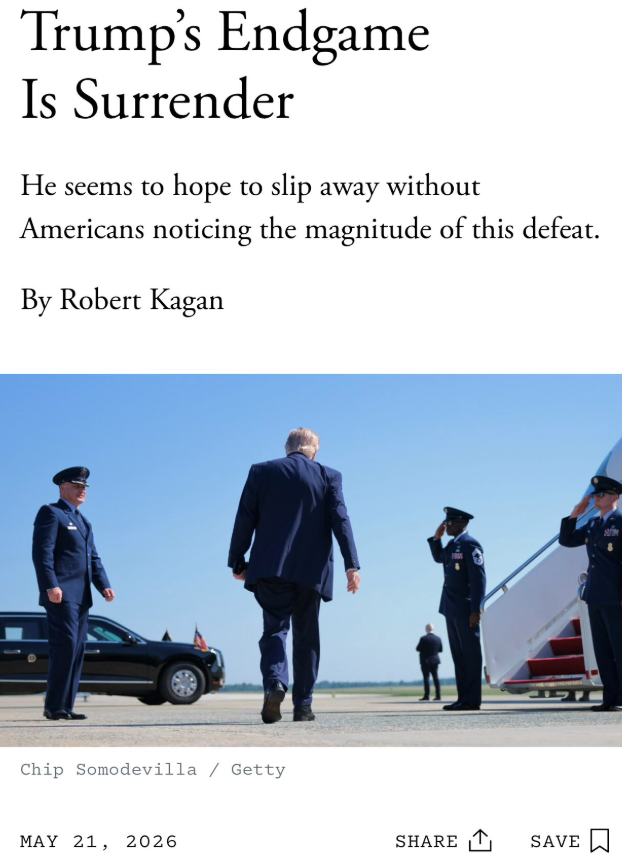
As this war stumbles to a close, it is clear that the president is lost: He didn’t know what he was doing when he began it, and now he doesn’t know how to get out of it.
https://t.co/WtiJcw7PUO
Buster Keaton was really riding the driverless motorcycle in Sherlock Jr..
He learned to steer from the handlebars and performed the chase on real streets, even crashing straight into the camera crew during one take.
I have finished my in-depth look at the causes of Australia's productivity slump, including:
* housing/planning distort capital allocation
* migration lowers the incentive for capital substitution
* energy costs weaken industrial competitiveness
* manufacturing erosion reduces process innovation capacity
* measured business dynamism is misleading
* R&D and intangible investment are weak
* non-market employment composition drags aggregate productivity
* AI encounters the same institutional constraints
https://t.co/y2Ner7sKEA
#auspol #ausbiz #ausecon