I am a Husband, a Dad and a Grandad. I support the Saints😉 God is good, and you are more significant than you know. Follows are not always endorsements.
In 1952, an English teacher named Cecil Dormand secretly paid for a dirt-poor 11-year-old to take a drama course.
He never told him and the boy didn’t find out until decades later.
By then, he was a knight, that little boy’s name was Patrick Stewart.
He was born into a poor family in Mirfield, a small mill town in Yorkshire and his father came home from World War II a violent man, and he was violent toward Patrick’s mother.
Young Patrick learned exactly when to step between his father’s fist and his mother.
An English teacher put a copy of Shakespeare in his hand and told him to get up and perform.
He never stopped and left school at 15.
By 19 he was completely bald... most agencies told him he'd never make it because of that.
In 1987, the LA Times called him an “unknown British Shakespearean actor” when he was cast as Captain Picard.
Then he became one of the most famous faces on Earth.
You’ve probably heard that part.
Here’s the part you haven’t:
He spent decades as a patron of Refuge, sheltering women and children from domestic violence.
But he never stopped trying to understand his father.
He dug up a 1940 newspaper clipping that said his dad had come home with severe shell shock.
He went to France and walked the ground where his father’s unit was pinned down under bombing for hours.
He learned his father had PTSD, and nobody ever helped him.
So Patrick became an ambassador for Combat Stress, a charity that helps veterans.
In 2013, a young woman at a Texas convention told him she was a survivor of domestic violence.
He asked, “My dear, are you okay?”
Then he hopped off the stage, held her, and told her: “You never have to go through that again, you’re safe now.”
At Dragon Con, a Make-A-Wish girl dressed as Spock came to meet him.
2,000 people were waiting for him to speak... he sat down and talked with her for 15 minutes, making all of them wait.
He told her that since they were friends now, whenever she saw him on screen she could wave and say, “Hello Patrick.”
After 9/11, he felt helpless, so he brought his one-man A Christmas Carol back to Broadway for a full week of charity shows.
He played every character himself and donated every cent.
In 2019 he did it again, and every dollar went to feeding hungry New Yorkers.
In 2017, he fostered a pit bull named Ginger, who had been rescued from a dogfighting ring.
She was his first dog in more than 50 years.
He couldn’t bring her home to England, so he found her a family.
Then he kept fostering more.
When he said he was done with Star Trek so many people told him the show had gotten them through the hardest times of their lives.
So he wanted to see if Picard could do it one more time.
Rest in Peace, Sir Patrick 🖖
He skipped school, withdrew £200, bought a one-way ticket to London, and disappeared. Nobody has seen him since.
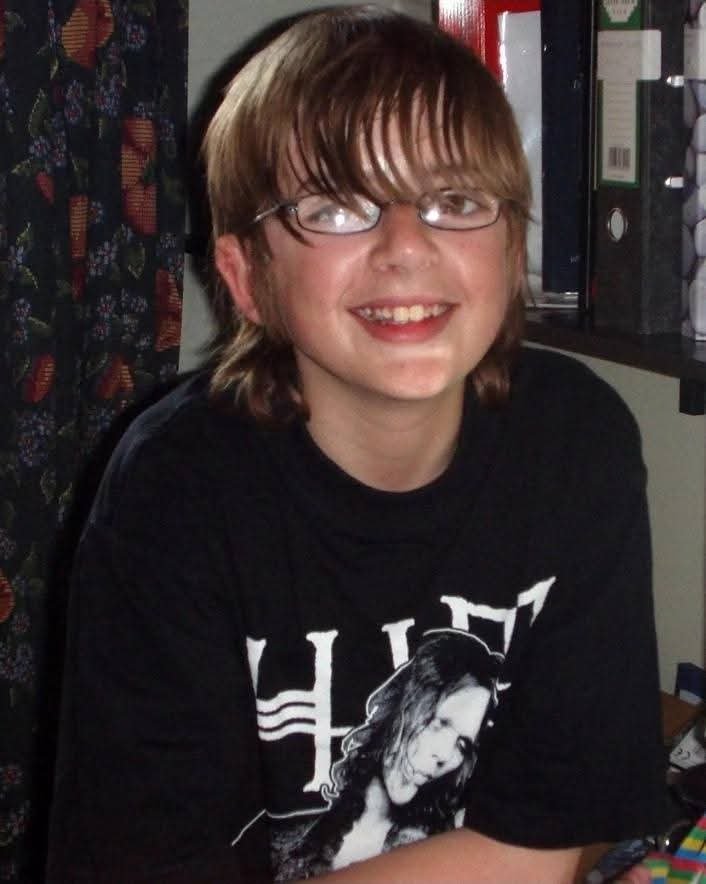
On September 14, 2007, 14-year-old Andrew Gosden left his family home in Doncaster, England, and appeared to be heading to school as usual.
Andrew was a bright teenager with an excellent school attendance record. His family had no reason to suspect that anything was wrong.
But that morning, he never arrived at school.
Instead, he waited until his family had left home, returned to the house, changed out of his school uniform and put on a black Slipknot T-shirt, black jeans and Vans trainers. He also took his PlayStation Portable.
Then he walked to the railway station.
He bought a one-way ticket to London
On his way to the station, Andrew withdrew £200 from his bank account, almost emptying it.
He bought a one-way ticket to London King's Cross. The ticket seller reportedly offered him a return ticket for less than £1 extra, but Andrew declined.
At approximately 9:36 a.m., he boarded a train to London.
He travelled alone, carrying his belongings and playing on his handheld game console during the journey.
The train arrived at King's Cross at around 11:20 a.m. CCTV footage captured Andrew leaving the station about five minutes later.
It was the last confirmed sighting of him.
He was just 14 years old, alone in London, and his family had no idea where he was.
His family discovered he was missing
That evening, Andrew's family expected him to return home from school. When he did not appear, they began searching for him.
They discovered that he had not attended school and eventually learned that he had withdrawn money and travelled to London.
His father, Kevin Gosden, and the rest of the family were desperate for answers.
Andrew had not told them about the trip. He had not arranged a known place to stay, and there was no confirmed evidence that he had planned to meet anyone.
Why had he travelled to London? Did he intend to return home that evening? Had he arranged to meet somebody?
Nobody knew.
The trail went cold
Police investigated possible sightings and followed numerous leads, but none established what happened after Andrew left King's Cross station.
His family continued appealing for information, and missing-person organisations helped keep his case in the public eye.
Andrew had light brown hair, brown eyes and wore strong prescription glasses. He was also deaf in his left ear and had a distinctive double ridge on his right ear. Investigators later released age-progressed images showing how he might look as an adult.
Years passed without a confirmed sighting.
Two men were arrested
In December 2021, police arrested two men on suspicion of offences including kidnapping as part of the investigation into Andrew's disappearance.
The arrests renewed hopes that the case might finally be solved.
However, the men were later released from the investigation. By September 2023, police had confirmed that they had been eliminated from the inquiry.
The arrests produced no answers about Andrew's whereabouts.
What happened to Andrew Gosden?
More than 19 years have passed since Andrew disappeared. He would now be in his thirties.
Investigators know that he left Doncaster, withdrew money, bought a one-way ticket to London and arrived at King's Cross. What happened after he walked out of the station remains unknown.
There is no confirmed evidence establishing whether Andrew was abducted, harmed by someone he met, or deliberately disappeared.
His family has spent years searching for answers, without knowing whether he is alive or what happened to him.
A 14-year-old boy travelled to London alone. A camera recorded him leaving the station. Then every confirmed trace of him disappeared.
Someone may know what happened that day. Even a small piece of information could help investigators understand where Andrew went.
Nearly two decades later, his family is still waiting for answers.
On Saturday 31 May 2025, Josh Hobbs, 35, and his wife Hannah Lloyd Hobbs, 34, from Rhayader in Powys, were on holiday, enjoying a quiet walk with their dog along the River Thames near Lechlade. They were barely ten minutes in when an almighty bang rang out. Hannah thought it might be a confetti cannon. Josh wondered if a gas barbecue had gone up. Then came the screams.
A boat had drifted out into the middle of the river and was engulfed in f*ames. Those on board shouted that they couldn’t swim. Josh and Hannah urged them to jump anyway. Among them was an 18 month old baby. Hannah dived straight in, reached the little one, passed the baby to Josh, then stayed with the child on the bank.
Josh went back into the water and brought two young children to safety. At one point, he had four people hanging off him as he fought to stay afloat and shouted for help. The explosion had been heard for miles, and members of the public raced to the scene to help pull everyone out and give first aid. Only when the air ambulance crews arrived did the couple finally let themselves breathe.
Nine people, five adults and four children aged from 18 months to seven, were taken to hospital .Sadly, two of them, including the toddler, suffered potentially life changing burns. But everyone survived.
Detective Superintendent Joe Garrity of Wiltshire Police said it was a miracle there were no fatalities , crediting much of that to two holidaymakers from Wales who happened to be passing. He called it “heroic bravery.”
The couple simply said they were in the “right place at the right time.” Hannah added: “We hope the families are doing OK and wish them a speedy recovery.”
No medals . No fanfare. Just two ordinary people who didn’t hesitate.
The jacket that kept the pilots of the Battle of Britain alive was designed by a Hollywood stuntman, and it was a sheep turned inside out.
Leslie Irvin grew up in Los Angeles jumping out of balloons for the cameras. In 1919 he became the first man to leap from an aeroplane and open a parachute by hand in free fall. He broke his ankle on landing and started a company on the strength of it. In 1926 he opened a factory in Letchworth, in Hertfordshire.
His parachutes were silk. Anyone whose life was saved by one was sent a small gold pin in the shape of a caterpillar, after the creature that had spun the canopy.
Then he turned to the other thing that was killing airmen. Aircraft were climbing higher every year, and the cockpits had no heating. At 30,000 feet it is 45 degrees below zero. A pilot's hands stopped working. He could not think.
Irvin's answer was approved by the Air Ministry in 1932. Whole sheepskins, the fleece left on and turned inwards, the leather out to the wind. He insisted on the most supple skins, because a man in a Spitfire can barely move his shoulders as it is.
In the summer of 1940 that jacket was hanging on a hook at every fighter station in the south of England. The bell went, the pilot pulled it on and ran. Twenty minutes later he was five miles up with no heater, fighting for his country in a sheep.
By 1945 more than 34,000 airmen were wearing the caterpillar pin.
So the Few went up wrapped in a fleece and came down under a silkworm. The Spitfire gets the statues.
In 1967 Britain had more electric vehicles on its roads than every other country on earth put together, and they were all delivering milk.
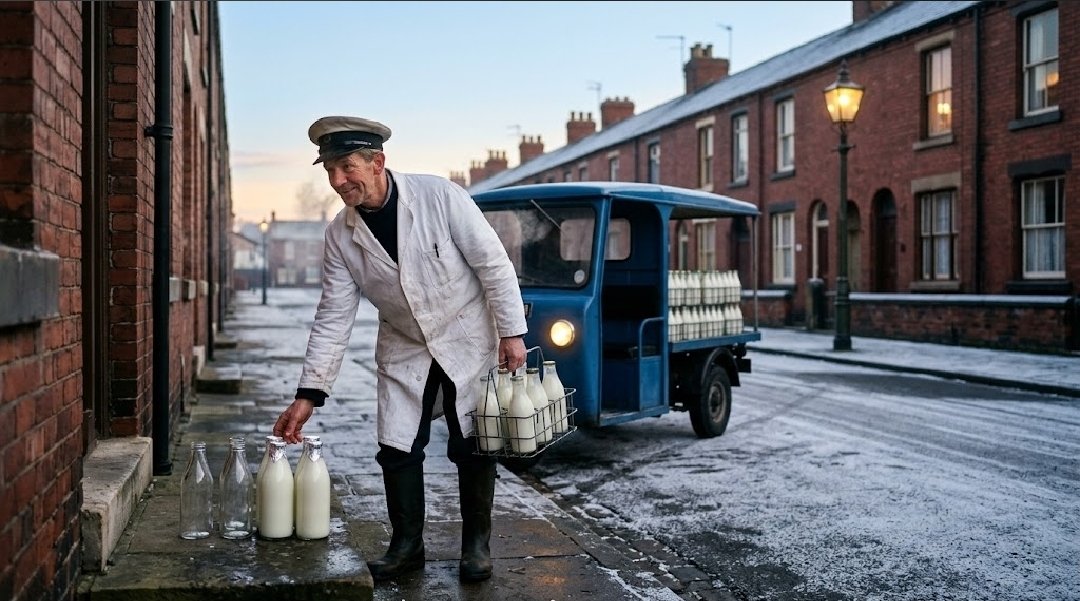
There were tens of thousands of them. The milk float: open sided, battery under the floor, top speed of about 15 miles an hour, and a whine you could pick out in your sleep. It was charged overnight at the depot and was back there by lunchtime.
It carried glass bottles. Each one was collected from your step the next morning, washed and refilled. A bottle went round like that 20 or 30 times before it broke. The foil cap went for scrap. There was no other packaging.
The milk had come from farms within a few miles, through a local dairy, and was on the step before 7.
So here is what the country had. A zero-emission delivery fleet. Reusable containers with a return rate any modern scheme would kill for. No plastic. A supply chain you could cycle the length of. A man who noticed if an old lady's bottles were piling up, and knocked.
It was dismantled in about 15 years, because a supermarket could sell milk a few pence cheaper in a plastic jug as a way of getting you through the door.
Every piece of that system is now the subject of a government target for 2040.
It was running in 1967, silently, in the dark, and nobody thought it was worth a mention.
This woman is about to be executed in Iran.
Her name is Taraneh Rahimi. 20 years old. From Isfahan.
Her crime? Joining the January uprising and stopping the beating of another protester.
Sentence: DEATH after being tortured with electric shocks and threatened with rape in prison.
Despite Taraneh's deteriorating health, an official in the prison's medical unit told her:
"You're going to be executed anyway whether you die from the pain in your leg or die paralyzed, what does it matter?"
Be her voice before try he hang her!
#StopExecutionsInIran
His father gave him a red bandana when he was just a boy and shared a simple lesson: always carry something that might help another person.
That bandana would one day become the symbol of one of the most extraordinary acts of courage on September 11, 2001.
His name was Welles Crowther.
Raised in Nyack, New York, Welles grew up admiring his father, a volunteer firefighter. The red bandana became a constant part of his life. He carried it everywhere — through childhood, through college, and later into the professional world.
A talented athlete, Welles played Division I lacrosse at Boston College before graduating in 1999. He took a job as an equities trader in the South Tower of the World Trade Center, working on the 104th floor.
But despite his success on Wall Street, his heart never drifted far from firefighting. It was a calling he hoped to pursue full-time someday.
And every day, that red bandana remained close by.
On the morning of September 11, 2001, everything changed.
At 9:03 a.m., Flight 175 struck the South Tower.
Welles was only 24 years old.
The impact devastated the building, especially around the 78th-floor sky lobby, where smoke, fire, debris, and panic trapped countless people. Survivors later described chaos and confusion as many believed escape was impossible.
Then a young man appeared through the smoke.
His mouth and nose were covered by a red bandana.
He was calm. Focused. Determined.
"Follow me," he told those around him. "I know the way out."
Witnesses say Welles led a group of survivors to a stairwell and guided them down toward safety.
Then, instead of continuing to escape himself, he turned around and went back up.
Again he returned to the danger.
Again he led more people out.
And once more, he went back into the smoke-filled floors.
By survivor accounts, Welles made three separate trips, repeatedly choosing to help strangers instead of saving himself.
It is believed that as many as 18 people survived because of those actions.
One survivor, Ling Young, recalled following the mysterious man in the red bandana after he assured them there was a way out.
Another survivor, Judy Wein, later said simply:
"Without him, I wouldn't be alive today."
At 9:59 a.m., the South Tower collapsed.
Welles never made it back out.
For months, his family knew only that he was missing.
Then his mother, Alison Crowther, read an article describing an unidentified hero wearing a red bandana who had repeatedly guided people to safety.
She instantly knew who it was.
The boy who had carried that bandana his entire life.
The man who had spent his final moments helping others.
In March 2002, Welles' remains were recovered from Ground Zero. He was found alongside firefighters, having reached them during his final effort to save lives.
Years later, the FDNY honored him as one of their own.
His story would eventually be shared with the nation, including at the dedication of the National September 11 Memorial & Museum, where President Obama recognized his extraordinary sacrifice.
Welles Crowther never became the firefighter he dreamed of being.
But when the moment came, he lived the values of one.
A simple gift from his father became a symbol of courage, compassion, and selflessness.
And when others were running for their lives, Welles chose to turn back.
Again.
And again.
And again.
Rest easy, Welles Crowther — the man the world remembers as The Red Bandana Hero. ❤️
THE COACH WHO GAVE EVERYTHING: 💔
Derrick Moore spent 20 years teaching elementary school outside Atlanta. The kids didn't call him "Mr. Moore."
They called him "Coach."
This summer he was standing on a beach in Myrtle Beach when a 10-year-old girl he'd never met got caught in a rip current.
Her name was Summer - and she was going under the waves.
Derrick didn't hesitate.
He swam out to a stranger's child and pushed her toward the other rescuers. He got her out. The same current that let her go took him instead.
His body washed ashore the next day.
He was 47.
He left behind four children of his own.
Think about that.
A man who spent his whole life keeping other people's kids safe in a classroom died keeping one more safe in the water - a girl he'd known for less than a minute.
Summer got to say seven words to his family: "Thank you, I really owe my life to you."
And his mother, who buried her son, said this: "My son is the type of person that would do it again. Even though we lost my son, I'm not mad at anybody."
That's who Derrick Moore was. Not a headline. Not a hashtag. A man who saw a child drowning and decided his own life was the acceptable price.
We spend so much energy arguing about who the good guys are.
Then a schoolteacher walks into the ocean for a stranger and answers the question without saying a word.
Remember his name.
Pray for his four kids.
This is what love looks like when it costs everything.