Practical ways to uncover your unique functions (according to Aristotle).
Suppose you discover you have a knack for public speaking.
1. Reflect on when you’ve successfully communicated ideas or inspired others.
2. Experiment with joining a debate club or delivering presentations at work.
3. Seek feedback from colleagues on your clarity and persuasiveness.
4. Align your speaking skills with a virtuous cause, such as teaching or advocacy.
5. Practice regularly by watching TED Talks, refining your delivery, and challenge yourself.
6. Avoid arrogance by balancing humility with confidence.
7. Use your skill to educate or inspire others toward positive change.
How to uncover your unique capabilities.
Start by asking yourself these three questions:
What do you naturally excel at?
What activities make you feel energized & fulfilled?
What do others compliment in you or seek your help with?
There's a feeling you get when you see someone doing something great.
It's inspiring seeing someone performs their unique function to the best of their ability.
It makes part of you wants to be great too.
This is where I used to fail:
𝘣𝘺 𝘵𝘳𝘺𝘪𝘯𝘨 𝘵𝘰 𝘤𝘰𝘱𝘺 𝘵𝘩𝘦𝘪𝘳 𝘶𝘯𝘪𝘲𝘶𝘦 𝘧𝘶𝘯𝘤𝘵𝘪𝘰𝘯 𝘪𝘯𝘴𝘵𝘦𝘢𝘥 𝘰𝘧 𝘶𝘯𝘤𝘰𝘷𝘦𝘳𝘪𝘯𝘨 𝘮𝘺 𝘰𝘸𝘯.
Wanting to be great is a good thing.
Uncover it, face it, and let that feeling guide you.
I help undisciplined people wanting a change in their unfulfilling lives find purpose and progress towards their personal goals.
Read more here 👇
https://t.co/CqdIijAlH3
Aristotle argues the best way to live is to fulfill our function.
Which is our ability to reason and our unique capabilities.
And I believe he is right, because we aren't made to be carbon copies of those around us.
We all have unique gifts, but sometimes they're hard to see.
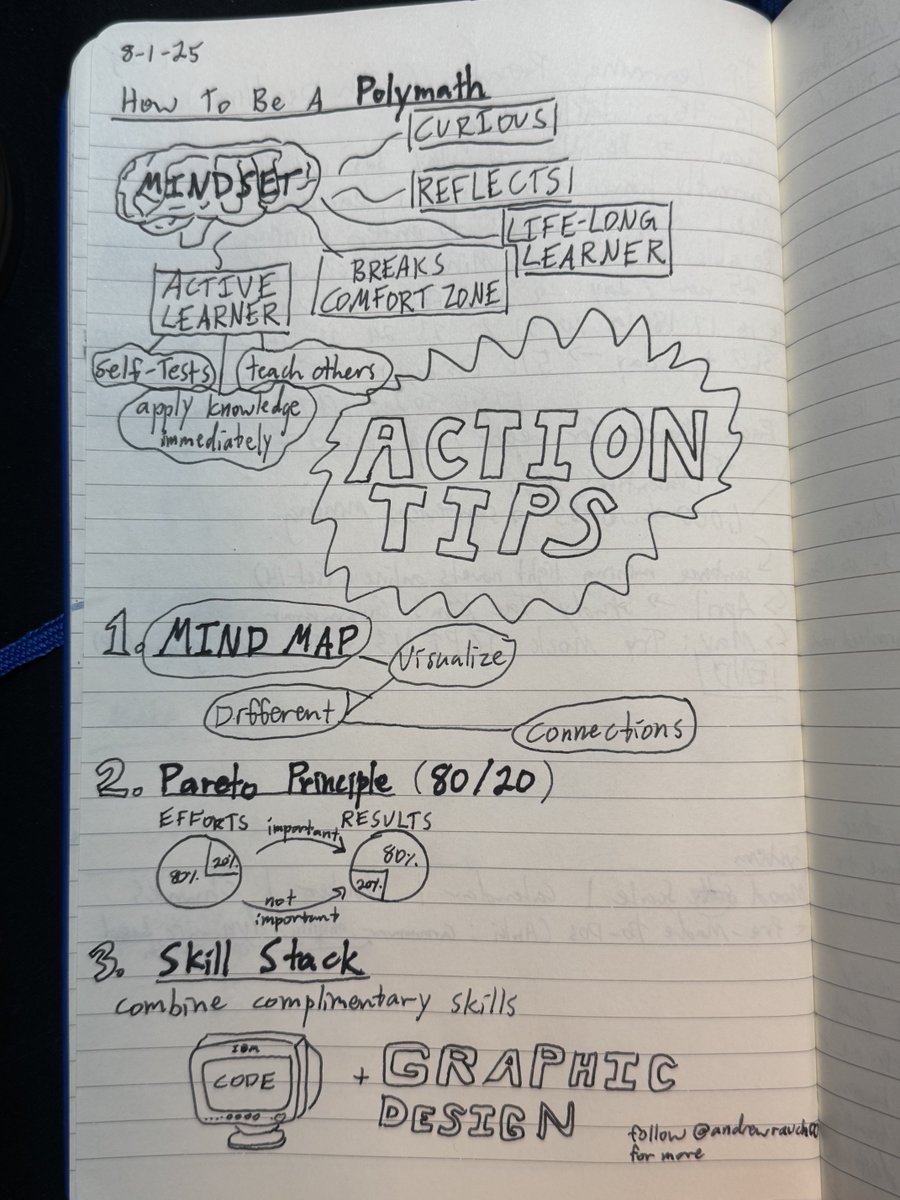
Polymaths are naturally curious.
Which actually helps you learn.
Like learning your favorite instrument, reading a book you can't put down, or playing a sport you love, these are naturally fun.
So pick a topic you love, and learn it.
Passive learners just re-read and highlight text.
Active learners test themselves, teach others, or apply their knowledge immediately.
The more uncomfortable you are learning, the easier you can recall the knowledge when you need it.
How to learn like a Polymath
1. Mind mapping.
1. Writing your topics down and visually create different connections.
2. Pareto principle (80/20)
1. 80% of results often come from 20% of the efforts.
2. Find the 20% highest level tasks.
3. Skill stack
1. Combining multiple skills (like code, graphic design, and marketing).
4. Spaced repetitions (SRS)
1. Reviewing material in intervals promotes long-term memory.
2. Like using flashcards.
5. Knowledge distillation.
1. Create a 1 page "cheat-sheet" of your topic you just learned.
2. Promotes active learning.
6. Experiment.
1. Create side-projects or use the skills in real life.
It's Monday early January, below freezing temperature, on the day I run.
Laced up my shoes, put on my gloves, and let the rhythm of my feet fill my ears.
After running past the thoughts of discomfort from running, I met a feeling.
Rather, a lack of feeling.
My hands were numb.
Through my gloves each finger was gone.
My hands lacked functionality.
Not that I needed them while running anyways.
But it was still uncomfortable.
I started losing focus running.
I suddenly felt the pain in my legs again.
Noticed my breath getting heavier and heavier.
Then I felt my palms.
They were on fire.
The center of my hands were like hot coals.
To solve the freezing of my fingers I grabbed the tip of my glove with one hand and with the other hand curled my fingers towards my palm.
The radiant heat.
I managed to do the same with the other hand.
I felt the fire within bring the rest of me back to life.
My fingers were not just warm, they were hot!
And my run felt effortless.
I started to remember why I run.
Because that fire within me yearns to burn bright.
And when part of me gets cold.
I can find the fire within.
Essentialism = the ideal lifestyle:
Not 𝘭𝘶𝘬𝘦𝘸𝘢𝘳𝘮, but on 𝗳𝗶𝗿𝗲.
Essentials evolve, but the goal remains: choose the important few.
What are your 3 𝗲𝘀𝘀𝗲𝗻𝘁𝗶𝗮𝗹𝘀?
How to be an 𝗘𝘀𝘀𝗲𝗻𝘁𝗶𝗮𝗹𝗶𝘀𝘁:
Set a time for your essential (e.g., a daily walk for fitness).
Identify with it: "I am a healthy person."
Delay non-essentials: "No scrolling until I exercise."
Living by your essentials brings:
- Progress toward your vision.
- Simplicity over chaos.
- Energy over disorder.
When you say yes to distractions, you say no to what matters.
Yes to scrolling = No to spiritual growth.
Yes to junk food = No to nourishing your body.
It’s not about denying pleasure—it’s about knowing your priorities.
Embrace 𝗲𝘀𝘀𝗲𝗻𝘁𝗶𝗮𝗹𝗶𝘀𝗺:
See your priorities clearly.
Stop drifting through life.
Yesterday, I was physically exhausted and wanted to rest.
But I hadn’t made much progress on YouTube (current goal).
I realized it was a higher priority than rest at that moment.
So, I tackled a problem for an hour—and felt 𝙞𝙣𝙫𝙞𝙜𝙤𝙧𝙖𝙩𝙚𝙙.
When your 𝗲𝘀𝘀𝗲𝗻𝘁𝗶𝗮𝗹𝘀 𝘢𝘭𝘪𝘨𝘯 with 𝙮𝙤𝙪𝙧 𝙘𝙖𝙡𝙡𝙞𝙣𝙜, you’ll feel:
Excited
Energized
Invigorated
Prioritize what truly matters.
When you discover we are finite beings living in a finite world of unlimited opportunities and possibilities, you learn that only few things truly matter.