Many leadership teams have too little conflict, not too much. Research suggests that task conflict among senior leaders—debate over ideas and decisions, as distinct from interpersonal conflict—can improve firm performance, particularly early in a team’s tenure. And teams that don’t raise difficult issues or debate the merit of ideas risk missing the best path forward and staying the wrong course too long.
Productive conflict helps teams surface different perspectives, make better decisions, and stay focused on achieving collective goals.
Learn how CEOs can create the conditions for this kind of debate: https://t.co/NUZgHwTljP
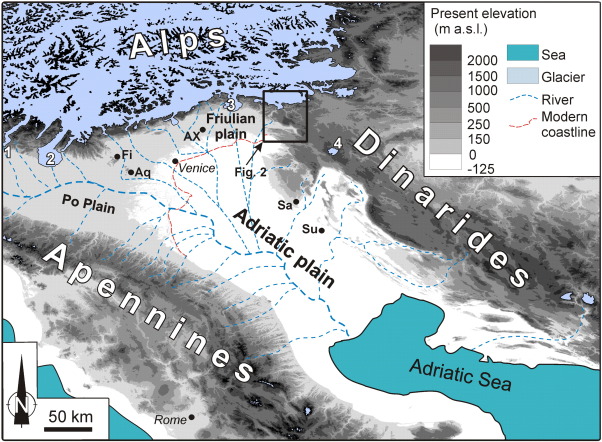
Around 20,000 years ago, at the height of the last Ice Age, Venice was nearly 300 km (185 miles) from the sea.
Sea level was around 120 m (400 ft) lower, exposing a vast lowland across much of the northern Adriatic.
1/3
This week features Chapter Twenty-Two of the Playing to Win/Practitioner Insights All-Stars Book Club: The Best Strategy Icebreaker: Reverse-Engineering the Strategy of Your Competitors
https://t.co/1X0xS50BqP
I have found a great icebreaker for starting any initial strategy discussion with a management team – and that is to reverse-engineer the strategy of its most respected competitor. It is a fun, concrete and playful exercise with lots of learning for the organization’s own strategy. And it isn’t as contentious as starting with the organization’s own strategy.
I hope you find the piece helpful!
Most organisations have adopted #AI. The real question is: how many are using it to accelerate business.
AI leaders are achieving 7.2x greater revenue and efficiency outcomes than their peers by using AI to reshape how they create value, uncover new opportunities and strengthen competitive advantage.
Discover what separates AI-fit organisations from the rest: https://t.co/TohDtrnjyv #BusinessTransformation #Leadership
A surprisingly useful business exercise:
Write down the five things preventing the company from doubling.
Then look at everyone's calendars.
Are you actually working on those five things?
A deep understanding of context, the ability to embrace complexity and paradox, and a willingness to flexibly change leadership style will be required for leaders who want to make things happen in times of increasing uncertainty. https://t.co/bWALNkToow
Respectfully, dismissing 'mixed fleet costs' as 'bureaucrat brain' ignores decades of RCAF and DRDC analysis
A single fleet shares one training pipeline, one supply chain, one set of simulators/tools/hangars, and one logistics system
Two fleets duplicate nearly all of that—pilots, maintainers, spares, infrastructure, and more. DRDC's parametric studies (using ASTRA models for Canada's NORAD/NATO missions) showed a mixed fleet requires more aircraft and pilots for the same capability, with extra costs in O&S (70-80% of lifecycle) unless the cheaper jet is ~50% or less the acquisition price
Real-world duplication hits training, stealth facilities for F-35s, separate vendors &sustainment
Canada's planners rejected this for good operational reasons—not red tape. A larger fleet is appealing, but the math on duplication is harder than it looks
Facts over slogans for our pilots' and collective pocketbook sake
Yes, there is a real extra cost, potentially hundreds of millions per year in duplicated support, on top of whatever the base fleet costs
https://t.co/ea4Hq3EGWu
Hey @grok, Canada is reportedly the only G7 nation in a recession. Short answer: Is this primarily the result of global economic conditions, domestic policy choices, or both?
So much for Carney’s plan to get a third pole centered around the middle powers. Under conditions of hard power competition between two blocs, eventually middle powers must develop enough strategic autonomy (India, Turkey) or pick sides (UK, Australia, Japan, Canada, EU powers).