There are many similarities between Brazil under Ancelotti and France under Deschamps.
Both are strong examples of what a 4-2-4 with a relational front four can look like.
In possession, they are cautious about the number of players committed forward, usually maintaining a 4+2/3+2 rest-defense structure while relying on occasional dynamic fullback overlaps/underlaps from deeper positions. The quality of their front four allows them to create chances without needing to commit many players forward. Keeping the fullbacks deeper improves defensive balance and gives the attackers greater freedom to move according to the ball rather than occupying fixed positions.
Neither team is likely to excel in high pressing. Some key players are not naturally suited to sustained pressing, and neither coach places a major emphasis on that phase. Instead, both are comfortable dropping deeper, knowing they possess exceptional pace and quality in transition. Both teams will be the most dangerous counter-attacking sides in the World Cup.
Ancelotti and Deschamps also face a similar challenge: maximizing Vini Jr and Mbappé, who both prefer receiving wide on the left. To maintain balance, each team needs a complementary winger capable of rotating with them in possession while providing the defensive work rate and tactical discipline they lack out of possession. This is especially important because Vini Jr and Mbappé will often defend in more central positions, where their defensive limitations are less likely to expose the team than if they were required to track opposition full-backs in wide areas.
Finally, both squads possess world-class creative profiles like Neymar and Cherki, which could be decisive in certain game contexts, chasing a result or against low blocks. The trade-off is that they provide less pace and verticality in transition than the rest of the attacking players, potentially reducing some of the team's counter-attacking threat.
Germany's OOP is pretty much classic Julian Nagelsmann.
• 3-5-2 (depending on the opponent's midfield structure, whether they're in a 4-3-3 or 4-2-3-1).
• Once the ball is played to the full-back, the man-oriented press is triggered. The forwards make the return pass difficult.
• It's an effective concept for a while, but if it's your only mechanism, it's also relatively easy to manipulate against teams with strong rotations.
• For example, an overlapping full-back, a false nine, and a winger making an inside run can really stress-test the Sané-Kimmich-Tah.
• A smart midfield can also drag Felix Nmecha too high up the pitch, creating a huge pocket of space for the striker to interpret and exploit.
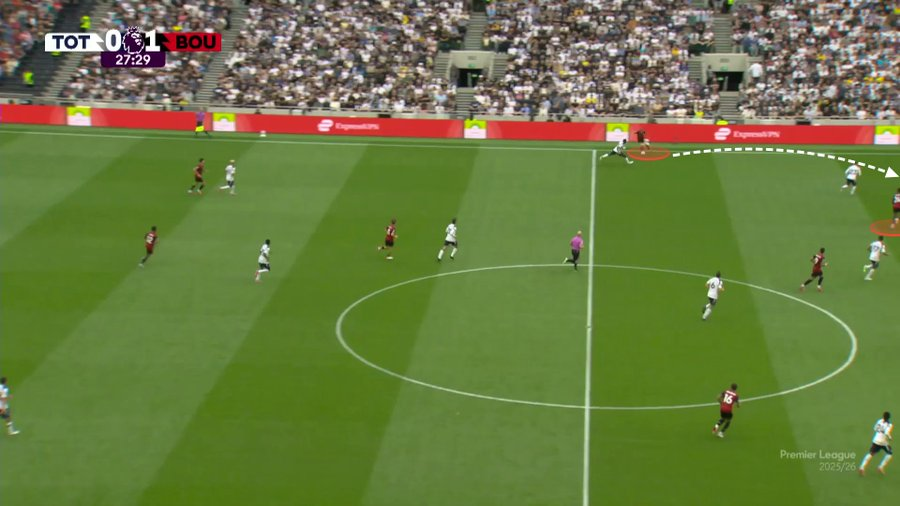
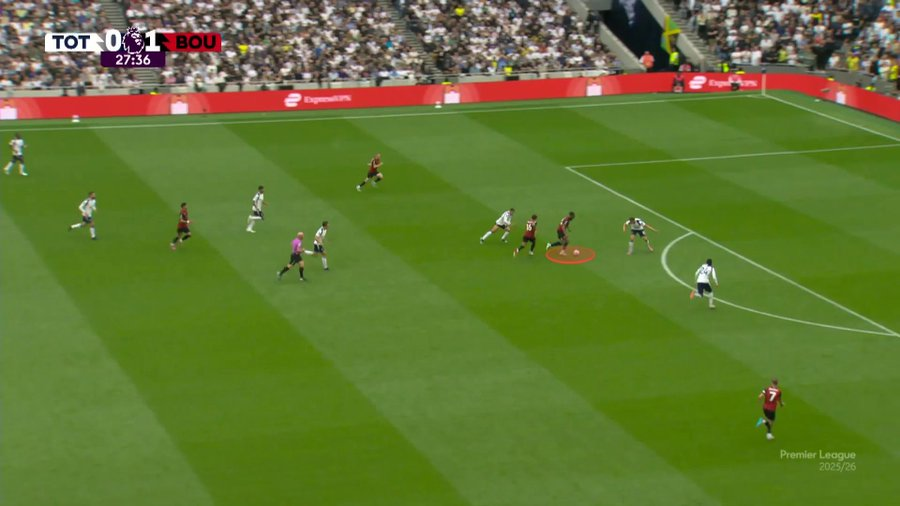
This is what Iraola's Bournemouth were all about chance creation wise.
Fullbacks off the shoulders of the winger, Senesi often finding Truffert on the outside.
Fullback wide?
That's the cue for the winger to position themself inside so they are on different lines.
Old-school.
Sartori alla @Gazzetta_it: “Perché #Tedesco? Ci piace perché è moderno, propositivo, non integralista, lui faceva vari moduli, dalla difesa a cinque alla quattro, oltre agli accorgimenti in gara. Un allenatore internazionale che ha allenato il Belgio e in tre campionati europei in cui anche vinto due trofei. E parla cinque lingue”
🚨⚫️🟢 Alberto Aquilani as new Sassuolo head coach, confirmed and here we go!
Deal in place until June 2028 for former Catanzaro manager who replaces Fabio Grosso.
Silvio #Baldini: “Vi siete mai chiesti perché Antonio #Conte vince sempre o al massimo arriva secondo? Perché ha una metodologia come l’aveva #Lippi nella #Juve di Giraudo-Moggi-Bettega. Andate a vedere quanto si allenavano queste squadre. Una metodologia precisa, che ho applicato anche nelle mie squadre, è indispensabile: si, anche negli allenamenti con l’occhio blindato, altrimenti si resta schiavi delle superstizioni”
Iraola's Bournemouth.
4-3-3.
Fullback and wingers offering double width and constantly looking to play on different lines and to combine with one another.
#6, #8, #10 balance in midfield.
Not overly concerned with positional play. More about dynamics and player relationships.
The risk?
Defensive transitions and a lack of systematic methods of chance creation.
Vincenzo Italiano'nun Bologna'dan ayrıldığı sezon bölgelere göre %55 ve üzeri topla oynadığı bölümler bu şekilde. Sol tarafı Bologna kalesi olarak düşünebilirsiniz.
Negli ultimi anni avevo consigliato #Maresca#Farioli#DeZerbi e #Italiano. Oggi allenano tutti all’estero, dove tra poco andranno anche #ThiagoMotta e #Ballardini. Intanto il #Milan è ancora senza allenatore e ds .
Poi c’è chi si stupisce perché la @SerieA è ormai
il 5^campionato d’Europa
The attacking dynamics from France is going to be quite fun to watch, especially with the quality of players that they've got. The structure seems fluid with foundational structures and principles. Following are the points that I've noted down.
Structurally:
- Central midfielder (Tchouameni) drops into the backline.
- Both fullbacks occupy advanced positions.
- On the left, the fullback (Hernandez) usually holds the width while the winger (Thuram) drifts inside and essentially plays as the striker.
- This allows Mbappe to generally position as a second striker/attacking midfielder with freedom to roam.
- On the right, the winger (Olise) usually holds the width while the fullback (Kounde) provides underlapping support.
- The attacking midfielder supports the wide triangle on the right.
Principles:
- Side connections on both sides with rotations between them.
- The front four usually triggers the positional rotations. They can occupy any of the positions mentioned previously. Further, they're not constricted within the central or wide channels. They can switch sides, too.
- The side connections on the right usually maintain shorter distances while the left have greater gaps. This is due to the profile of players on each side along with their individual roles.
- The other central midfielder (Rabiot) decides between forming the left side triangle and supporting his partner depending on the situation.
- An emphasis on providing plenty of movement in all thirds during possession phases. Constant below, beside, and beyond runs.
- There is a mix between short passing combinations and long balls. The former is preferred in the final third, latter is emphasised in the defensive third, and there's a mix in the middle third.
All of this makes them quite fun to watch.
In the second half, Arteta instructed Arsenal to press high more often and do so aggressively. This was more of the "between" approach that Kompany highlighted, which he didn't think would work. Performance-wise, following were the type of attacks the opened up more often for PSG with Arsenal's defensive approach in the second half:
Situations where Arsenal pressed high -
Image 1: Kvaratskhelia can receive between the lines after creating separation from his marker. He proceeds to attack diagonally through a carry before finding Dembele on the far-side.
Image 2: Havertz jumps up to Marquinhos, wanting to trigger a high press. However, Trossard cannot follow the lead due to a wide 2v1 against Hincapie. Thus, Trossard must retreat and allow Ruiz to carry forward.
*The structure of Arsenal's backline and pivots have been drawn in images 1 and 2 to illustrate how PSG's movements drags those players.
Situations where Arsenal form a 4-4-2 mid-block:
Image 3: Doue finding the beyond run to attack the space behind Arsenal's defensive line. This is a more threatening situation once Doue receives compared to doing it against a low block because there's more space to drive into or play an early cross/cutback.
Image 4: If both Arsenal pivots were occupied, a PSG forward could receive centrally and between the lines with a below run.
Overall, the type of attacking opportunities changed for PSG. I think these attacking situations also better suited them. So, I suppose Kompany was partly incorrect in saying that you can't defend PSG with the "between" approach since Arsenal did it and didn't really leak quality chances from open play. But I wonder whether there were indirect effects, if any. Or maybe was it just a one-off as PSG didn't capitalise enough?