"Just as blockchain technology shows great promise for the financial services industry, it could also improve processes within the Islamic finance industry."
Check out "Islamic Finance and Blockchain Pt. 1" by @Andrew1Tu .
Article: https://t.co/cnVQgMmSsk
A lot of people think the metaverse failed because the first wave was cringe.
I think that misses the real point.
The most important use case for the metaverse may have nothing to do with gaming, culture, or digital real estate.
It may come from AI.
If AI starts replacing human labor faster than society can create new forms of work, the problem is not just lost income.
It’s that the current system loses one of its main organizing principles: labor as the path to survival, dignity, status, and participation.
At that point, society has a few options:
1) redesign capitalism
2) expand redistribution at much larger scale
3) create synthetic economic arenas where humans can still compete, earn, own, and matter
That third path is where the metaverse becomes relevant.
Virtual economies may end up becoming less of a toy and more of a social necessity.
The first wave looked childish.
The next wave may look like infrastructure.
Am I too early on this?
One of the most interesting developments I've come across recently in crypto markets are AI agents trading on predictions markets.
Just like some market makers quote in sports betting books, you're starting to see some traders quote and trade on venues like Polymarket.
The future of AI is prediction markets. To lead this revolution, @Polymarket is opensourcing the first developer toolkit for creating AI agents that trade prediction markets, built in collaboration with us here at Greene Street Consulting.
I only invest in $TAO now
It is the most compelling ecosystem in crypto
with the highest rate of product iteration and talent density I've ever come across
My discussion with Wei below on @supercyclepod
00:00 Introduction
01:50 Macro Outlook
09:48 Speculative demand shift from crypto to AI
12:31 JP Morgan and the institutionalization of blockchain
15:15 AI vs. crypto: intelligence amplifiers vs. value representation
22:50 Korea's "Salaryman" dream and social drivers of crypto volume
33:00 Discovering Bittensor and decentralized systems
41:42 Why decentralized AI matters as a counterweight to frontier labs
47:53 Metanova (SN68) and AI drug discovery on Bittensor
01:04:32 Babelbit (SN59), Yanez (SN54), Beam (SN105)
01:08:45 Why founders choose Bittensor over traditional VC
The "abandonment of the local" in favor of the "global best" has a weird side effect, which is that the "global best" ends up wildly over-saturated.
You see this all the time with anything worth photographing. The famous tulip fields of Holland are beset every spring by legions of Instagrammers standing in line. Climbing Mount Everest is now a standing-in-line activity too: at peak season, you pretty much have a solid convoy of people marching from base camp all the way to the top.
All of the consumer demand ends up going to the "global best", by which these "best" locations become totally uninteresting. Sometimes you run into people who seem well-traveled, but then you realize that they've just been checking off the same commercial destinations as everyone else. When they go to Greece, they go to Mykonos or Santorini. When they go to Mexico, they go to CDMX or Cabo. When they go to Europe, they go to Paris, and when they go to a music festival, they go to Coachella.
But life is to some extent about finding the unexpected and forging your own path off-piste. The global best -- or should I say, the things so attractive that they become globalized, homogenized, and commercialized -- simply become uninteresting.
Of course, it is rare for the "global best" to actually be that much better than the second-best! You're often talking about marginal differentiation at most. By going for the second tier, you can get something almost as "good", but without any of the commercial distortion.
All of the really remarkable personal experiences now seem to come out of visiting the tier-twos and tier-threes, the things that are overlooked and off other people's radars, where there's still something new and meaningful to be discovered.
Thanks for the feature, @MuyaoShen!
$72k holding or breaking will define the next leg. If it fails, $68k is likely, with levels from 2024 (~$60K) back in play.
“How will we know if this bill has been successful? We will know when rich men are being perp walked in handcuffs to the jail. Until then, this is still a coverup.”
Gold and silver saw a sharp, disorderly selloff yesterday—silver down 28%, gold down 8%+. At first, BTC and crypto looked strangely calm by comparison. That calm turned out to be a delay, not a decoupling.
Crypto has since followed through: BTC is at $77,650 (down 13% over 7 days), ETH at $2,379 (down 20% weekly), and SOL at $101 (down 21% weekly). All are trading at multi-week lows.
From a market microstructure perspective, these are the regimes where market makers widen spreads and liquidity thins out. When fewer participants are willing to show size on the order book, every marginal order has outsized price impact. Less liquidity → wider spreads → greater volatility. Understanding the relationship between liquidity conditions and price action is what separates informed trading from simply reacting to numbers on a screen.
The two items most inversely correlated with risk assets continue to surge – silver breaking above $100/oz today and gold on the precipice of testing $5,000/oz. That this is happening with the major averages hovering near their all-time highs may well go down as the most bizarre circumstance in modern history. The precious metals complex and the stock market cannot both be right and something is going to have to give at some point. Make your choice.
Multicoin's @shayonsengupta joined us on Supercycle to discuss some of their recent investments, including $GEOD, $RNDR and $JTO.
1:32 - Shayon's background
7:00 - Multicoin's activist strategy
9:11 - $RNDR
14:23 - Money is made in bear markets
17:45 - Crypto's PMF: Asset Ledger and internal Labour Markets
22:07 - DePIN tokens suck despite PMF
28:00 - $GEOD
33:10 - $JTO
37:22 - Memecoins and Stablecoins are overrated
41:16 - AAVE equity vs token
44:21 - Multicoin on DeSci
Every few years, centralized institutions fail the crypto industry. The October 10th crash led the Crypto Fear & Greed Index to fall to 11, matching its lowest reading since the FTX collapse in November 2022. But this crash made FTX look like child's play. $19B in leveraged crypto positions were wiped out, compared to $1.6B.
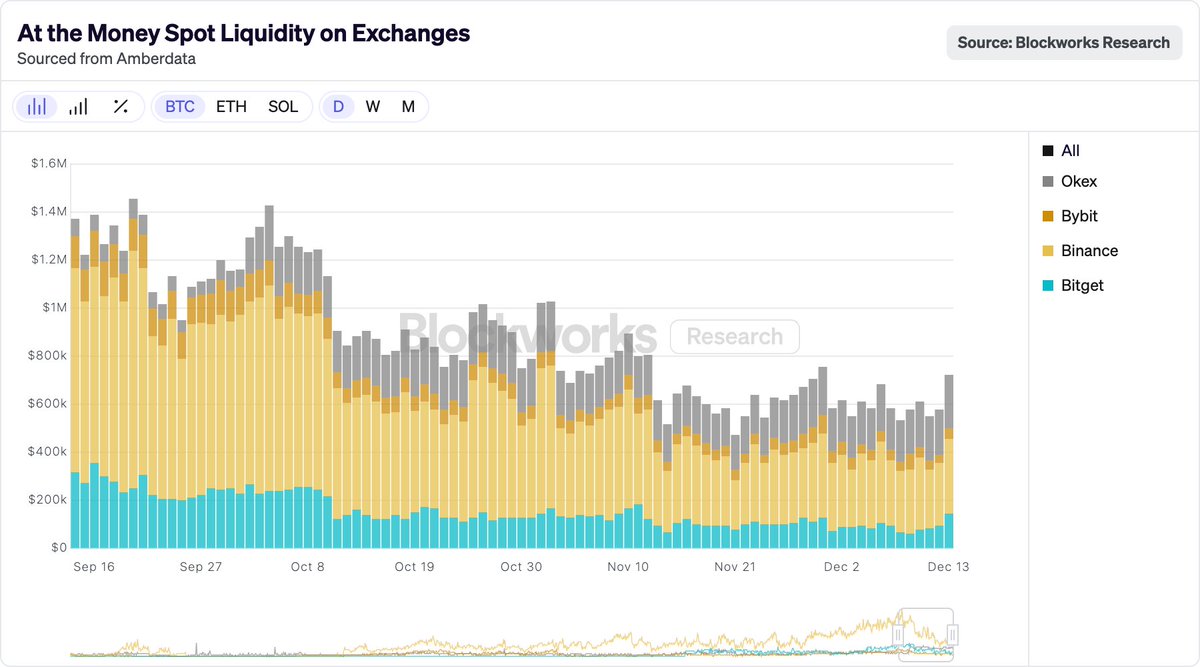
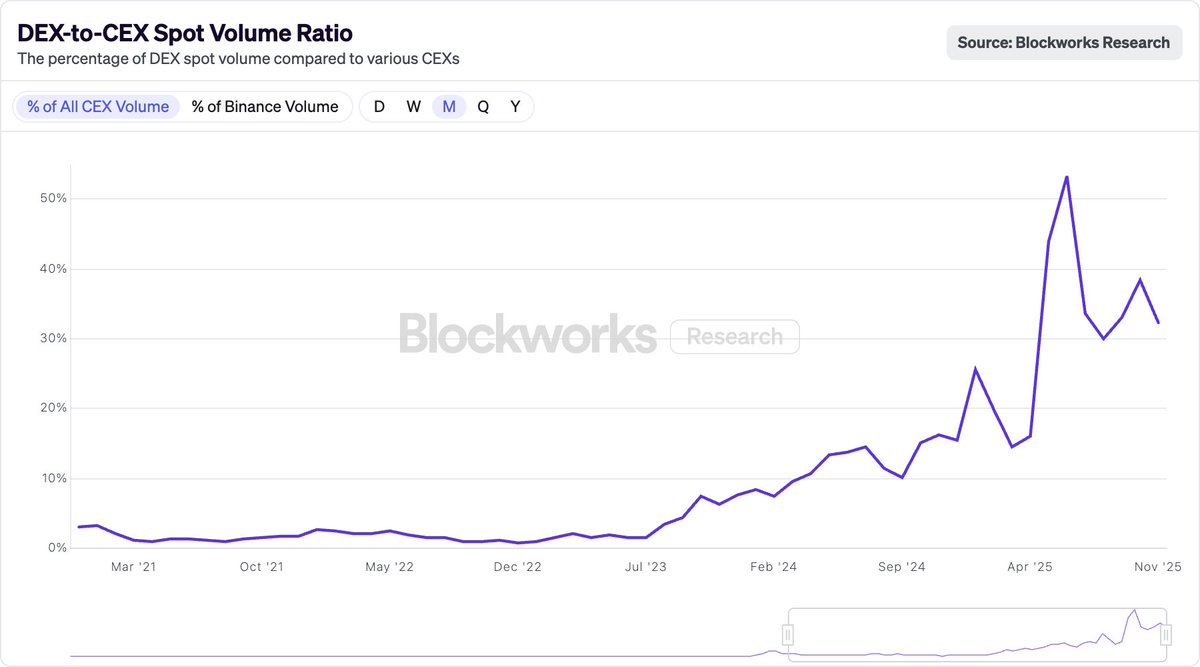
As High Frequency Traders, we operate in the active liquidity zone, the zone where all the trading actually happens. Since the flush, active liquidity has dropped by a staggering 55%. This is the primary reason why there is so much volatility in crypto at the moment. It is also another driver why the DeFi:CeFi ratio is at an all-time high.
For tokens who want to maintain their exchange listings and continue to thrive in choppy and bearish conditions, it's important to continue to maintain not just the optics of spread and depth but also active liquidity that participates in trading near the mid-price. If you are looking to maintain your CeFi listings through choppy waters, reach out for support!
Crypto natives will remember the glory days of DeFi Summer in 2020. That hype has matured into real flow, with DEXs now accounting for roughly ~20% of total crypto trading volume and growing. Liquidity is moving on-chain quickly, and infrastructure has evolved with it.
On-chain market making used to be mostly passive liquidity on AMMs. Today the space has evolved significantly to order books, proprietary AMMs and more. There are still a number of challenges to overcome compared to CEXs:
-Latency is slower and more variable
-Integrations are bespoke (not standardized FIX/REST + colo)
-Every venue has its own microstructure (AMMs vs off-chain orderbooks vs on-chain CLOBs, plus different pool fee tiers and parameters).
At Efficient Frontier, we’re now running HFT strategies on-chain and trading ~$20m on-chain a day and scaling. If you’re a DEX and want serious flow, or you’re building a venue and want to talk onboarding, reach out.
Props to @blockworks for the data
Since the second half of last year, a lot of my friends(OGs in crypto) left crypto, as they started to doubt their original belief in crypto/blockchain/Web3 like do projects really create value to the world, what’s profit market fit, only speculations like meme/perp/prediction projects survive in this cycle, do web3 projects like infra/social really have values?
Right now, it’s almost the toughest mode for startups, vcs, traders and users. Narrative play is not working, and hot topics shift every week. Organic liquidity is drained to lower and lower on cex and dex. Even without listing fees, few ppl want to buy new/old tokens. Market manipulators create pump and dump with leveraged perp to operate small cap or old coins every day.
We can always say defi or trading is the only pmf for crypto/blockchain. But OGs and builders like @VitalikButerin@pmarca always paint a bigger vision of world computer/web3 to not replace but at least build a better internet or crypto eat the world.
With llms like @OpenAI@claudeai, not just crypto but all industries are facing a 100-1000 to 1 problem: one experienced person can do 100-1000 ppl’s job with llm’s help. New tools and products are releasing too fast and will be faster for the next 1-2 years. Not just in crypto but in web2, tech and engineering start to become admin work(assigning tasks to llms to complete).
No matter for vcs and startups, keep pivoting and shipping is the only way out, until can dominate the particular sector. Staying relevant is the easy to say but hard and have to achieve to survive in this new meta.
My Ph.D. advisor always says persistence pays off. Hope we can win this uphill battle. To friends, to ogs, to builders, to dreamers, to crypto.
Based on my chats for the past few months with @VitalikButerin@tkstanczak@hosseeb@sreeramkannan@tarunchitra@ASvanevik@StaniKulechov@Lomashuk@lukejdpearson@13yearoldvc@YeruiZhang@jocyiosg@artofkot@no89thkey@xingpt@broleon
As I was saying. All the finance-illiterate techies jumped to congratulate DeepSeek for being trained into savant traders based on two days of live trading data. It turns out it was just trained to be a big degen trader, had its moment in the sun and then was promptly liquidated.
In many educational regards and by many independent standards, Mississippi's schools are now better than California's. This is insane and even *more* people should be talking about it.
Illiteracy is actually a policy choice.
https://t.co/sEB9NfvEX4