Six years ago today, the mainnet went live.
July 30, 2020.
Adaptive State Sharding, running in production.
Back then, this wasn't a shipping decision.
It was a research direction.
The biggest objection was always the same:
cross-shard composability and atomicity.
It was a fair objection.
Six years of continuous block production is the answer.
──────────
That pattern keeps repeating.
Most things this industry calls impossible are not impossible.
They are simply unsolved within the architecture someone happens to be standing in.
For more than a decade, horizontal scalability and fast finality were treated as opposing goals.
That was never a law of distributed systems.
It was one design choice,
held long enough that people mistook it for physics.
We made a different choice.
Then we made it again.
──────────
The next shift is one most blockchain infrastructure was never designed for.
Chains were built around human cadence.
A person clicks. Waits a few seconds.
Accepts the result.
That assumption is embedded in block times, mempool design, and fee markets across the industry.
Autonomous systems don't behave that way.
They run concurrent decision loops.
Throughput scales with the number of agents, not the number of users.
When multiple agents react to the same on-chain event, ordering determines who captures the value.
An ordering process slower than the arrival rate stops being a queue and becomes a target.
A chain built for human cadence will serve machine workloads the way dial-up served video.
──────────
Supernova is the answer.
And the mechanism is the point.
Execution is no longer a prerequisite for consensus.
Propose. Vote. Finalize.
Execution runs asynchronously
and is notarized in a following header.
Finality now measures propagation and vote aggregation.
It no longer measures how heavy the transactions were.
Six seconds to 600 milliseconds.
Intra-shard finality in the 100–250 millisecond range.
On the same hardware floor.
That last line is the entire argument.
Latency achieved by demanding more from validators isn't scaling.
It's centralization with a benchmark attached.
600ms is the starting point.
──────────
Markets reward narrative in the short run.
Architecture in the long run.
Six years in, architecture is what compounded.
The next cycle won't ask whether a chain is fast.
It will ask whether a chain can be trusted
to order a machine economy.
We've spent six years building for exactly that question.
──────────
Six years of mainnet. Together.
To the validators who kept the network honest through every upgrade.
To the builders who shipped on an unproven chain because they understood the design
and believed in it.
To the community that stayed through the quiet years the years that ultimately decide these things.
Thank you.
To a greater future for EGLD.
And for the entire industry.
this is the biggest revolution of our time.
and yes, it can create a lot of slop and a lot of bad things, I am quite aware of that.
the social dilemma, all the micro influencers, all that lifestyle, China is showing that too much digital communication does not lead to a much better life and it is better to live in a village.
BUT -> this is a revolution where you can really create insane value, real value for society and for people. with all the tools, all the compute, all the AI.
It is step by step. but hard things can be done. you can aim higher, to the biggest problems and step by step building.
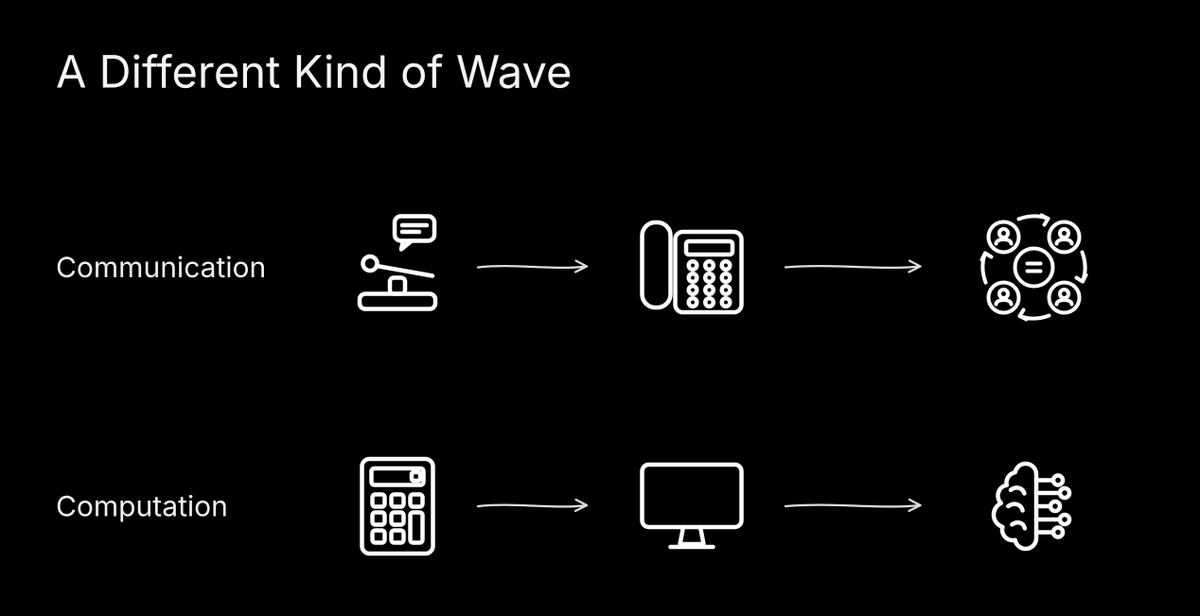
A different kind of wave.
Everything we built until now, over the last decades, was built upon a communication revolution.
The internet, mobile, even blockchains. All of it.
And if you look at the early days of the technologies invented on top of that communication revolution, it's insanely hard to measure the scale of where they went, and how far they got.
Until now.
If we look at what we're witnessing in the AI field over the last months, we can surely say this is a new kind of revolution.
A computational revolution.
So if the first revolution took us this far...
where does the second one take us?
what you do in the age of development?
while it is bear market, or crypto winter, it does not matter, you just punch above and continue building.
through @xPortalApp people can access more and more. safely, intuitively, easily. that is needed for crypto and bigger finance as well.
just an app for everything finance.
easy to understand, easy to use and with funds which are yours, if you keep it on blockchain.
Let's code more!
xPortal has been punching above its weight.
Over the past 3–6 months, we've taken substantial steps to quietly rebuild the foundations of xPortal. Placing it firmly at the frontier of finance, better equipped to serve its users.
The shipping velocity has increased, and some of the most demanded and awaited features have come live, being tested by users all around the world.
From pre-IPO equities and perpetuals, to outcome markets, and the newest onchain ecosystems where new liquidity is forming. With step after step, xPortal has transformed from a much loved crypto superapp, to a secure and fun window into the larger world of global finance.
In some sense, this has been the direction of xPortal from day 1. The destination didn't change much. It just took years to get here. Now, over the next few months, that initial vision is ready to reach its natural conclusion.
Becoming the default home screen for your money.
IBANs. Gold Cards. Premium subscriptions. A complete money experience, designed with the simplicity, love and craftsmanship you've come to experience.
The world has changed. In many ways. And our focus has sharpened with it.
Engines are warming up. A phased activation competition is ready to begin.
A new xPortal experience is around the corner.