Gioggia Meloni visita un poverissimo paese della Basilicata e chiede al sindaco quali siano le tre priorità per rilanciare la zona.
«La prima è l’ospedale: c’è, ma mancano i medici».
Lei tira fuori il telefonino, parla per un paio di minuti e poi annuncia:
«Fatto. Entro una settimana arrivano i medici».
«La seconda è l’acqua: c’è, ma una miniera a monte ha inquinato le falde».
Lei riprende il telefonino, altre due parole, e dice:
«Fatto. Entro un mese le falde saranno bonificate e la proprietà risarcirà gli abitanti».
«E la terza?» chiede lei.
«La terza sono i telefonini» risponde il sindaco.
«Qui non prende niente».
It took a little longer than expected, but we have created a website for people to view the footage collected from Gaza in one place. You no longer have to download the entire archives to see them.
It includes:
64,537 videos
17,905 photos
Ability to download individual videos
Searchable index
Exhaustive sources list (300+ journalists)
Geolocation data
Livemap with minute to minute updates
Victim list
It can be accessed here: https://t.co/s0Se94PXWF
Please share & quote tweet to help this post break out of the twitter algorithm prison.
We will keep adding the rest of the archives to the site, be patient- it is difficult work. Continue to seed the torrents provided, as that is the best way to ensure the footage remains stored in decentalized way.
God bless all those who sacrificed their lives to get this footage out, and everyone invovled in collecting/archiving it.
Join our telegram:
https://t.co/bvcis3b9GT
Follow our backup accounts:
@ZionismExposedx & @IsraelExposedAr
A first-of-its-kind analysis by The Intercept found that in the Army, women are more likely to be killed by their fellow service members than by enemy combatants, in a reversal of the threat soldiers are trained to face.
Michael Parenti:
“Communism in Eastern Europe, Russia, China, Mongolia, N. Korea, and Cuba brought land reform and human services, a dramatic bettering of the living conditions of hundreds of millions of people on a scale never before or never since witnessed in human history.”
As a Chinese person, I certainly don't want to see Europeans all installing air conditioners. If all 500+ million people across Europe ran AC and lived the way folks do in China, it would spell real trouble for our planet.
Moreover, just as Europeans don't want to see modernization in China's Tibet and Xinjiang, claiming it destroys the culture of local ethnic minorities, we Chinese feel the same way — we don't like seeing modern technologies, such as AC, destroy Europe's primitive way of life. It's an assault on Europe's indigenous culture. We Chinese must speak up for the preservation of European traditions, and never allow modern technology to wipe out Europe's backward but beautiful cultures.
It's remarkable how climate disasters become a global emergency only when they affect the wealthier parts of the world. Across the Global South, people have been living through relentless heat, prolonged droughts, devastating wildfires, and failing harvests for years with little attention, yet a single week of unusually high temperatures in Northern Europe suddenly puts climate change at the center of the conversation. Yes, countries in the Sahel, North Africa, and other hot regions have always been accustomed to warm climates, but there is a huge difference between ordinary summer heat and temperatures above 45°C lasting for weeks or months. That isn't normal. Agricultural workers dying from extreme heat in India isn't normal. The Mediterranean warming at an exceptional pace isn't normal. Record droughts driving wildfires across the Amazon isn't normal. The years-long drought in the Horn of Africa isn't normal. People here may have adapted to living in hotter climates, but no one can adapt indefinitely to heat that keeps becoming more intense and more frequent. Across the Global South, people and animals are dying, crops are failing, ecosystems are deteriorating, and livelihoods are being destroyed. .
Israel Bombs Palestinians in Beach Tents in Gaza
“This area is made up of tents sheltering civilians... And the whole place was bombed.”
By @AbdSabbah91 & Mohamed Ahmed in Gaza
https://t.co/wc4y8Daijp
This report is haunting even for someone who has documented the most horrific aspects of this genocide - which too many world leaders pretend not to see.
I commend the Commission of Inquiry for its effort to bring about accountability and make the truth accessible.
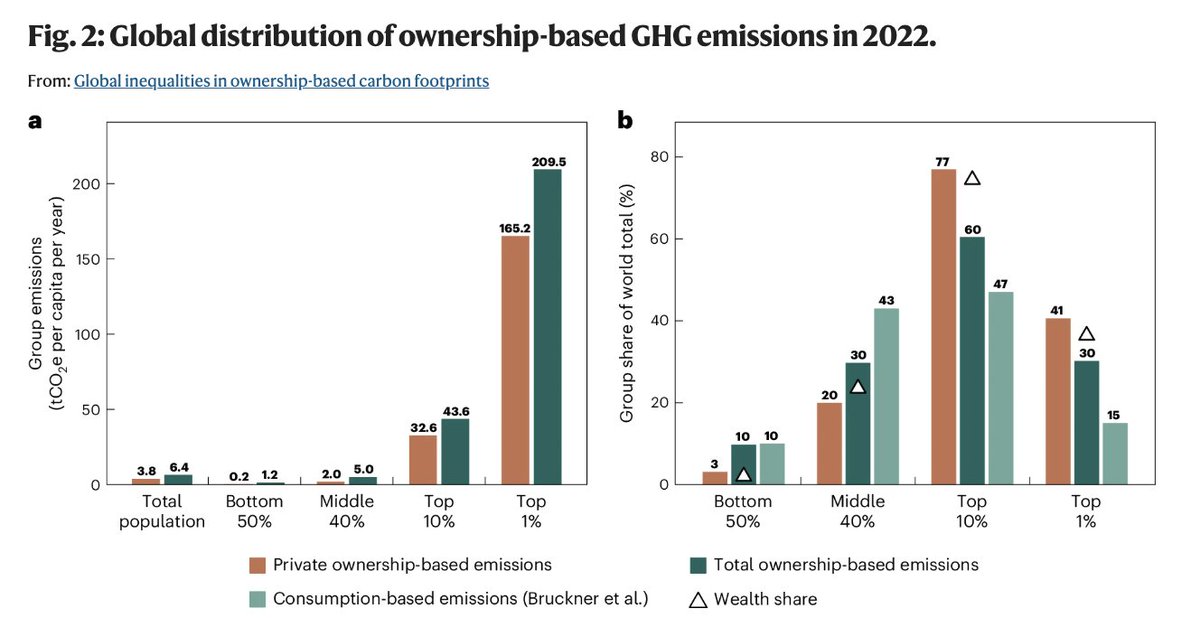
This is an important new paper.
When we allocate responsibility for emissions, it's normally in terms of consumption. We tally up direct household emissions (eg, from household energy use) plus the emissions embodied in all the stuff that a household consumes.
But this creates a problem, because households do not control the conditions under which that stuff is produced. The energy and production techniques, which determine the emissions content of goods and services, is decided by those who own the means of production - mostly the capitalist class, and to some extent governments.
Scholars have argued that owners should therefore be held responsible for emissions from production they control, given they have the power to produce differently, such as by using renewable energy, or by investing in less damaging forms of production.
When we account for private ownership-based emissions, together with government ownership-based emissions and direct household emissions, the richest 1% are responsible for 30% of global emissions, and the richest 10% are together responsible for a staggering 60%.
These are the people who are driving climate breakdown. Climate change is class war.
But these results should be understood as conservative. I would argue that even direct household emissions should be assessed at least in part in terms of energy-system ownership. When households cook or heat water for showers, they usually have little control over the source of the energy, i.e., whether it is fossil fuels or renewables. That is decided by the people who own the energy system.
The fact that so much of our energy system is still provided by fossil fuels is not the fault of the working classes, it is the fault of those who own and control the energy system - which is mostly capitalists, and to some extent governments (which are in turn often captured by the capitalist class).
So households may be responsible for the quantity of energy they use, but they cannot reasonably be held responsible for the additional emissions produced by fossil-fuel sources if renewable sources could be provided instead. Perhaps one methodological solution here would be to allocate emissions to households *as if* their energy use was provided by currently available renewables, and allocate the rest to the owners of the energy system.
The paper is by @lucas_chancel and Yannic Rehm in Nature Climate Change: https://t.co/iLIO9vnBvR
NEW: The DEA permitted hundreds of thousands of fentanyl pills to hit the streets of New Mexico in bid to build prosecutions
“We poisoned our community to make cases,” DEA Agent David Howell tells @AP
“We 100% got people killed”
w/ @APjoshgoodman
https://t.co/1tRshl8Xoa
🚨 BOMBSHELL! Former US Ambassador Chas Freeman exposes a terrifying coverup.
He confirms the actual death toll in Gaza is a staggering 680,000 people.
He reveals the Zionist regime intentionally hides these massive casualties to avoid genocide charges.
Fascinating argument by Bloomberg's top energy analyst Javier Blas 👇: he argues that China effectively saved the world economy during the Iran war by absorbing the brunt of the global oil supply shock on its own, without visible economic damage.
According to his calculations, China "cut its average daily waterborne oil imports by the same amount as the combined oil consumption of Germany, France and the UK."
And, still according to Blas, they "did so without suffering economic harm" because they could rely on many levers: their huge strategic petroleum reserve, a massive surge in EV usage, their remaining coal-fired electricity capacity, and coal-to-chemicals replacing lost feedstocks.
Had China not been ready to absorb that blow, a good argument can be made that the economic damage to the West, and the world at large, would have spiraled far beyond what we saw.
Effectively, China's energy strategy at all levels (petroleum reserves, EVs, etc.) and its ability to withstand huge supply shocks paid off for everyone, not just for them.
It sounds awfully familiar: in 2008 too it was China's stimulus package and continuous buying of US Treasuries that averted a complete breakdown of the global financial system.
So twice in 20 years the country the West loves to present as a "threat" to the global economy effectively saved it from a US-made global economic disaster 🤷
This is a very good example of how democracy works at a local level in China 👇
To explain succinctly, at every administrative level in China, they have a "people's congress" (人民代表大会 - rénmín dàibiǎo dàhuì).
At the county, district and township level, representatives are directly elected by voters in their constituencies. Above that (prefectural cities, provinces, and the National People's Congress) - representatives are elected by the congress one level below.
Depending on the location, local people's congresses have more or less oversight power on local spending, appointments, and policy.
Zhejiang province is one of the places in China where people's congresses have the most power after an official named Xi Jinping - you may have heard of the guy - established a framework called "do practical things for the people" (为民办实事 - wèi mín bàn shí shì) when he was provincial party secretary in the early 2000s.
What "do practical things for the people" established was a principle that local people's congress representatives should have a direct say in how local public money got spent. Over time, this evolved into a formal voting system where representatives vote on proposed government projects.
They just exercised this power in a major way: the Huangyan District People's Congress (黄岩区人大) in Taizhou, Zhejiang voted on 16 major government investment projects for 2026 but killed two of them on the spot - a sports center and an irrigation megaproject, totaling over a billion yuan - with roughly 80% voting against.
This doesn't mean these 2 projects are dead forever but they're sent back to the drawing board. The responsible departments have to address whatever concerns representatives raised, bring in experts for further review, and resubmit when they're ready.
This is a level of local democracy that many people will probably be surprised exists in China: it's genuine democratic oversight, they can actually block government spending, and the executive has to go back and try again.
It's also - and this is where China is complex - something that surprised many people in China.
As I mentioned above, not all people's congresses have this sort of power and the story generated a lot of national interest - with many national outlets writing about it, such as Guancha (https://t.co/Ad94EJH3vt) or The Paper (https://t.co/EPPcXQxXRV).
So much so that the Zhejiang People's Congress deleted their original WeChat post about it. We don't know why - the story wasn't suppressed since so many state media outlets carried it - but the Zhejiang People's Congress probably didn't love being the face of a national debate about why other provinces aren't doing this too, as it amounts to throwing shade on their peers. I genuinely don't know, just a hypothesis.
Anyhow, that's China in all its complexity and why sweeping narratives about it are always wrong: a country where elected local representatives can genuinely exercise oversight power over the government thanks to reforms initiated by Xi Jinping himself, and where mainstream media boast about it, but where the provincial organ that broke the story would rather avoid the publicity.
🇺🇸/IRAN - There is no US-Iran "Deal"
▪️The US signed multiple arms control treaties with the Soviet Union, then the Russian Federation, agreed to "One China" with Beijing, and singed a "Nuclear Deal" specifically with Iran...
All of these treaties, agreements, and deals have one thing in common, they all extracted obedience from targets of US primacy, AND they've all been categorically violated and in most cases unilaterally withdrawn from at the moment it was beneficial for the US to do so.
The only exception is "One China" which the US still pretends to uphold, but only because when it says "One China," it actually means all of China is under the fake admin in Taiwan the US created and controls, not Beijing.
Do you understand the point here?
There are no agreements possible with the US.
Only illusions of agreements the US makes to buy time for itself and to position targeted nations ahead of betrayal planned before any of these agreements were even proposed let alone signed.
The toppling of Iran using the "Nuclear Deal" was proposed in 2009 by the Brookings Institution then verbatim carried out over the course of the Obama, Trump, Biden, and Trump administrations.
Recall the tale of the scorpion and the frog which teaches children actions speak louder than words, to be cautious of false charms and dishonest rationalizations, and most importantly, that nothing can change the inherent nature of some people or in this case an entire system.
This will not be the first time in US history Washington honors its word, if an actual deal is even arrived at.