Clearly ppl is the main metric to hillclimb in the rsi loop for pretraining but are we spending enough efforts to design the dataset to be evaluated on? Can we have a well-designed held-out eval set, which can track the things we care about and be shared aceoss all models?🧐
We decided to provide more transparency into pretraining progress at OpenAI for the sake of moving toward shared safety bars. In “Perplexity and Intelligence” I argue for common limits based on perplexity and other measurements, with progress beyond them gated on our ability to understand AI behavior.
https://t.co/XX35m5vq89
@jon_barron This successive S-curves is so beautiful. I wonder if it is fair to say that we’re too optimistic about how soon the next S-curve will arrive—or whether it will arrive at all. Seems cannot be directly used in ai?
To see how its 3D spatial understanding, multimodal reasoning, and coding come together, the team gave Neon a raw Smithsonian 3D scan of a woolly mammoth. Neon segmented the scan into individual bones, arranged and rigged them anatomically into a full 3D skeleton, and generated this museum walkthrough of the build.
World models promise to predict the future. But can they predict the RIGHT future given the CURRENT state?
Excited to share FlipTest, my work from Google DeepMind internship during the summer.
In the physical world, 1 mm decides whether an object stays or falls. When a tiny change crosses a tipping point, a true world model must flip its prediction.
Blog: https://t.co/QiNCQuJ02g
Do today’s video world models pass the test? 🧵[0/8]
We've released a demo of real-time world generation powered by our new Atlas model!
This is a spiritual successor to our RTFM demo from last year. It's a vision for the future of interactive media might look like, with frames streamed directly from a powerful generative model
I did say we'd be releasing our models periodically...introducing Gemini 4 Carbon, our next frontier model.
Following Argon's release just two weeks ago, Carbon shows the pace at which we’re pushing the frontier, it ranks #1 on the recently updated v5.0 of @ArtificialAnlys Intelligence Index at 59. It also leads across key cybersecurity evaluations scoring 88.2% on SEC-bench Pro for finding vulnerabilities, 54.8% on ExploitGym for exploitation, and 71.0% on CWE-bench for patching.
We’re seeing significant improvements in long-horizon tasks even compared to Argon, and we’ve strengthened frontier safeguards.
As we did with Argon, we’re going to roll it out gradually + responsibly. Some trusted cyber defenders will get access starting this week. We'll be expanding it to more partners through our Fairwind Program, ahead of wider availability soon, so hang tight!
Gemini 4 Argon is underrated 😱.
When auditing the traces, we found that Pi Harness just ends the run whenever it hits a fallback (e.g. for security task) in 20% of the runs. We rerun Argon with Antigravity Harness, and now it beats Astra and sits right behind Opus 5.5. Congrats to the team @GoogleDeepMind and looking forward to the new ckpt.
Today we are launching FrontierCS 2, the most frontier benchmark for AI agents in computer science R&D. We built 48 tasks from published papers across 13 areas of CS, refining each one with experts in its field. Excited to co-launch FrontierCS 2 with @kaggle@GoogleDeepMind
Always thought GRPO-style RL can't be optimal. With billions going into self-play & RSI, the underlying RL methods need to be efficient.
Very exciting project 🔥:
1. Using critics to supervise policy
2. Exploiting easy resets for LLMs
3. Sharing params between Q & policy
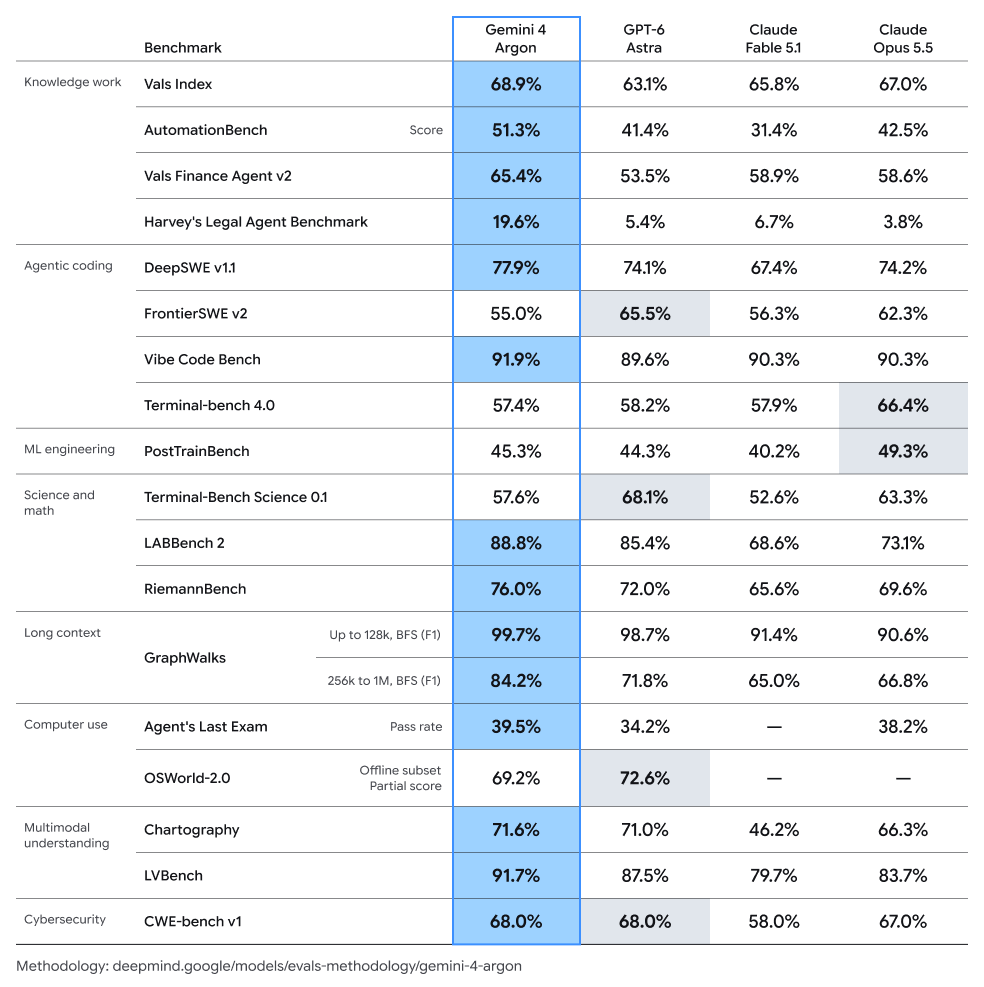
Lots of discussion out there about our next model(!), so I wanted to give an early look as soon as possible. Introducing Gemini 4 Argon!
It shows frontier performance in complex workflows, cyber defense and software engineering. Teams are using it extensively at Google, from coding to quantum computing, great feedback.
Here’s a look at the benchmarks: