A few months ago, a high profile paper in Science claimed to find that researchers' ideology produced biased results in favour of immigration.
A reanalysis of the data finds that result came from a coding error, which once corrected, shows no effect.
Will people who shared that original finding update their views?
https://t.co/pSuAZ26pqe
@analisereal My current framing focuses on finding the most sensible descriptive decomposition. But yes, under the right assumptions, it becomes the odds ratio analogue of a causal disparity decomposition
Later this week, I'm presenting "Explaining with Odds Ratios: Nonparametric Estimands and Estimators" at the Sociological Science Conference at Stanford University. Very excited to share this research for the first time!
I just found out that my paper with Felix Elwert, “Nonparametric Causal Decomposition of Group Disparities,” has received the Outstanding Publication Award from @AsaMethodology! It means so much to receive recognition from a community I identify with so strongly.
People often say that the linear probability model is bad, because it produces impossible fitted values, and logit is good because it doesn't. In this blog post, I explain why I think otherwise: https://t.co/z0Qz8JOGPX
I think the real bottleneck has always been dissemination rather than creation, and AI does not change that. Many people literally and figuratively consume snake oils, despite clear scientific consensus against them. Within the scientific community, applied researchers continue to make basic mistakes that statistical experts identified decades ago. Yes, AI is going to create new techniques at a speed that had been unimaginable, but without broad dissemination and adoption, the returns won't be very high. I think human methodologists will still be needed for relentlessly evangelizing good practices!
The Cologne Journal of Sociology and Social Psychology has an interesting new special issue on explanation and causality in sociology
https://t.co/9hlEKhiWOb
I happen to know that one of the authors did run Refine on this paper and in fact used the helpful comments they got from Refine to advertise it to me. I have little knowledge of the Mendelian randomization literature, but doesn’t this paper try to address the alleged violation of exclusion in multiple ways?
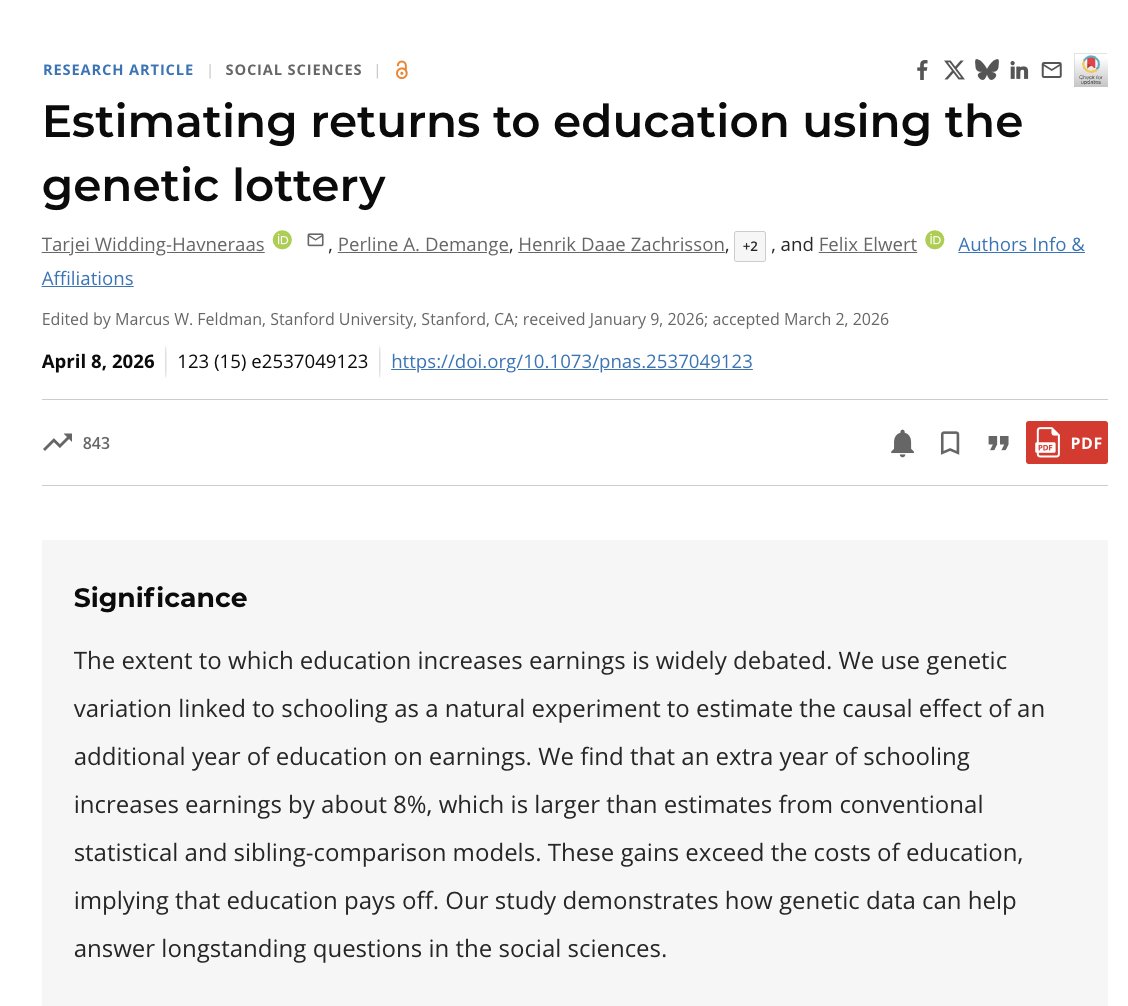
Each extra year of schooling increases earnings by ~8%
This is more than the cost of education, which implies that additional educatioin pays off financially: https://t.co/K83gmoP1Bn