Uma das maiores covardias que eu já vi um jogador fazer numa Copa do Mundo. Ainda mais sendo uma final...
Messi tentando cavar uma expulsão do Cucurella do nada.
Que coisa de mau caráter. https://t.co/PnJSuOEaL0
Harvard's first chairman of sociology, Pitirim Sorokin, spent decades analyzing every major civilization in recorded history to answer one question:
Why do great cultures die?
His answer, published in 1941, predicted almost everything happening today.
Down to the collapse of the family, the death of art, and the rise of tyrants. Maybe even the popularity of TikTok.
(thread) 🧵
When I was Muslim, I never noticed what the Quran doesn’t have.
Dates. Places. Names you can check.
Read the Quran’s stories: no chronology, almost no geography, kings called only “Pharaoh,” events floating in no particular year.
Where did the story happen? When? Under whom? The text doesn’t say. You can’t check it… which conveniently means you can’t crosscheck it.
Now read the opening of Luke 3:
“In the FIFTEENTH YEAR of the reign of TIBERIUS CAESAR — PONTIUS PILATE being governor of JUDEA, HEROD being tetrarch of GALILEE, his brother PHILIP tetrarch of ITUREA and TRACHONITIS, and LYSANIAS tetrarch of ABILENE, during the high priesthood of ANNAS and CAIAPHAS…”
SEVEN historical anchors in one sentence.
An emperor, a governor, three rulers with their exact territories, two high priests.
And people HAVE checked — for centuries, often trying to break it. Skeptics mocked Luke’s “Lysanias of Abilene” as an error…
UNTIL an inscription naming Lysanias the tetrarch of Abilene turned up.
Pilate was called legend by some… until the Pilate Stone was dug up at Caesarea in 1961 with his name and title carved in it.
Luke 1:3-4 tells you why: “Having followed all things closely… that you may have CERTAINTY.”
Certainty. That’s the offer.
One book floats above history where nothing can touch it.
The other planted its flag in checkable ground and said: dig.
They dug. It’s still standing.
Praise the Lord and His mighty God-Breathed scripture.
In 1947, a young shepherd threw a stone into a cave near the Dead Sea and heard pottery shatter. Inside those clay jars, sealed for nearly two thousand years, were the oldest copies of the Hebrew Scriptures ever found.
Before this discovery, the earliest complete Hebrew text of the Old Testament dated to around 1,000 years after Christ. Skeptics argued that over so many centuries, scribes copying by hand must have changed, corrupted, and rewritten the text beyond recognition. Then the scrolls were dated. Some went back to the second and third centuries before Christ. Among them was a complete scroll of Isaiah, more than a thousand years older than any copy previously known.
So scholars laid them side by side. The ancient Isaiah scroll against the medieval text, a millennium younger. And what they found astonished them. The two were virtually identical. Word for word, line for line, across a thousand years of copying, the message had not changed. The few differences were spelling variations and slips of the pen that altered nothing of meaning.
Think about what that means. The prophecies of Isaiah, written centuries before Jesus was born, describing a suffering servant pierced for our transgressions and crushed for our iniquities, were preserved exactly as they are read today. No one tampered with them after the fact. No one inserted the predictions later. They were already ancient, already settled, already waiting, when Jesus walked to the cross and fulfilled them.
To the world, the Bible is just a book passed through too many hands to trust. They assume it must have drifted from its source. But God said His Word would stand forever, and He preserved it in a sealed jar in a desert cave for two thousand years to prove it.
The same Word that has not failed across millennia will not fail in your life either. It is living. It is true. It endures. Hold fast to it. Build your life on it. Heaven and earth will pass away, but His words never will.
Jesus is the Word made flesh.
Egypt forgot how to build the pyramids.
Rome forgot how to build the aqueducts. Some still carry water today. What they built still stands. Neither civilization remembers how they did it.
Musk: “You look at great civilizations like ancient Egypt, and they were able to make the pyramids, and they forgot how to do that.”
Musk: “And the Romans, they built these incredible aqueducts. They forgot how to do it.”
No army invaded them. The knowledge just stopped getting used, and the moment it did, it was gone.
Same collapse. Compressed into fifty years instead of a thousand.
Musk: “In 1969, we were able to send somebody to the moon… Then the space shuttle retired, and the United States could take no one to orbit.”
Musk: “People are mistaken when they think that technology just automatically improves… it will, by itself, degrade.”
Capability doesn’t sit in a vault. It only exists inside the people doing the work right now.
The second they stop, it doesn’t pause.
It disappears.
That should not scare you. It should focus you.
Nobody loses a civilization to war. They lose it the moment they stop building.
Nobody is owed the future. It belongs to whoever keeps building it.
« Dans le passé,
le monde était dur,
parce qu’il était gouverné par les intelligents.
Les intelligents forçaient les stupides à apprendre,
et cela était difficile pour les stupides.
Mais aujourd’hui, ce sont les stupides qui gouvernent le monde.
Et c’est quelque chose de juste,
car les stupides sont bien plus nombreux.
Maintenant, les intelligents apprennent à parler de façon à être compris par les stupides.
Si le stupide ne comprend rien, c’est le problème de l’intelligent !
Autrefois, les stupides souffraient.
Aujourd’hui, ce sont les intelligents qui souffrent.
Mais le nombre de ceux qui souffrent diminue chaque jour,
car le nombre d’intelligents diminue jour après jour. »Mikhaïl Jvanetski
@newstart_2024 Con estas manos trabajamos duro. Si nos maldicen, bendecimos; si nos persiguen, lo soportamos; si nos calumnian, los tratamos con gentileza. Se nos considera la escoria de la tierra, la basura del mundo, y así hasta el día de hoy.
1 Corintios 4:12-14
@Bastos_Quotes Ser Cristiano es seguir a Cristo (yo soy el camino, la verdad y la vida). Si siguiéramos las modas, los razonamientos sin conocimiento y demás, seguiríamos al mundo y se nos conocería en vez de cristianos como “mundanos”.
@Bastos_Quotes “Mantiene los mismos principios”, claro, porque son la ley De Dios. Son principios porque emanan de lo que es primero. Y la iglesia actual, tan solo ha heredado esa fe. No puede cambiar la verdad. Otra cosa es que el mundo “caído” sea capaz de aceptarla.
@eris_28@BlueRapsberry_ El Cristiano no tiene miedo a morir. Ahí te equivocas. El cristiano descubre su vocación a la vida eterna. Descubre cómo y para qué está hecho.
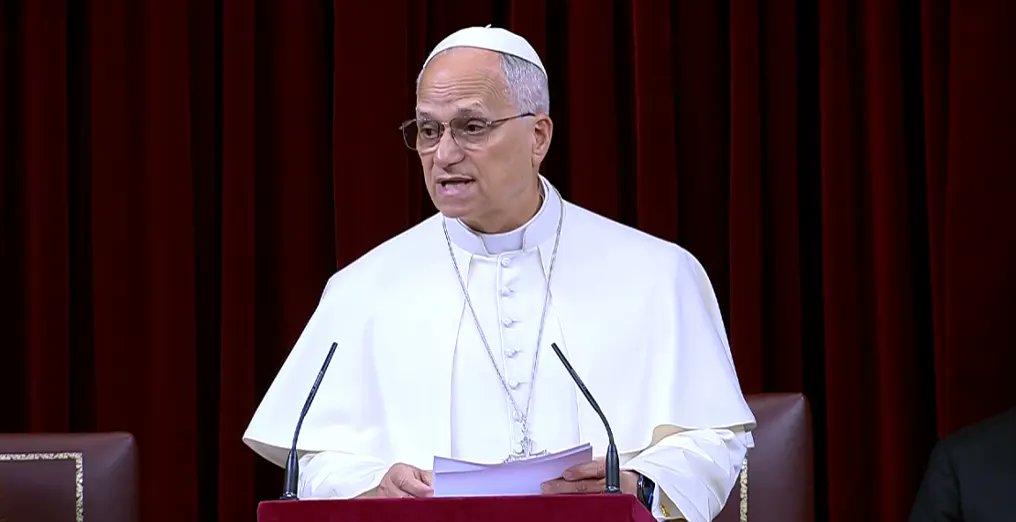
Como jurista, me quedo con una frase del discurso del @Pontifex_es en el @Congreso_Es que debería enmarcarse en cada parlamento: "Una ley no alcanza su verdadera grandeza por el mero hecho de haber sido formalmente aprobada; la alcanza cuando puede comparecer ante la dignidad de la persona y salir de ese examen sin avergonzarse".