Mestra&Pedagoga Ed.Especial i Orientació familiar-escolar.
Especialista en Pertorbacions del Llenguatge i l'Audició. Assessora en Programes d'Estimulació.MDA.
Tot just fa una setmana de l'efemèride que marcarà per sempre l'inici del nostre segon mil·lenni ⛪.
👐🏼 Encara agraïts per la visita del @Pontifex Lleó XIV, que va voler encomanar a la #MaredeDéu de #Montserrat el seu «servei petrí i la missió de l’Església en el món que clama demanant justícia i pau» ✝️.
Avui, els infants de 1r de Primària han obert les portes del seu aprenentatge compartint el seu portfoli amb les famílies. Quina il·lusió veure tot el camí recorregut!
Gaudí ADORAVA la pirotècnia i el foc 🔥, ja feia servir bengales de colors el 1882, abans fins i tot de quedar-se el projecte de la SF. Cada 19 de març, per Sant Josep, muntava una festa de focs artificials al temple. El millor del dia! Gran final! 👌
📹 Sagrada Família
Para reconocer la voz de Dios, puede ayudarnos ante todo el silencio, que favorece la atención y el recogimiento. Al liberarnos del estruendo de mil voces, reconocemos que algunas engañan nuestros deseos, otras nos compran sin alimentarnos, otras hablan por interés. En el silencio comprendemos que las ideologías pasan, mientras la verdad permanece. https://t.co/Y7qEwjKQUf
Os invito a ser hilos nuevos para tejer redes nuevas que armonicen todos los ámbitos de la vida, para entramar una sociedad renovada en donde el tiempo se impregne de eternidad, la cultura custodie la memoria y favorezca el diálogo, la educación promueva la búsqueda de la verdad con espíritu crítico, el arte despierte asombro y genere emociones nobles, la empresa reconozca la dignidad de la persona y el trabajo siga siendo motor de esperanza. #ViajeApostólico https://t.co/3ezTgOylCO
Viatge a Madrid 6è Primària. Hem visitat Puy Du Fou un parc temàtic on la Història, els espectacles, l’emoció i la natura s’uneixen. Aquest viatge ens ha regalat grans records!
🕊️⛪ Volem compartir-vos imatges dels preparatius perquè la Visita del Sant Pare esdevingui un moment de renovació espiritual i de joia compartida en la fe.
🙏✨Ens veiem el pròxim dimecres 10 de juny per acollir el successor de Pere a la casa de la #MareDéuMontserrat.
#AbadiaMontserrat #Alçalamirada
📣 Nou concert del Festival de Música de Montserrat 🎼!
📅 Dissabte 6 de juny a les 21 h
📍Basílica de Santa Maria #AbadiaMontserrat
🎟️ Entrada lliure
👐🏼 Us convidem a acompanyar-nos en aquest concert que s'emmarca en la celebració dels 150 anys del naixement de Pau Casals.
📰 Més informació a
https://t.co/nXGA3kfOpd
💬 L'abat de Montserrat, el P. Manel Gasch i Hurios, reflexiona sobre les nostres febleses com a humans.
🎥 Ho fa en un vídeo que podeu veure sencer a
https://t.co/MBgeyBa7wl
👉🏼També el trobareu al Canal de Youtube @abadiamontserrat 🔴
#AbadiaMontserrat
Maig floreix amb la tendresa dels infants 🌸 Cada flor portada a Maria és un petit gest d’amor, esperança i llum que omple l’escola de primavera i de cor. 💙 Moltes gràcies, famílies!
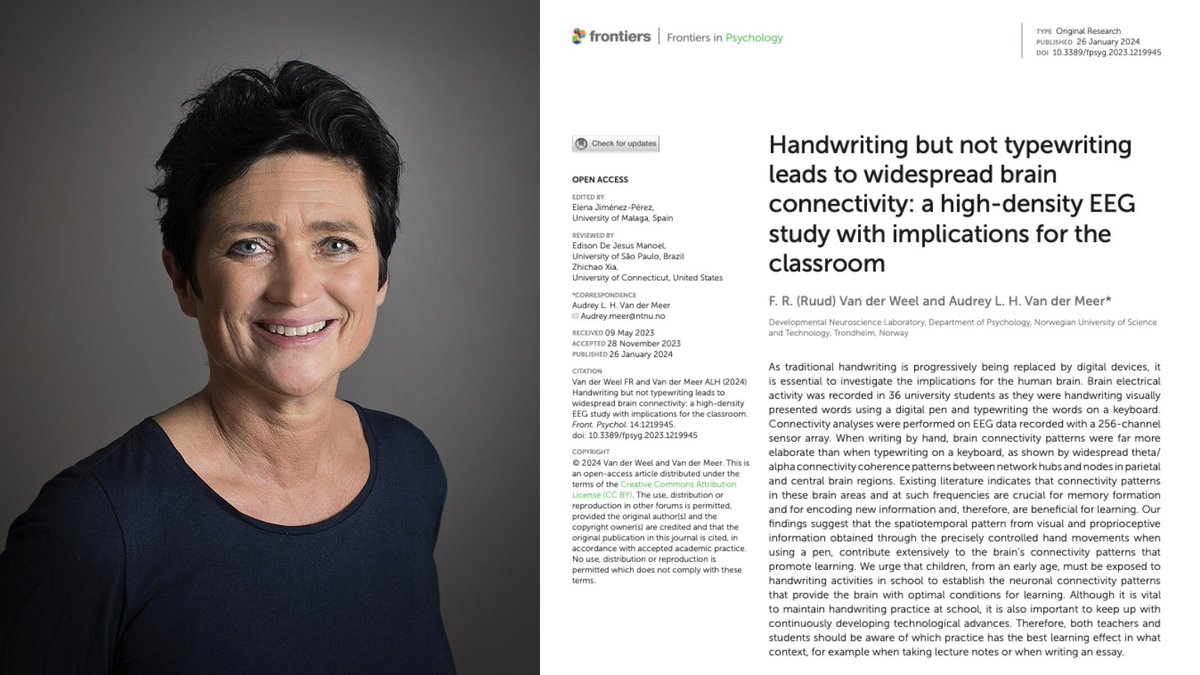
A Norwegian neuroscientist spent 20 years proving that the act of writing by hand changes the human brain in ways typing physically cannot, and almost nobody outside her field has read the paper.
Her name is Audrey van der Meer.
She runs a brain research lab in Trondheim, and the paper that closed the argument was published in 2024 in a journal called Frontiers in Psychology. The finding is brutal enough that it should have changed every classroom on Earth.
The experiment was simple. She recruited 36 university students and put each one in a cap with 256 sensors pressed against their scalp to record brain activity. Words flashed on a screen one at a time.
Sometimes the students wrote the word by hand on a touchscreen using a digital pen, and sometimes they typed the same word on a keyboard. Every neural response was recorded for the full five seconds the word stayed on screen.
Then her team looked at the part of the data most researchers had ignored for years, which is how different parts of the brain were communicating with each other during the task.
When the students wrote by hand, the brain lit up everywhere at once.
The regions responsible for memory, sensory integration, and the encoding of new information were all firing together in a coordinated pattern that spread across the entire cortex. The whole network was awake and connected.
When the same students typed the same word, that pattern collapsed almost completely.
Most of the brain went quiet, and the connections between regions that had been alive seconds earlier were nowhere to be found on the EEG.
Same word, same brain, same person, and two completely different neurological events.
The reason turned out to be something nobody had really paid attention to before her work. Writing by hand is not one motion but a sequence of thousands of tiny micro-movements coordinated with your eyes in real time, where each letter is a different shape that requires the brain to solve a slightly different spatial problem.
Your fingers, wrist, vision, and the parts of your brain that track position in space are all working together to produce one letter, then the next, then the next.
Typing throws all of that away. Every key on a keyboard requires the exact same finger motion regardless of which letter you are pressing, which means the brain has almost nothing to integrate and almost no problem to solve.
Van der Meer said it plainly in her interviews.
Pressing the same key with the same finger over and over does not stimulate the brain in any meaningful way, and she pointed out something that should scare every parent who handed their kid an iPad.
Children who learn to read and write on tablets often cannot tell letters like b and d apart, because they have never physically felt with their bodies what it takes to actually produce those letters on a page.
A decade before her, two researchers at Princeton ran the same fight using a completely different method and ended up at the same answer. Pam Mueller and Daniel Oppenheimer tested 327 students across three experiments, where half took notes on laptops with the internet disabled and half took notes by hand, before testing everyone on what they actually understood from the lectures they had watched.
The handwriting group won by a wide margin on every question that required real understanding rather than surface recall.
The reason was hiding in the transcripts of what the two groups had actually written down.
The laptop students typed almost word for word, capturing more total content but processing almost none of it as they went, while the handwriting students physically could not write fast enough to transcribe a lecture in real time, which forced them to listen carefully, decide what actually mattered, and put it in their own words on the page.
That single act of choosing what to keep was the learning itself, and the keyboard had quietly skipped the choosing and skipped the learning along with it.
Two studies. Two countries. Same answer.
Handwriting makes the brain work. Typing lets it coast.
Every note you have ever typed instead of written went into your brain through a thinner pipe. Every meeting, every book highlight, every idea you captured on your phone instead of on paper was processed at half depth.
You did not forget those things because your memory is bad. You forgot them because typing never woke the part of the brain that would have made them stick.
The fix is the thing your grandmother already knew.
Pick up a pen. Write the thing down. The slower road is the faster one.
Felicitats per la vostra Primera Comunió! Que Jesús us acompanyi cada dia del vostre camí i us ajudi a créixer amb bondat i il·lusió. Gràcies @crist_rei
Avui Jesús entra d’una manera molt especial als vostres cors. Que aquesta Primera Comunió us ompli sempre d’amor, alegria i esperança. Gracies @crist_rei
No hay que confundir cuidado con comodidad. En la escuela, cuidar es crear condiciones para que el esfuerzo tenga sentido. Un docente que no exige, no cuida #Educación#Docentes
Una persona nos propone reflexionar sobre el replanteamiento de la vida y su sentido alrededor de los 60 años.
En esta etapa, algo cambia de manera profunda. Ya no se trata de construir, demostrar o alcanzar, como en etapas anteriores. Muchas de esas tareas —trabajo, familia, logros— ya han sido vividas en mayor o menor medida. Y entonces aparece una pregunta distinta:
¿Qué significa todo lo que he vivido?
A esta edad, la psique comienza a moverse hacia una forma más reflexiva. Ya no mira tanto hacia adelante, sino también hacia atrás. No para quedarse en el pasado, sino para integrarlo.
Es un momento donde muchas personas hacen una especie de “revisión interna”: decisiones tomadas, caminos elegidos, errores, aciertos, vínculos, pérdidas. Y en esa revisión puede aparecer tanto satisfacción como arrepentimiento.
Pero lo esencial no es juzgar la vida…
sino darle sentido.
Jung observó que en la segunda mitad de la vida —y especialmente en esta etapa— el ser humano está llamado a un proceso más profundo: no el de acumular experiencias, sino el de comprenderlas.
También aparece con más claridad la conciencia del tiempo. La finitud deja de ser una idea lejana y se vuelve más concreta. Y lejos de ser solo una fuente de angustia, puede convertirse en un elemento que ordena la vida:
lo superfluo pierde importancia,
lo esencial se vuelve más visible.
En muchas personas surge una necesidad de mayor coherencia interna. De vivir con más autenticidad, de soltar roles que ya no representan, de reconciliarse con partes de sí mismas que fueron postergadas.
También puede aparecer la búsqueda de calma. No una calma superficial, sino una más profunda: estar en paz con lo vivido, con lo que fue… y también con lo que no fue.
Esto no significa que todo esté resuelto.
Pero sí que la mirada cambia.
Ya no se trata de ser quien el mundo esperaba,
sino de ser fiel a uno mismo.
Y quizá uno de los movimientos más importantes de esta etapa es este: pasar de preguntarse “¿qué más puedo lograr?” a preguntarse
“¿cómo quiero vivir el tiempo que queda?”
Ahí, la vida deja de ser una carrera…
y comienza a convertirse en una experiencia más consciente, más elegida, más esencial.