November through April represents the strongest six-month period of the year for the S&P 500. When this natural seasonal momentum coincides with the resolution of midterm election uncertainty, the combined effect can trigger powerful multi-month market advances.
Over past century, stock market performance in year following midterm election shows a consistency rarely matched by other macro indicators:
Over 12 months: In roughly 90% of midterm cycles since 1920, U.S. stock market was higher 12 months after election than on election day
Strong average 12-month gain: The average S&P 500 return in the 12 months following a midterm election is approximately 16%, nearly double the average 8.1% annual return of non-midterm years.
The year-3 effect: In the standard four-year presidential cycle, year 3 – the calendar year immediately following the midterm election (2027 in this cycle) – is historically the strongest of all four years, averaging gains above 16%.
The Canary 🦜 in the Coal Mine⚫️
While the cattle focuses on US futures, something ominous is developing on the eastern belt.
The Taiwan index, the heart of the AI boom, is starting to let go. If there was ever a smoke signal of an impending collapse, this is it.
Stay safe, vigilant, disciplined, and remain a little curious.
But most of all, stay informed.
Yours truly.
The Great Martis💫
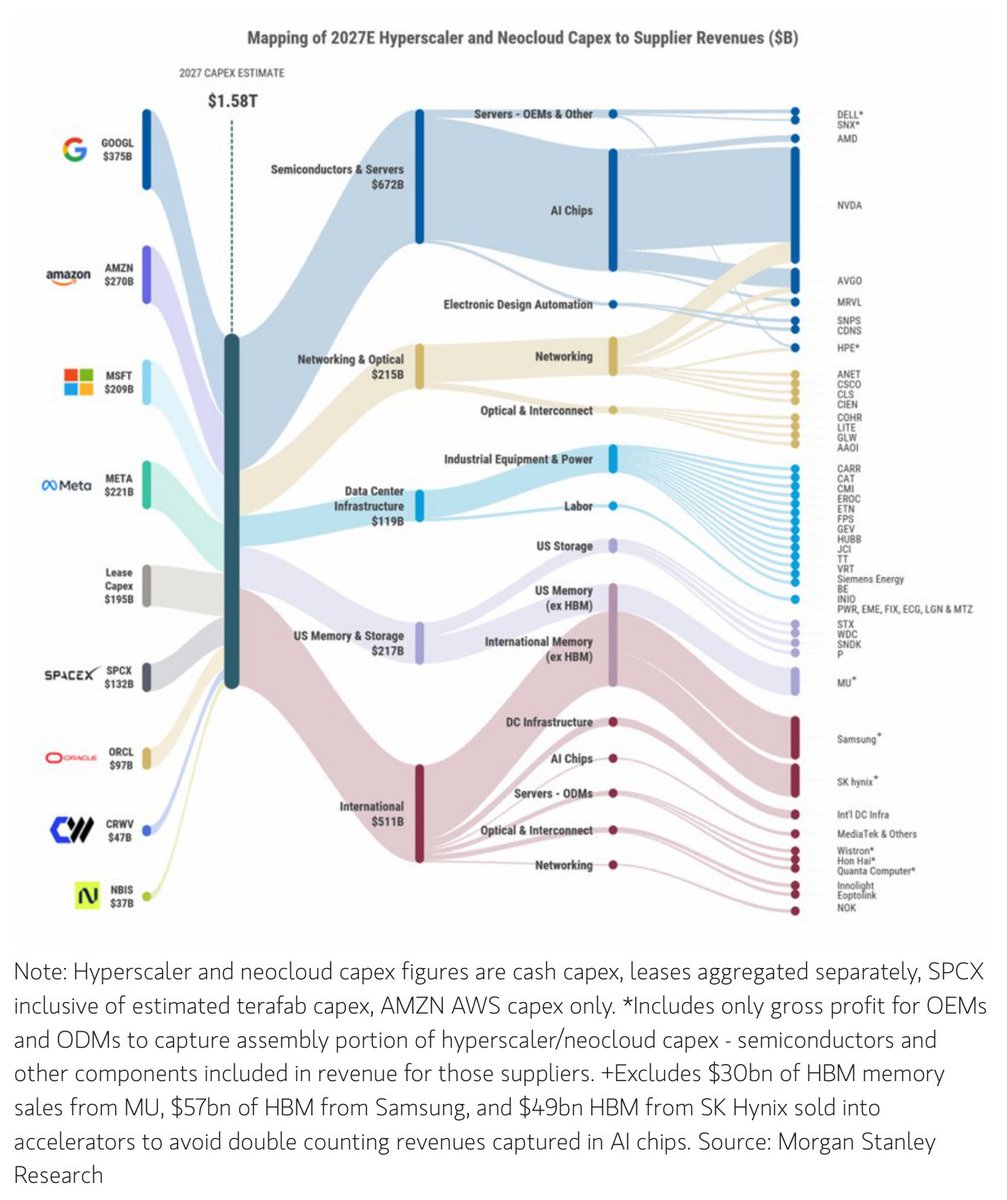
$1.6 trillion in projected AI capex drives 5% of 2027 sales and 25% of sales growth.
Half of that capex is debt-funded.
Would be a pity if something happened to the debt market.
@zerohedge In other words: Warsh is kowtowing to Trump when he should raise at least 25bps this month. And Trump is blaming everyone but himself. Lagging effects of 50%+ diesel have not even fully hit yet. Food and Energy inflation will remain hot in 2027.
Fed will hike 25bps Oct 28. And it will be like a firecracker hitting an asteroid the size of Texas. Everyone is wrong about 2027 'return to normal' CPI and PCE projections. Lagging effects from 50%+ diesel have not even fully hit prices yet.